Barista Interview Questions: What to Expect and How to Prepare
A walk through the format, the questions hiring managers actually ask behind the counter, and the answers that show you can hold a bar during a rush.
Quick answer
- Prepare one story each for an angry customer, a wrong order you fixed, and a rush you got through — these three cover most of what gets asked.
- Visit the café as a customer first and note the milk options, the espresso machine type and how orders are called, then reference what you saw in the interview.
- Expect a trial shift or latte art test; ask in advance whether it is paid and how your availability for early starts and weekends will be scheduled.
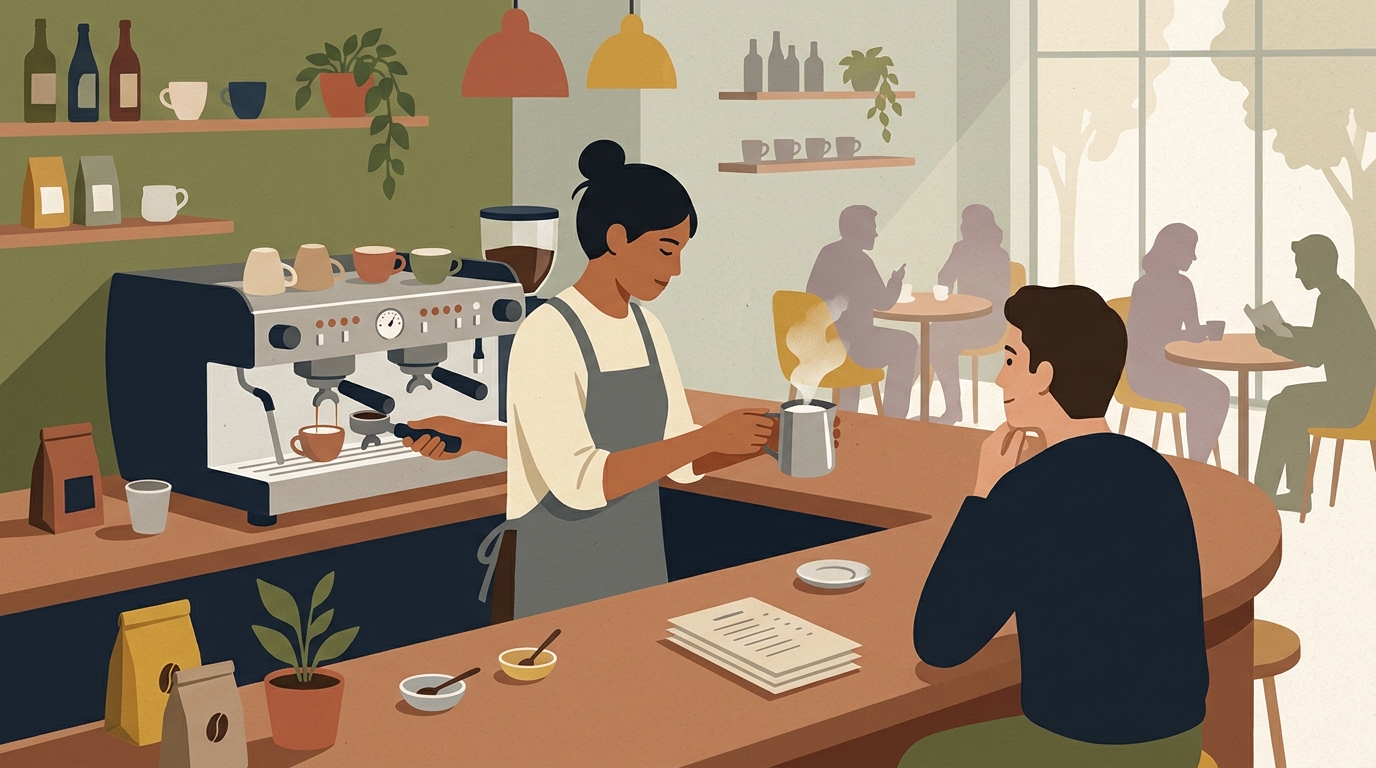
A barista interview is usually short, informal and heavily focused on speed, hygiene and how you behave with customers when things go wrong. Expect a conversation with a store or shift manager, questions about availability and the morning rush, and in many cafés a paid or unpaid trial shift on the bar before any offer.
Preparation is less about coffee trivia than about having two or three real service stories ready, knowing the menu style of the place you applied to, and being able to explain how you keep a bar clean while serving.
What This Interview Usually Covers
Most barista hiring runs in two or three steps. First, a short screening chat — often in the café itself, sometimes by phone — covering your availability, right to work in that country, and why you applied to this site rather than the one down the road. Independent cafés may stop there; chains usually add a structured interview with set behavioural questions scored against a form.
The second step is commonly a trial on the bar, anywhere from thirty minutes to a full shift. You may be asked to pull a shot, steam milk to a given texture, take orders at the till, or simply shadow and clear tables while someone watches how you move. Some employers pay for trial time and some do not; rules differ by country and by state or province, so ask before you agree.
Experienced applicants may also face a tasting or dialling-in question — adjusting a grinder when shots run fast. Entry-level applicants are judged almost entirely on attitude, reliability and cleanliness instead.
Common Questions and Sample Answers
Why do you want to work here rather than another café?
Sample answer
I came in twice last week to see how the bar runs. You were doing filter batch brew alongside espresso, and the staff called every order back to the customer by name, which I liked. I wanted to work somewhere that still weighs doses rather than running on autopilot. I had been serving in a sandwich shop where I learned speed but almost nothing about extraction, so I bought a hand grinder and have been pulling shots at home for about four months. I applied here because I want to get better at the craft side, not just faster at the till.
Tell me about a time you dealt with an angry customer.
Sample answer
A regular at my last café was given an oat flat white when she had asked for soy, and she had already left and come back. She was upset because she had a ten-minute window before a meeting. My job was to fix it without holding up a queue of about twelve people. I apologised without excuses, remade the drink myself straight away ahead of the queue, and explained to the next two customers that I was correcting an error — both were fine about it. She was back the next morning and I made a point of repeating her order back to her.
How do you handle the morning rush?
Sample answer
Our busiest window was 7:45 to 9:00, roughly 130 drinks with two people on bar. We kept falling behind because we were steaming milk one jug at a time. I suggested we split roles instead of both doing everything: I ran espresso and milk, my colleague took orders, called them in a fixed sequence and handed out. We also pre-stocked cups and lids before 7:30. Average wait dropped from about six minutes to under three, and we stopped losing people from the queue. I still use that split whenever two of us are on.
Tell me about a mistake you made on shift.
Sample answer
I once left the group head unpurged after cleaning and sent out three bitter shots before a customer told me. I had to decide whether to say nothing or flag it. I told the shift lead immediately, remade the three drinks, and ran a full backflush before service continued. Then I wrote the purge step onto the opening checklist taped by the machine so it was not just something we remembered. Nobody else made that mistake on the opening shift in the months I was there.
How do you keep the bar clean while serving?
Sample answer
At my last job the health inspection scheduled for a Tuesday found milk residue in a steam wand tip. The manager asked me to redo the cleaning routine for the bar. I built a timed loop: wipe and purge the wand after every jug, rinse the group every drink, swap cloths every two hours into a sanitiser bucket, and a five-minute reset at the top of each hour. I printed it on a card by the sink. The follow-up inspection came back clean and the routine stayed after I left.
How do you handle cash and the till accurately?
Sample answer
I ran close on a till that was coming up short by small amounts most evenings. My task was to find out why before the owner assumed theft. I started counting the float at the start and end of every shift and writing it in the book, and noticed the shortfalls always fell on days we ran a loyalty discount that staff were keying in manually. We added a button on the till for it. The drawer balanced to the cent for the next six weeks.
Tell me about working with someone who wasn't pulling their weight.
Sample answer
A colleague kept leaving the dishwasher and bins for the closer, which was usually me, adding about twenty minutes to my night. Rather than complain to the manager first, I asked him directly at a quiet moment whether he knew the closing list, and it turned out he had never been shown it — he had been trained only on bar. We walked through it together once. He closed properly after that, and I raised with the manager that the training sheet was missing the closing section.
What are your availability and early-start limits?
Sample answer
At my last café I was the opener three days a week, in at 5:45 for a 7:00 open, and I kept that for eleven months without a late arrival because I cycled rather than relying on the first bus. I can do the same here. I'm available weekdays from open until about 2pm and all day Saturday; Sunday mornings I have a fixed commitment, so I'd rather say that now than cancel later. I'm happy to cover extra shifts with a day's notice.
Mistakes That Cost Candidates the Job
- Saying you want the job because you "love coffee" and offering nothing beyond that — no mention of the menu, the brew methods or anything you noticed in the shop.
- Overstating your skill level on the machine, then freezing during the trial shift. Say plainly what you can and cannot do yet; managers train willing beginners and resent being misled.
- Giving vague availability ("I'm pretty flexible") and then declining early starts or weekends when a rota is offered.
- Badmouthing a former manager or a previous café's standards when asked why you left. Describe what you wanted to learn next instead.
- Ignoring the bar during a trial — standing still between drinks rather than wiping down, restocking cups or clearing tables.
- Answering the difficult-customer question with a hypothetical ("I would stay calm") instead of one real incident with an outcome.
- Opening with pay and tips before any discussion of the role. Ask about rates after you've been asked about your own questions.
- Leaving without asking anything, or asking only questions already answered on the job ad.
Frequently asked questions
What should I wear to a barista interview?
Wear clean, plain clothes you could actually work a shift in: closed-toe non-slip shoes, no loose sleeves, hair tied back, minimal jewellery. A plain shirt and dark trousers reads right in almost any café. Avoid strong fragrance — it interferes with tasting and some managers will mention it.
Should I ask about pay in the interview?
Yes, but near the end, after you've asked about the rota and training. Ask for the hourly rate, how tips are pooled and distributed, and whether trial shifts are paid. Check the legal minimum and typical rates first through your country's official statistics or labour department site.
Do I need a barista qualification to get hired?
Usually no. Most employers train on their own equipment and recipes. A short course helps you talk confidently about extraction and milk texture, but food hygiene certification — which some countries or states require of all food handlers — matters more to a manager's paperwork.
How should I follow up after the interview?
Send a short email within 24 hours thanking them and naming one specific thing from the conversation. If you heard nothing after a week, phone during a quiet period — mid-afternoon, not the morning rush — and ask the manager directly where the decision stands.
What if I've never used an espresso machine?
Say so, and show what you have done instead: cash handling, food service speed, cleaning standards, early starts. Then name one concrete step you've taken to learn — a weekend course, a home setup, watching a dialling-in guide — so the gap sounds temporary rather than permanent.

Written by
Wyatt covers work outside the office: construction, logistics, repair, and the people who keep things running. He's skeptical of career advice that assumes everyone sits at a desk.