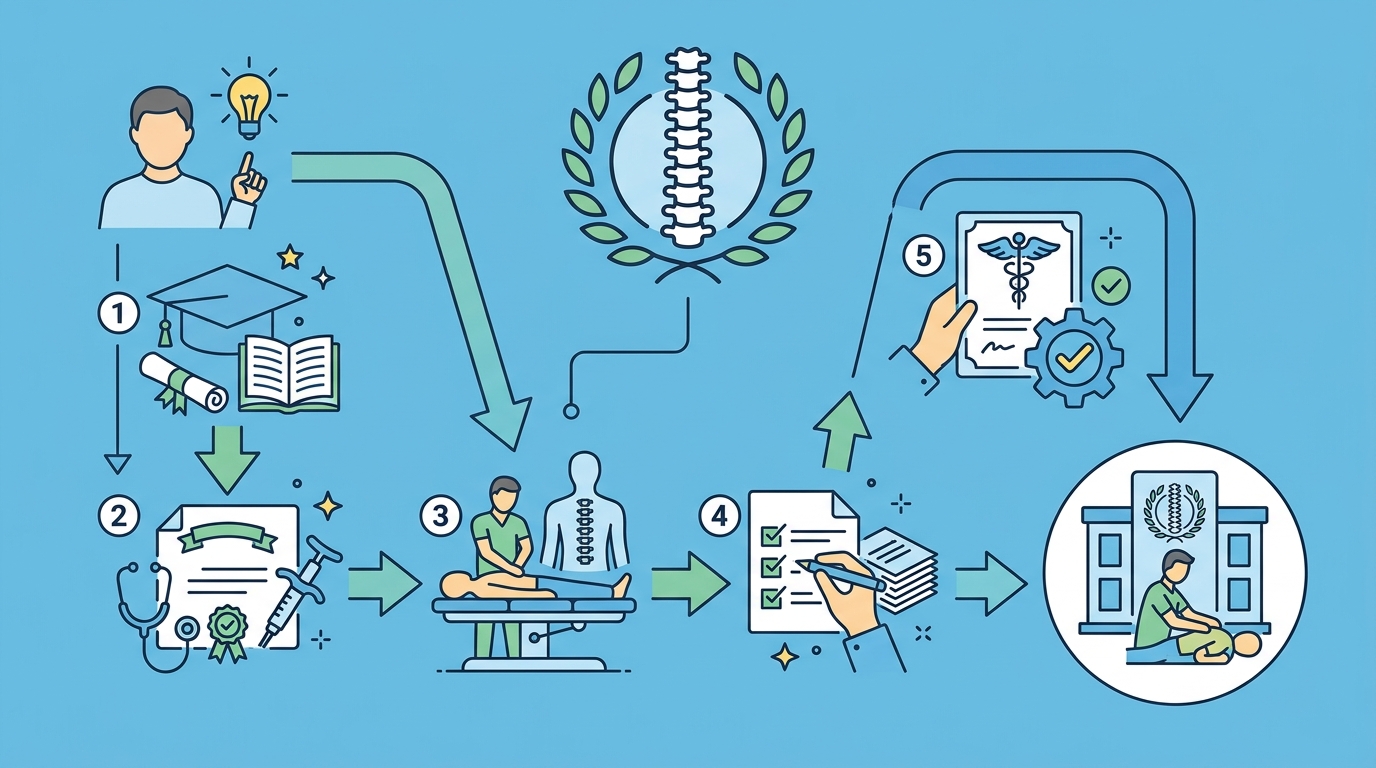
Breaking Into Physical Therapy: A Step-by-Step Guide
What physical therapists actually do across hospitals, outpatient clinics and home visits, plus the degree, licence and standing hours that come with it.
Quick answer
- Fastest common US route: a bachelor's degree with science prerequisites, then an entry-level Doctor of Physical Therapy programme, then a state licence — roughly six to eight years full time.
- Minimum credential is graduate level in most systems: O*NET OnLine (U.S. Department of Labor), 2025 reports 47% of survey respondents said a doctoral degree is required and 38% said a master's degree.
- Earlier entry points exist — O*NET lists Physical Therapist Assistants (SOC 31-2021.00) and Physical Therapist Aides (SOC 31-2022.00) as related occupations.
Becoming a physical therapist means committing to a long academic route: O*NET OnLine (U.S. Department of Labor), 2025 places the occupation in Job Zone Five, Extensive Preparation Needed, where most jobs require graduate study. In the United States that usually means an undergraduate degree, then an entry-level doctoral programme, then a licence from the board in the state where you want to practise.
Entry requirements differ sharply by country — some national systems still register physiotherapists with a bachelor's or master's degree — so check the regulator where you intend to work before you choose a programme.
Is This Career Right for You?
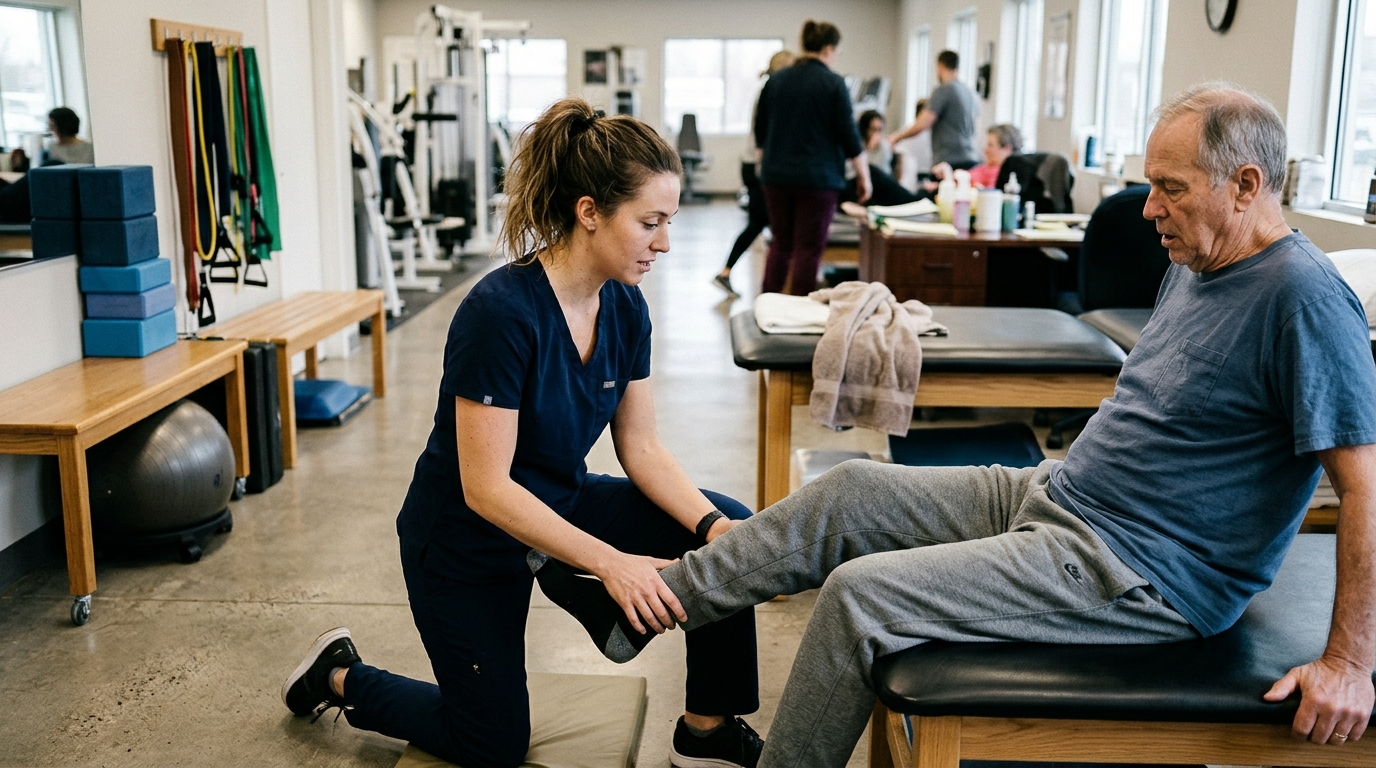
This is hands-on, physically active work. You spend most of a shift on your feet: guiding a patient through gait training on parallel bars, kneeling on a mat to cue a hip exercise, transferring someone from bed to chair with a gait belt or hoist, and applying manual therapy that puts load through your own hands, wrists and back.
Settings vary more than people expect, and they shape the day:
- Outpatient clinics often run early-morning and evening appointment slots so patients can attend around work, with back-to-back bookings.
- Acute hospital wards involve bleeps, ward rounds, patients attached to lines and monitors, and weekend or on-call rota cover in some services.
- Skilled nursing and rehabilitation facilities mean repeated heavy transfers and working with people who may be confused or distressed.
- Home health means driving between visits, carrying equipment, and treating in cramped rooms with no plinth.
Documentation follows every contact. Notes, outcome measures and insurance or funding justifications go into an electronic record, and that writing often spills past the last appointment of the day.
It suits people who are comfortable touching strangers, can stay patient when progress is slow over months, and can hold a conversation while watching movement closely. It suits you less if you need a seated desk role, have an existing back or shoulder injury that heavy transfers would aggravate, or want a short training route — O*NET OnLine (U.S. Department of Labor), 2025 rates the occupation's specific vocational preparation at 8.0 and above.
Steps to Becoming a Physical Therapist
- Observe the job before you commit (a few days to several weeks). Arrange shadowing in at least two settings — an outpatient clinic and an inpatient ward or nursing facility — because the work looks nothing alike. Many entry-level programmes ask for documented observation hours signed by a licensed therapist; check the exact number each programme wants, since it differs.
- Complete an undergraduate degree with the science prerequisites (typically three to four years full time). Anatomy, physiology, biology, chemistry, physics, statistics and psychology are the usual requirements in US admissions. Confirm the list programme by programme, and keep lab-course grades strong, since admission is competitive.
- Consider a related role first (one to two years of study). O*NET OnLine (U.S. Department of Labor), 2025 lists Physical Therapist Assistants (SOC 31-2021.00) and Physical Therapist Aides (SOC 31-2022.00) as related occupations. An aide post can often be entered quickly and pays you while you accumulate patient contact; an assistant qualification takes longer but gives you treatment experience.
- Complete an accredited entry-level physical therapy programme (commonly about three years full time in the US). O*NET OnLine (U.S. Department of Labor), 2025 classifies the occupation in Job Zone Five, where most jobs require graduate school. Tuition varies enormously between public and private institutions and between countries — request the published cost of attendance from each programme rather than relying on an average.
- Finish your clinical placements. These are unpaid, full-time blocks inside the programme, often in different settings and sometimes in another city, so budget for travel and accommodation on top of tuition.
- Pass the licensing examination and register with the regulator (allow several months). In the United States you are licensed by the board of the individual state, each with its own application, fees, jurisprudence requirements and processing times. Other countries register through a national regulator. Get the current fee schedule and exam dates directly from the board that will license you.
- Take an entry-level post and learn the caseload. New graduates typically carry a smaller caseload, treat straightforward post-operative or musculoskeletal referrals, and have treatment plans reviewed by a senior. Experienced therapists take complex, multi-diagnosis patients, supervise assistants and students, make discharge decisions, and may run a service line or sign off on clinical reasoning for others.
- Specialise or advance (one year or more). Residencies, fellowships and board specialist certification exist in some systems. O*NET OnLine (U.S. Department of Labor), 2025 lists the American Physical Therapy Association (apta.org) as the professional association for the occupation; its resources are the place to check current specialty and continuing-competence requirements in the US.
Education and Certification Options
| Path | Typical time | Approximate cost | Required or preferred |
|---|---|---|---|
| Entry-level doctoral degree in physical therapy (US route) | About three years full time after a bachelor's degree | Varies widely by institution and residency status; request each programme's published cost of attendance | Required by most US employers and state boards — O*NET OnLine (U.S. Department of Labor), 2025 reports 47% of respondents said a doctoral degree is required |
| Master's-level entry qualification (used in some countries) | Typically one to two years after a relevant bachelor's degree | Set by the national system; some countries subsidise tuition heavily | Accepted where the national regulator recognises it — 38% of ONET respondents said a master's degree is required (ONET OnLine, U.S. Department of Labor, 2025) |
| Bachelor's-level entry physiotherapy degree (some national systems) | Three to four years full time | Varies by country; check the regulator's list of approved programmes | Only 8% of ONET respondents said a bachelor's degree is required (ONET OnLine, U.S. Department of Labor, 2025), so it is rarely sufficient in the US |
| Physical Therapist Assistant qualification (SOC 31-2021.00) | Usually a two-year associate-level programme | Community-college tuition is typically the lowest-cost option; confirm locally | A separate licensed occupation, not a substitute for therapist licensure — useful as paid experience |
| Physical Therapist Aide role (SOC 31-2022.00) | Weeks of on-the-job training | Minimal | Not a credential; preferred by admissions panels as evidence of exposure |
Where to Find Physical Therapist Jobs
- The American Physical Therapy Association (apta.org) — listed by O*NET OnLine (U.S. Department of Labor), 2025 as the professional association for the occupation. Its career resources and state chapter networks carry vacancies and local practice information. Outside the US, the equivalent national physiotherapy association plays the same role.
- Hospital and health-system career portals. Acute care, inpatient rehabilitation and outpatient hospital departments usually advertise only on their own portals and recruit new graduates in cohorts.
- Outpatient orthopaedic and sports clinic groups. Multi-site private practices hire steadily and often list clinic-by-clinic, so apply directly rather than waiting for aggregator postings.
- Skilled nursing facilities, long-term care providers and home health agencies. These employers frequently recruit year-round and are a common first post, though caseloads involve heavy transfers and driving between homes.
- Travel and locum therapy staffing agencies. They place licensed therapists on fixed-term contracts, usually requiring a licence in the destination state or jurisdiction before you start.
- School systems and paediatric services. Education authorities and school districts employ therapists on academic-year contracts; vacancies appear on government or education recruitment sites, not clinical ones.
- Your clinical placement sites and programme alumni network. Placement supervisors are the most direct route into a first job, because they have already watched you treat patients.
- State, provincial or national regulator registers. Many publish lists of licensed practices and employers, which gives you a mailing list for speculative applications.
For context on the market, O*NET OnLine (U.S. Department of Labor), 2025 lists US employment at 283,700, projected openings of 13,400 for 2025–2035, and growth described as much faster than average, 7% or higher.
Frequently asked questions
How long does it take from leaving school to working as a physical therapist?
In the United States, plan on roughly six to eight years: three to four years for an undergraduate degree with science prerequisites, then about three years in an entry-level doctoral programme, then licensing. O*NET OnLine (U.S. Department of Labor), 2025 places the occupation in Job Zone Five, Extensive Preparation Needed. Countries that register physiotherapists at bachelor's or master's level can be shorter — check your regulator first.
What will the training cost me?
Tuition varies enormously between public and private institutions, between in-state and out-of-state status in the US, and between countries with and without subsidised higher education. Add exam and licence application fees set by your state or national board, plus unpaid clinical placement blocks where you may need to fund travel and accommodation. Ask each programme for its published cost of attendance and the board for its current fee schedule, since both change yearly.
Is there an age limit, and can I switch careers later?
There is generally no upper age limit for entry-level programmes, and mature applicants are common because the prerequisites can be completed part time. The practical constraints are the science course requirements, the full-time clinical placement blocks that are hard to combine with a job, and the physical demands of transfers and standing shifts. Confirm prerequisite validity dates, as some programmes will not accept science courses taken many years earlier.
Will I need a background check?
Expect one. Licensing boards and healthcare employers routinely require criminal record checks, and clinical placement sites usually require their own check plus immunisation records and sometimes drug screening before you can treat patients. Requirements and what counts as a disqualifying record differ by state and country, so ask the specific board and your programme's placement office early rather than after you enrol.
Is demand for physical therapists growing?
O*NET OnLine (U.S. Department of Labor), 2025 lists US employment at 283,700, projects 13,400 openings for 2025–2035, and describes growth as much faster than average, 7% or higher. That is a national picture, not a guarantee in any one city, and vacancies cluster in settings such as skilled nursing and home health. Check local listings and your state licensing board for a regional view.
Sources
- O*NET OnLine (U.S. Department of Labor) — 29-1123.00 - Physical Therapists (2025)

Written by
Noor writes personal essays and interviews about career changes, burnout, and starting over. She's interested in the stories people tell themselves about what a job is supposed to mean.