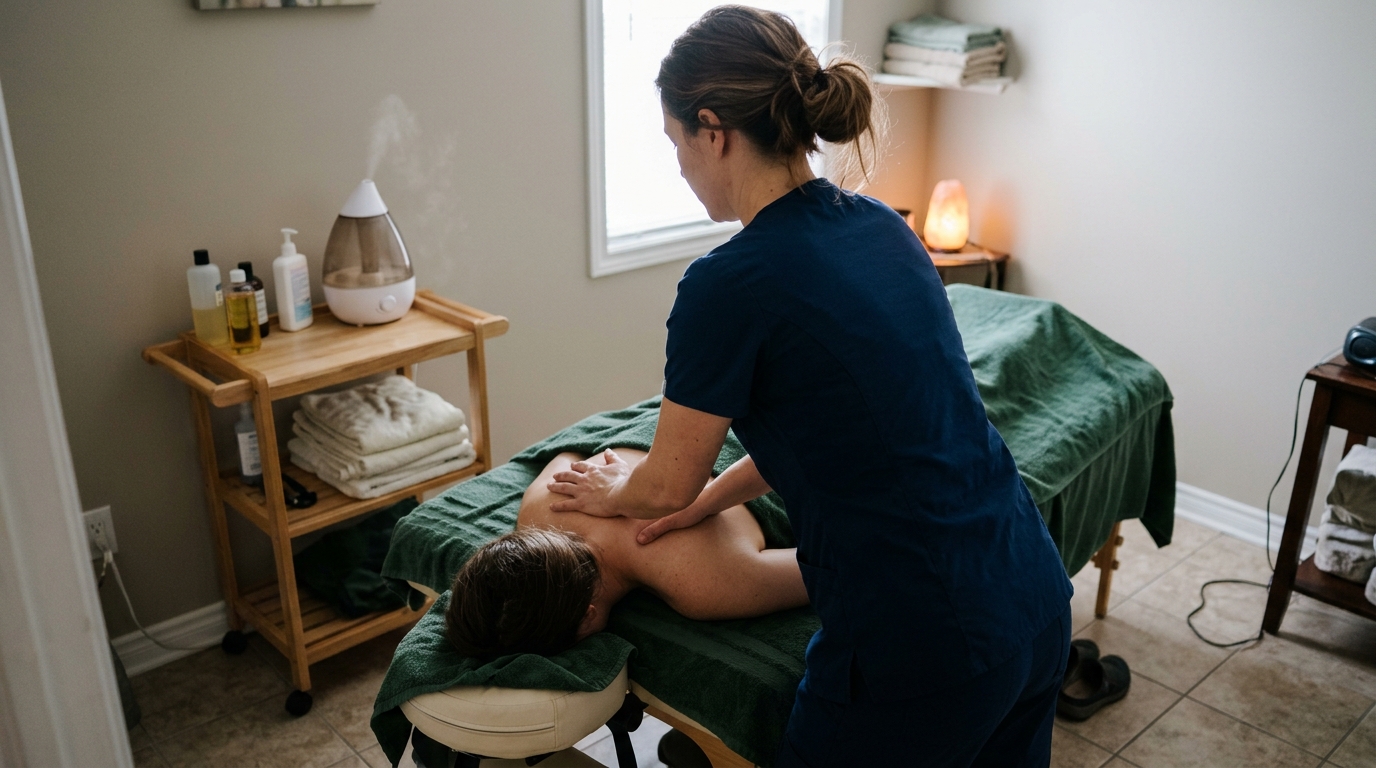
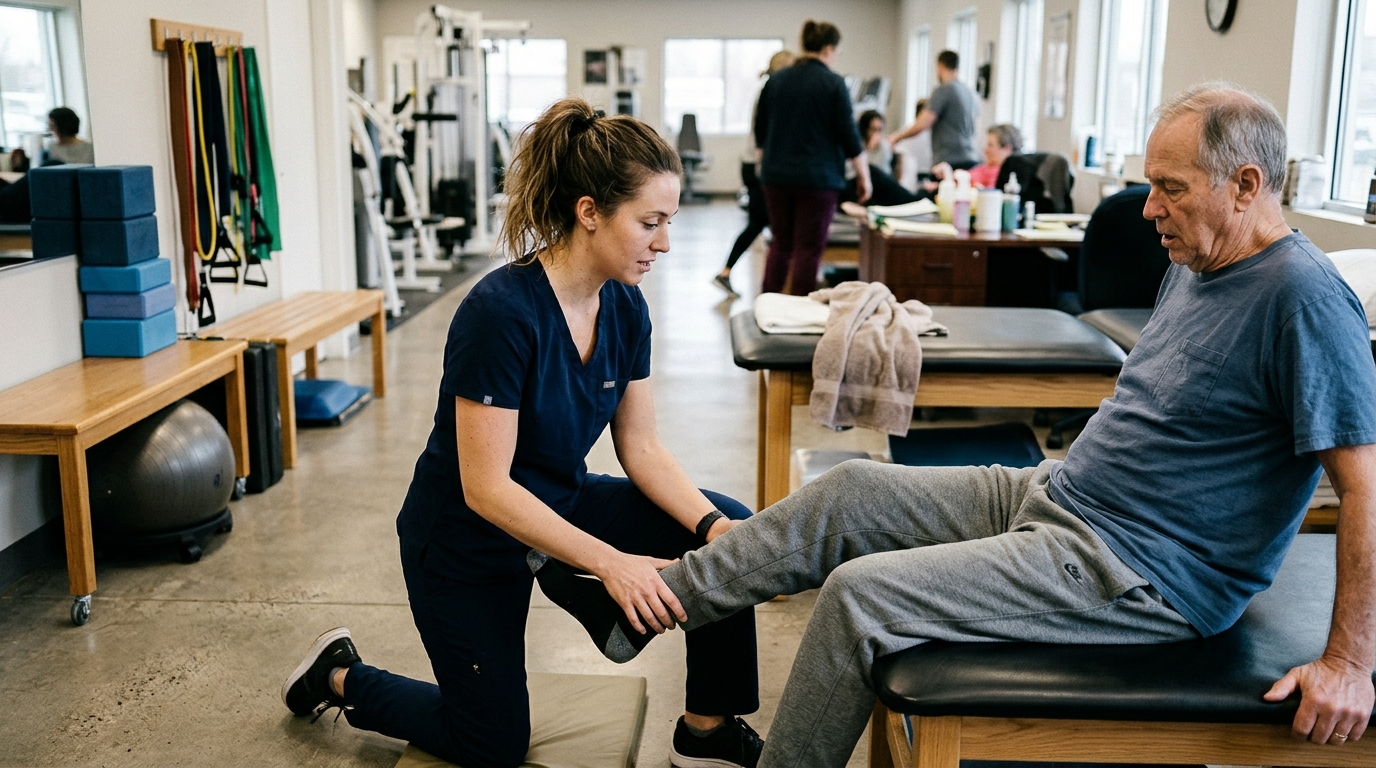
How to Become a Licensed Chiropractor
The route runs from undergraduate study to a four-year doctoral degree, national board exams and a state or national licence before you can treat anyone.
Quick answer
- Entry requires a doctoral or professional degree — a four-year D.C. programme entered after at least three years of undergraduate study, with no prior work experience needed (U.S. Bureau of Labor Statistics, 2025).
- The examinations are the NBCE Part I, Part II, Part III and the Part IV National Practical Exam, which examinees typically sit before graduating; all 50 US states accept or require them (National Board of Chiropractic Examiners, undated).
- Licences are issued per state in the US, so renewal differs — in Pennsylvania licences expire 1 September of every even-numbered year and renewal needs 24 hours of board-approved continuing education and a $225.00 fee (Commonwealth of Pennsylvania, Department of State, undated).
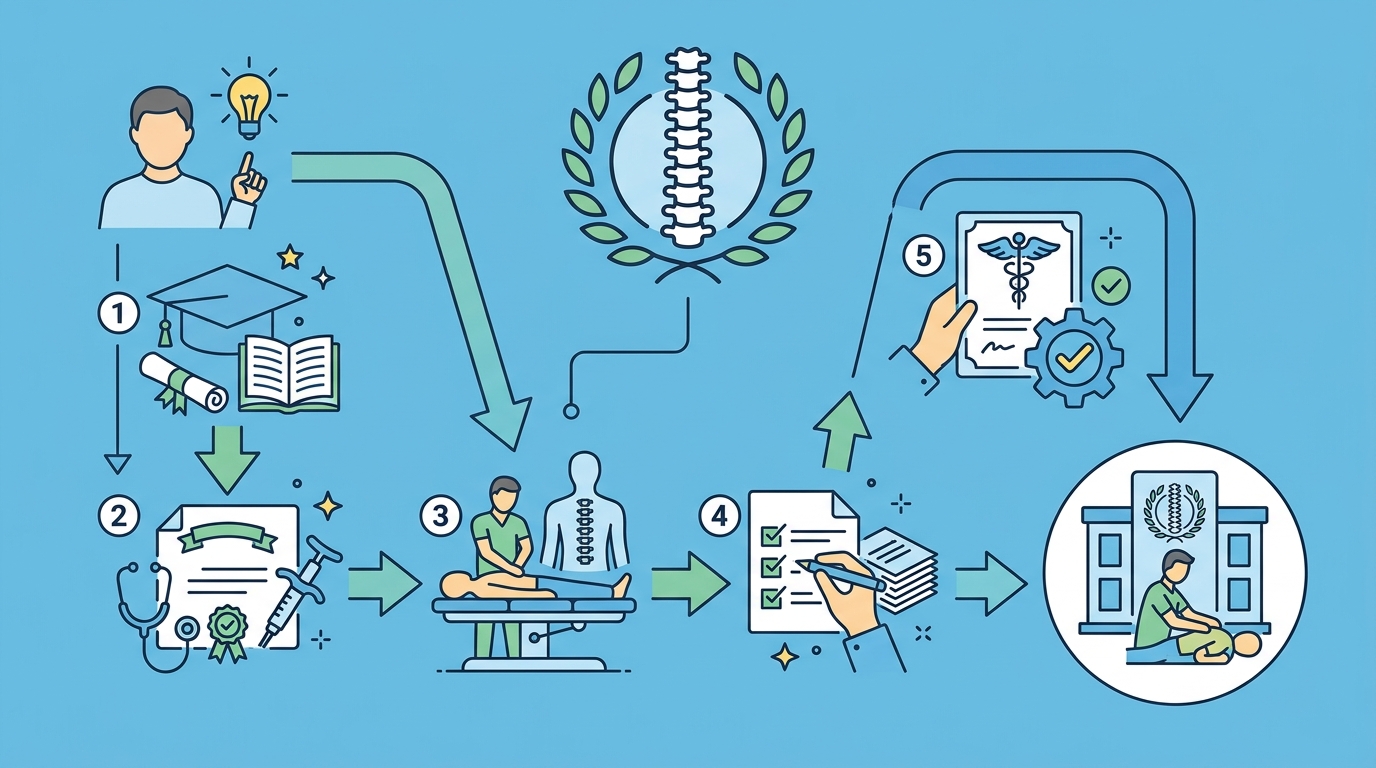
Becoming a chiropractor means completing a Doctor of Chiropractic (D.C.) degree from an accredited chiropractic college — usually four years of study after at least three years of undergraduate education — and then passing the board examinations your jurisdiction accepts (U.S. Bureau of Labor Statistics, 2025). In the United States every state requires a licence, and all 50 states either accept or require passage of the National Board of Chiropractic Examiners Parts I, II, III and IV (National Board of Chiropractic Examiners, undated).
The degree and the national exams are the fixed part. What changes is the licensing authority: each US state board sets its own instruction-hour minimum, background check, jurisprudence exam and renewal cycle, and outside the US the registering body is national rather than state-level.
Why This Credential Matters
There is no way around this one. All states require chiropractors to be licensed, and at a minimum licensure means completing an accredited D.C. degree programme and passing an exam (U.S. Bureau of Labor Statistics, 2025). No assistant grade converts into practice rights, and no employer can lawfully let you adjust a patient while your application is pending.
The testing body boards recognise is the National Board of Chiropractic Examiners (NBCE), a non-profit national and international testing organisation set up in 1963 to standardise chiropractic testing requirements (Wikipedia, undated). Its written and practical examinations run twice yearly at chiropractic colleges in the United States, Canada, France, the United Kingdom, Australia, South Korea and New Zealand (Wikipedia, undated).
Who checks it:
- US state boards — the Commonwealth of Pennsylvania's Department of State requires 4,000 hours of classroom and laboratory instruction and passage of a National Examination (Commonwealth of Pennsylvania, Department of State, undated). Arkansas sets a higher bar: applicants must be at least 21, hold a D.C. degree with not less than 4,400 fifty-minute resident class hours or four academic years, and hold a valid NBCE certificate covering Parts I, II, III, IV and the physiological therapeutics section (O*NET OnLine, U.S. Department of Labor, undated).
- Employers — group chiropractic clinics, integrated practices with physiotherapists and medical staff, hospital outpatient and occupational-health services, university athletic departments, and insurers who credential providers before paying claims.
To a hiring manager, an active licence plus a full NBCE certificate signals that your clinical competency has been tested against a national standard rather than one college's grading.
Step-by-Step Path to Certification
- Finish the undergraduate prerequisite. Admission to D.C. programmes requires at least three years of undergraduate education, although applicants commonly hold a bachelor's degree (U.S. Bureau of Labor Statistics, 2025). Keep sealed transcripts for every science course.
- Apply to an accredited chiropractic college and sit the readiness assessment. The Chiropractic Education Readiness Assessment (CERA) evaluates preparedness of students entering Doctor of Chiropractic programmes, totals 110 questions and is administered on campus at no cost (National Board of Chiropractic Examiners, undated).
- Complete the D.C. degree. It usually takes four years (U.S. Bureau of Labor Statistics, 2025), and your instruction hours must meet your target board's figure — 4,000 classroom and laboratory hours in Pennsylvania, or not less than 4,400 fifty-minute resident class hours in Arkansas (Commonwealth of Pennsylvania, Department of State, undated; O*NET OnLine, U.S. Department of Labor, undated).
- Pass NBCE Part I and Part II during the programme. Part I assesses academic proficiency in six basic science areas and Part II in six clinical science areas (National Board of Chiropractic Examiners, undated). Apply early: the Part I testing fee of $710 is payable once your application is approved (Mometrix, undated).
- Pass NBCE Part III and the Part IV National Practical Exam. Part III assesses application of knowledge across nine areas of clinical competency, and Part IV asks you to perform assessments similar to those you might meet in practice, offered at chiropractic colleges in the United States (National Board of Chiropractic Examiners, undated). Examinees typically clear all four parts before graduating (National Board of Chiropractic Examiners, undated).
- File the licence application with your jurisdiction's board. Submit degree transcripts, your NBCE certificate and the initial fee — $105.00 in Pennsylvania (Commonwealth of Pennsylvania, Department of State, undated). States may also require a background check and a state-specific law exam, called a jurisprudence exam (U.S. Bureau of Labor Statistics, 2025).
- Activate the licence and set up compliance. Arrange the professional liability cover your board specifies, then diarise your first renewal: all states require a specified number of continuing education hours to maintain a chiropractic licence (U.S. Bureau of Labor Statistics, 2025).
Exam and License Details
| Detail | Specification |
|---|---|
| Exam names | NBCE Part I (six basic science areas), Part II (six clinical science areas), Part III (nine areas of clinical competency) and the Part IV National Practical Exam, plus a state jurisprudence exam where required (National Board of Chiropractic Examiners, undated; U.S. Bureau of Labor Statistics, 2025) |
| Pre-entry assessment | Chiropractic Education Readiness Assessment (CERA), 110 questions, on campus at no cost (National Board of Chiropractic Examiners, undated) |
| Passing requirement | A valid NBCE certificate covering the parts your board names — Arkansas requires Parts I, II, III, IV and the physiological therapeutics section (O*NET OnLine, U.S. Department of Labor, undated); confirm each part's current scaled pass standard with the NBCE |
| Fees | Part I testing fee $710, payable after application approval (Mometrix, undated); a proposed Part IV format change would set that exam's fee at $2,600, an increase of $1,015 (National Board of Chiropractic Examiners, 2025-04-29) |
| Retake policy | Examinations run twice yearly at chiropractic colleges (Wikipedia, undated); the full retake fee for Part I is $710 (Mometrix, undated) |
| Degree hours | 4,000 classroom and laboratory hours in Pennsylvania; not less than 4,400 fifty-minute resident class hours, or four academic years, in Arkansas (Commonwealth of Pennsylvania, Department of State, undated; O*NET OnLine, U.S. Department of Labor, undated) |
| Initial licence fee | $105.00 in Pennsylvania, with no experience requirement (Commonwealth of Pennsylvania, Department of State, undated) |
| Renewal requirement | Pennsylvania licences expire 1 September of every even-numbered year; renewal needs 24 hours of board-approved continuing education and a $225.00 fee (Commonwealth of Pennsylvania, Department of State, undated) |
| Insurance | Pennsylvania requires professional liability cover of at least $100,000 per occurrence and $300,000 per annual aggregate (Commonwealth of Pennsylvania, Department of State, undated) |
Realistic Timeline
Counted from the first month of undergraduate study, with month numbers running continuously.
- Months 1–36: Undergraduate prerequisites — the minimum three years required for admission, longer if you complete a full bachelor's degree (U.S. Bureau of Labor Statistics, 2025).
- Months 30–38: College applications, transcripts and interviews, then the 110-question CERA on campus at no cost (National Board of Chiropractic Examiners, undated).
- Months 37–84: The D.C. programme itself — about 48 months, accumulating the hours your target board requires (U.S. Bureau of Labor Statistics, 2025).
- Months 55–66: NBCE Part I, once basic science coursework is behind you. Budget the $710 testing fee at application approval (Mometrix, undated); sittings come round twice a year (Wikipedia, undated), so a missed or failed attempt pushes you about six months.
- Months 66–78: Part II and Part III, as clinical coursework and clinic rotations progress.
- Months 78–84: The Part IV National Practical Exam at a chiropractic college, plus graduation.
- Months 82–90: Licence application — transcripts, NBCE certificate, initial fee, background check and jurisprudence exam where required (U.S. Bureau of Labor Statistics, 2025).
- Months 85–92: Licence issued, liability insurance in place, first renewal cycle logged.
Total: roughly seven to eight years from the first undergraduate class to an active licence, with board processing the hardest stage to forecast.
Frequently asked questions
How much should I budget for exams and the first licence?
The two published figures to plan around are the $710 NBCE Part I testing fee (Mometrix, undated) and Pennsylvania's $105.00 initial licensure fee (Commonwealth of Pennsylvania, Department of State, undated). A proposed Part IV format change would bring that exam to $2,600 (National Board of Chiropractic Examiners, 2025-04-29). Check each part's current fee schedule with the NBCE and your board's own fee page before you commit, since the two are set independently.
Can I use my NBCE results outside the United States?
The NBCE describes itself as a national and international testing organisation and runs examinations at chiropractic colleges in Canada, France, the United Kingdom, Australia, South Korea and New Zealand as well as the US (Wikipedia, undated). You may therefore be able to test close to where you studied. Whether a registration authority outside the US accepts those results toward practice rights is a question only that authority can answer, so write to it before booking a sitting.
Does a licence from one state let me practise in another?
No — each US state issues its own licence, and a move means a fresh application to the new board. Because all 50 states accept or require the same NBCE parts (National Board of Chiropractic Examiners, undated), your board results usually travel; the instruction-hour minimum, background check, jurisprudence exam and fees do not. Compare the two states' rules side by side before accepting a job across a state line.
What happens if I let the continuing education lapse?
Every state ties the right to keep practising to a set number of continuing education hours (U.S. Bureau of Labor Statistics, 2025), so falling short usually blocks renewal until the hours are made up, sometimes with a reinstatement charge. Track hours against your board's approved provider list rather than assuming any seminar counts. Set a reminder a few months before the deadline, which in Pennsylvania falls on a fixed date in even-numbered years.
Sources
- U.S. Bureau of Labor Statistics — Chiropractors : Occupational Outlook Handbook (2025)
- Wikipedia — National Board of Chiropractic Examiners
Written by
Marisol steers Jobladderhq's coverage of hiring trends and the strange rituals of modern recruiting. She's drawn to the gap between what job ads promise and what the work actually feels like. Her editing hand favors clarity over jargon, always.