Firefighter vs. Paramedic: Which Career Fits You?
Two emergency careers that share a scene but not a job: one forces entry and puts water on fire, the other owns the patient, the airway and the paperwork.
Quick answer
- Entry route differs: firefighters typically need a high school diploma plus EMS training, with most trained at a fire academy, while EMTs and paramedics typically complete a postsecondary educational programme and are licensed by the state (U.S. Bureau of Labor Statistics, 2025).
- Paramedics usually need to work as an EMT first, and paramedic programmes require EMT-Intermediate certification before entry (U.S. Bureau of Labor Statistics, 2025).
- Schedules differ: firefighters may work 24-hour shifts followed by 48 or 72 hours off, while EMTs and paramedics work varied nights, weekends and holidays, sometimes on 12-, 18- or 24-hour shifts (U.S. Bureau of Labor Statistics, 2025).
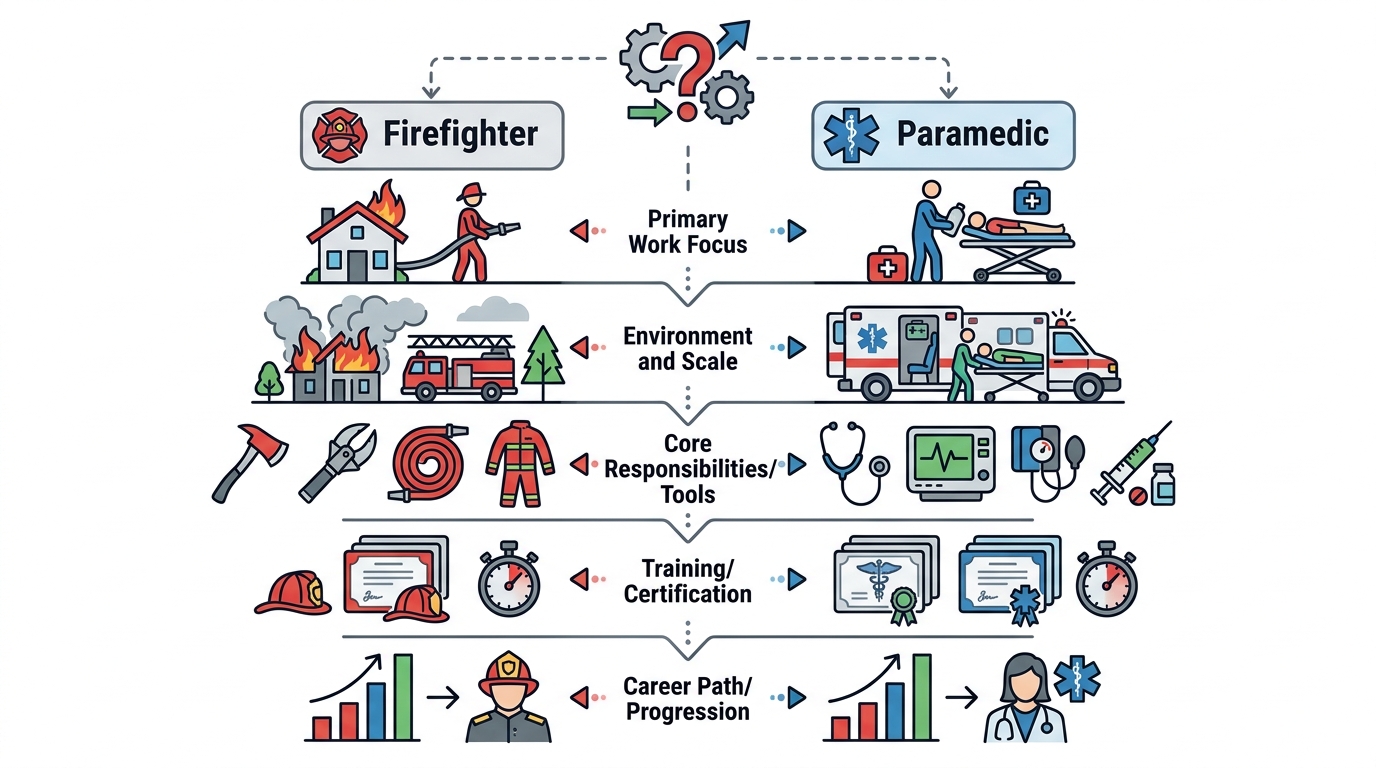
Firefighters and paramedics often arrive at the same address, but the work, the training route and the shift pattern are different. Firefighters typically enter with a high school diploma plus emergency medical services training and learn the job at a fire academy, while paramedics complete a postsecondary education programme and must be licensed in the state where they work (U.S. Bureau of Labor Statistics, 2025).
This guide compares the two on pay structure, entry requirements, physical demands, schedules and outlook, using the U.S. Bureau of Labor Statistics occupational titles. If you are outside the United States, the day-to-day work is broadly similar but titles, licensing and pay data come from your own national statistics agency and ambulance regulator.
Side-by-Side Comparison
All figures below come from the U.S. Bureau of Labor Statistics Occupational Outlook Handbook (2025 data; employment projections cover 2025–35). Because wage figures are revised, look up the current median for each occupation in the Handbook rather than relying on a number quoted second-hand.
| Category | Firefighter | Paramedic |
|---|---|---|
| Median pay | BLS publishes a median annual wage for firefighters (2025). Pay is usually set by a municipal or county pay scale with step increases, plus overtime, which BLS notes is common in this occupation. | BLS publishes a median annual wage for paramedics (2025), a separate median for emergency medical technicians, and a combined median for the "EMTs and paramedics" group. Pay is usually hourly, with shift differentials and overtime on extended shifts. Compare all three figures in the Handbook. |
| Typical education | BLS lists a typical entry-level education level for firefighters (2025): a high school diploma plus training in emergency medical services, with most firefighters trained at a fire academy. | BLS lists a typical entry-level education level for EMTs and paramedics (2025): completion of a postsecondary educational programme. Community college paramedic programmes usually lead to a nondegree award or an associate's degree; some four-year university programmes lead to a bachelor's degree. |
| Credentials and licensing | Certain credentials may be required, such as EMT and paramedic certification; requirements such as EMT certification vary by state or locality (BLS, 2025). | All states require EMTs and paramedics to be licensed in the state where they work. Paramedic programmes require applicants to hold EMT-Intermediate certification, and paramedics typically need work experience as an EMT before entering the programme (BLS, 2025). |
| Physical demands | Driving firetrucks, putting out fires with hoses, extinguishers and pumps, rescuing occupants from burning buildings, cleaning and maintaining equipment, and conducting drills (BLS, 2025). | Assessing patients, providing first aid or life support, and preparing and transporting patients. BLS (2025) notes EMTs and paramedics have one of the highest rates of injuries and illnesses of all occupations, with considerable time spent kneeling, bending and lifting. |
| Schedule type | Most paid firefighters work full time; shifts may run 24 hours on duty followed by 48 or 72 hours off, and overtime is common (BLS, 2025). | Most work full time and some work more than 40 hours a week; schedules may include nights, weekends and holidays, and some shifts run 12, 18 or 24 hours (BLS, 2025). |
| Size and outlook | BLS reports the total number of firefighter jobs and a projected employment change for 2025–35 — check the Handbook's job outlook tab for the current rate. | BLS reports the total number of jobs for the combined EMT-and-paramedic group and a projected employment change for 2025–35 — check the same tab for the current rate. |
Day-to-Day Differences
The first hour of a shift shows the split clearly.
A firefighter starts at the station with a handover from the off-going crew, then checks the apparatus: breathing apparatus cylinders and face pieces, hose beds, ladders, the pump and the extrication tools. Equipment cleaning and maintenance is part of the job description, not an extra, and so are drills — practising ladder throws, hose advances and search patterns before any call comes in (U.S. Bureau of Labor Statistics, 2025).
A paramedic's first hour is a rig check against an inventory sheet: oxygen cylinder pressure, suction, the cardiac monitor and defibrillator, drug seals and the stretcher. Inventorying and cleaning equipment is listed among core duties, alongside responding to calls, assessing patients and documenting treatment for hospital staff (U.S. Bureau of Labor Statistics, 2025).
At the same road traffic collision, the division continues. The firefighter stabilises the vehicle, forces access and rescues the occupant. The paramedic takes the patient from that point: assessing condition, providing life support, preparing and transporting the patient to hospital, then handing over a written record of observations and treatment.
Paperwork differs too. Firefighters prepare incident reports describing what happened at the scene. Paramedics write patient care documentation that becomes part of a clinical record. Entry-level crew members on both sides work under supervision and carry out more of the cleaning, restocking and drill work; experienced staff take the lead on decisions and sign off the record.
Which Career Is Right for You
- Choose firefighter if you want to start work with a high school diploma plus EMS training and do your core training at a fire academy, rather than enrolling in and paying for a postsecondary programme first (U.S. Bureau of Labor Statistics, 2025).
- Choose paramedic if you are willing to work as an EMT before training further — paramedic programmes require EMT-Intermediate certification and paramedics typically need EMT work experience before entry (U.S. Bureau of Labor Statistics, 2025).
- Choose firefighter if a 24-hours-on, 48-or-72-hours-off rotation fits your life, for example because you have long blocks of childcare to cover or a second commitment on your days off (U.S. Bureau of Labor Statistics, 2025).
- Choose paramedic if you want almost every hour of your shift spent on patient contact — assessment, life support, transport and clinical documentation — rather than on station duties, drills and equipment maintenance between calls.
- Choose firefighter if you want a route where EMT certification may be one credential among several rather than the licence your whole job depends on; BLS (2025) notes EMT certification requirements for firefighters vary by state or locality, while all states licence EMTs and paramedics.
- Choose paramedic only if your back and knees can sustain repeated kneeling, bending and lifting over a career; BLS (2025) reports EMTs and paramedics have one of the highest rates of injuries and illnesses of all occupations.
Frequently asked questions
Which takes longer to qualify for?
The paramedic route is usually longer. You generally need EMT work experience, then EMT-Intermediate certification to be accepted onto a paramedic programme, then a postsecondary programme that leads to a nondegree award, an associate's degree or in some universities a bachelor's degree, plus a state licence (U.S. Bureau of Labor Statistics, 2025). Firefighters typically need a high school diploma and EMS training, with most receiving their training at a fire academy after they are hired (U.S. Bureau of Labor Statistics, 2025).
Which pays more?
The Bureau of Labor Statistics publishes a 2025 median annual wage for firefighters and separate 2025 medians for paramedics, for emergency medical technicians, and for the combined EMT-and-paramedic group — look all four up in the Occupational Outlook Handbook before you commit. Structure matters as much as the headline figure: firefighter pay typically follows a municipal pay scale with overtime, which BLS notes is common, while EMT and paramedic pay is usually hourly with shift differentials and extended shifts of 12, 18 or 24 hours.
Do firefighters have to be paramedics?
Not everywhere. BLS (2025) states that firefighters may need credentials such as EMT and paramedic certification, and that requirements like EMT certification vary by state or locality. Check the specific hiring standards published by the department you want to apply to, because two neighbouring jurisdictions can set different minimums.
Can I move from one career to the other later?
Movement is common in both directions because firefighter training includes emergency medical services and many firefighters hold EMT or paramedic certification (U.S. Bureau of Labor Statistics, 2025). Moving from EMS to the fire service means adding fire academy training; moving the other way means meeting the state licensing requirement that applies to all EMTs and paramedics. Neither move is automatic — each employer sets its own entry standards.
Sources
- U.S. Bureau of Labor Statistics — Firefighters : Occupational Outlook Handbook (2025)
- U.S. Bureau of Labor Statistics — EMTs and Paramedics : Occupational Outlook Handbook (2025)

Written by
Noor writes personal essays and interviews about career changes, burnout, and starting over. She's interested in the stories people tell themselves about what a job is supposed to mean.