Forklift Operator vs. Warehouse Worker Salary: Which Pays More?
A plain comparison of two warehouse jobs: what each is paid for, which official wage tables to read, and why the gap widens once equipment tickets stack up.
Quick answer
- In the United States, forklift operators are counted as industrial truck and tractor operators (SOC 53-7051); the median, mean, 10th and 90th percentile annual wages for that code are published by the U.S. Bureau of Labor Statistics in its Occupational Employment Statistics national estimates (BLS OES, May 2016 release and later annual updates), and DataUSA (U.S. Census Bureau / BLS-derived data, 2024) publishes an average yearly wage for the same occupation.
- Warehouse workers who do not drive powered trucks are counted mainly as hand laborers and material movers in the same BLS OES release — compare both codes in the same release year or you are not comparing like with like.
- Forklift work is usually the higher paying of the two, because certification, machine classes and shift cover are paid for; DataUSA (U.S. Census Bureau / BLS-derived data, 2024) also publishes the national average salary across all occupations, the benchmark to judge both jobs against.
- Both figures are base wage estimates; overtime and differentials are extra.
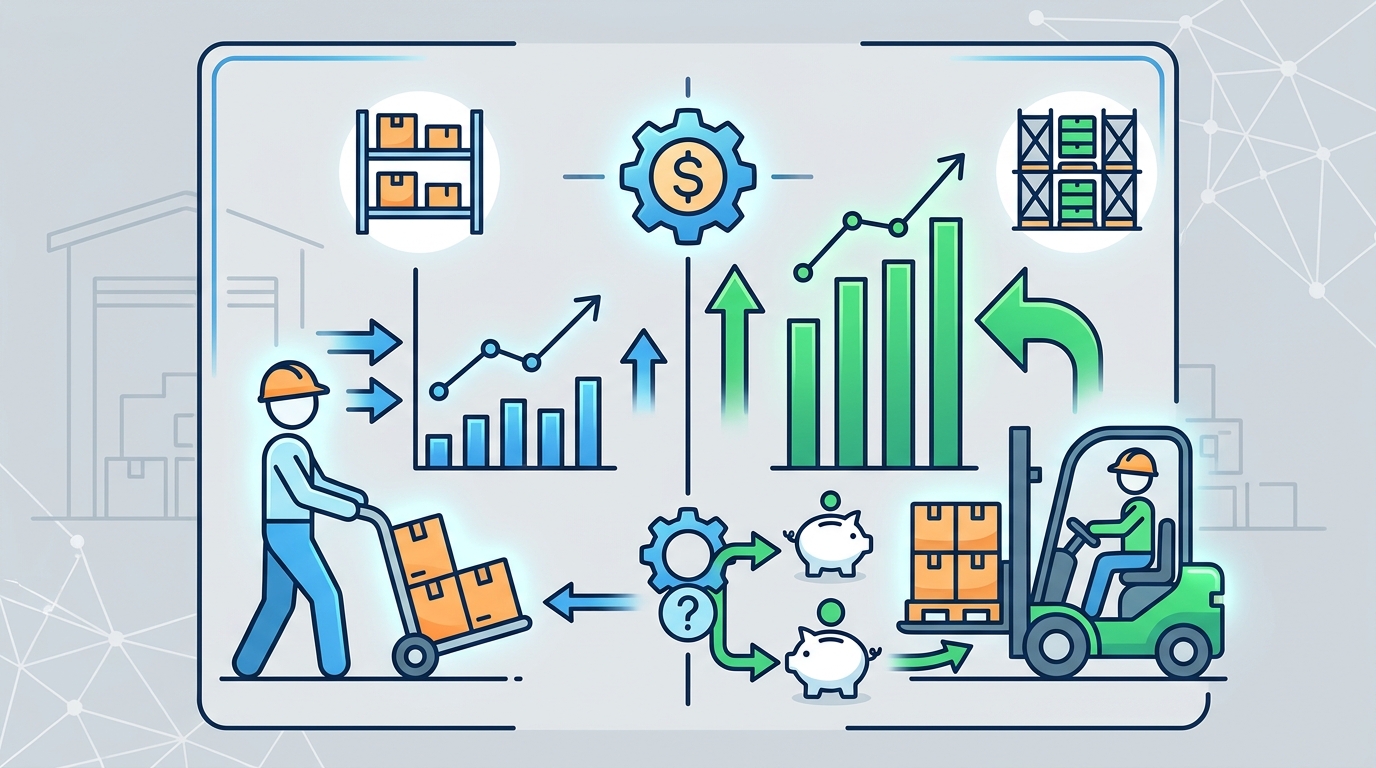
Forklift operating and general warehouse work happen on the same floor, but they are counted as separate occupations in official wage statistics and are usually paid at different rates. Forklift operating is normally the better paid of the two, because certification, machine classes and shift cover get priced into the hourly rate.
Both are hourly jobs, so the advertised base rate is only part of the story — overtime, night differentials and cold-store premiums sit on top. The figures below are named by series and source so you can read the current number yourself rather than a number that has aged.
Pay Side by Side
Both roles sit in the same U.S. wage programme, so you can line them up on identical definitions: same survey, same reference period, same unit. Read each cell as an instruction — open that source, that series, that year, and take the current number.
| Pay point (annual, United States) | Forklift operator — figure and source | Warehouse worker — figure and source |
|---|---|---|
| Entry level (10th percentile) | 10th percentile annual wage, SOC 53-7051 (BLS Occupational Employment Statistics, May 2016 national estimates and later annual updates) | 10th percentile annual wage for hand laborers and material movers, same BLS OES national estimates table |
| Median (50th percentile) | Median annual wage, SOC 53-7051 (BLS OES percentile wage estimates, May 2016 and later updates) | Median annual wage for the hand laborer and material mover code, same BLS OES percentile table |
| Experienced (90th percentile) | 90th percentile annual wage, SOC 53-7051 (BLS OES, May 2016 and later updates) | 90th percentile annual wage for hand laborers and material movers, same BLS OES release |
| Mean cross-check | Mean hourly and mean annual wage, SOC 53-7051 (BLS OES national estimate, May 2016); average yearly wage for the same occupation (DataUSA, U.S. Census Bureau / BLS-derived data, 2024) | Mean hourly and mean annual wage for the hand laborer and material mover code, same BLS OES national estimate |
Three things to hold on to:
- Every BLS estimate is labelled a mean or a percentile, and published in both hourly and annual form. Keep to one unit across the whole comparison.
- These are wage estimates for the surveyed pay period. Overtime, night differentials and attendance bonuses are not visible in a published median, so treat the table as base pay and add your own shift pattern.
- Outside the United States, use your national statistics office or labour ministry's occupation-level wage tables in local currency rather than converting a U.S. figure.
For context, compare both occupations against the national average salary across all occupations published by DataUSA (U.S. Census Bureau / BLS-derived data, 2024).
Why the Pay Differs
The gap is not about effort. It comes from a short list of checkable things.
1. A certificate stands between you and the controls. You cannot operate a powered industrial truck at work without documented training and a practical assessment on that machine, renewed on a set cycle set by your workplace safety regulator — in the U.S., the federal powered industrial truck rule. Picking, packing and loading need no such ticket, so employers recover training and renewal costs by paying certified operators above the general floor rate.
2. Machine classes stack. Counterbalance is the floor. Reach truck, order picker and narrow-aisle turret are separate assessments, and a site running 12-metre racking needs a turret operator more than another picker. Each class is a separate line on your record and a separate point at review time.
3. Overtime and differentials fall differently. Total compensation equals base rate plus overtime premium plus differentials. Trucks must cover the whole receiving and dispatch window, so operator rotas more often include nights, weekends and end-of-shift load-out — the hours that carry premiums. Two people on the same base rate can finish the year far apart.
4. Site conditions and sector. Cold storage, hazardous materials handling and container unloading usually carry a premium where they are run. A contract logistics warehouse, a manufacturer's internal stores and a unionised distribution centre with a published scale each price the same ticket differently.
5. Where the site is. DataUSA (U.S. Census Bureau / BLS-derived data, 2024) reports that the states with the highest average annual wage for industrial truck and tractor operators in 2024 were Minnesota, South Dakota and Maryland. Pull those three alongside your own state in the same 2024 table before judging an offer.
6. How many people can do the job. DataUSA (U.S. Census Bureau / BLS-derived data, 2024) publishes both the 2024 workforce size for industrial truck and tractor operators and the occupation's 10-year projected job growth. A certified pool smaller than the general warehouse labour pool, in a growing sector, explains most of the rate difference on a job board.
Earnings Over a Career
The two jobs do not just start apart — they move apart, then converge again at the top.
For a warehouse worker, year one is about reliability: accuracy, attendance, the warehouse management system and scanning. Pay then tends to sit near the 10th percentile row for hand laborers and material movers (BLS Occupational Employment Statistics, May 2016 and later annual updates). The biggest money milestone available is not seniority but certification: moving to the industrial truck and tractor operator code (SOC 53-7051) shifts you onto a different percentile table altogether, which is why many warehouse workers ask to be put through training rather than wait for a review.
For a forklift operator, the first milestone is the initial certification, which is what qualifies you for the entry-level row at all. The second usually comes within one to three years, as reach, order picker and narrow-aisle classes carry you from the 10th percentile band toward the median annual wage for SOC 53-7051 in the BLS OES percentile estimates. The third is training and assessing others, or adding cycle counting, goods-in checking or dispatch coordination. Operators at that stage, on a night rota in a high-paying state such as Minnesota, South Dakota or Maryland (DataUSA, U.S. Census Bureau / BLS-derived data, 2024), are the ones approaching the 90th percentile annual wage in the same BLS table.
After that, both paths lead to shift lead, inventory controller, then supervisor or operations manager. Those roles are usually salaried rather than hourly, which means losing overtime premiums — check total compensation, not the headline annual figure, before accepting. Measure any offer against the occupation's own mean annual wage in the BLS OES national estimate and against the national average salary across all occupations (DataUSA, U.S. Census Bureau / BLS-derived data, 2024).
Frequently asked questions
Does getting a forklift certificate automatically raise my pay?
No employer is obliged to pay more for one, but it moves you onto a different wage table: the BLS Occupational Employment Statistics percentile estimates for SOC 53-7051 rather than the hand laborer and material mover code. Compare the median rows for both codes in the same release year to see the size of that move.
Should I use the average or the median wage when judging an offer?
Use the median — the 50th percentile row in the table above — because a few very high earners pull the mean upward. The BLS OES national estimate publishes a mean hourly and mean annual wage for SOC 53-7051, and DataUSA (U.S. Census Bureau / BLS-derived data, 2024) publishes an average yearly wage for the same occupation.
Where do forklift operators earn the most?
DataUSA (U.S. Census Bureau / BLS-derived data, 2024) names Minnesota, South Dakota and Maryland as the states with the highest average annual wage for industrial truck and tractor operators in 2024. Read those state figures alongside the national mean annual wage for SOC 53-7051 from the BLS OES national estimate, in the same units.
Do the published figures include overtime and shift premiums?
Treat the median and percentile rows in the table above as base wage estimates for the surveyed pay period. Overtime, night and weekend differentials, cold-store pay and attendance bonuses sit on top, so two operators on the same median base rate can end the year far apart. Ask for base rate, premiums and expected weekly hours separately.
Sources
- DataUSA (U.S. Census Bureau / BLS-derived data) — Industrial truck & tractor operators (2024)
- U.S. Bureau of Labor Statistics (BLS), Occupational Employment Statistics — Industrial Truck and Tractor Operators, May 2016 OES (2016-05)

Written by
Marisol steers Jobladderhq's coverage of hiring trends and the strange rituals of modern recruiting. She's drawn to the gap between what job ads promise and what the work actually feels like. Her editing hand favors clarity over jargon, always.