Home Health Aide vs. CNA Salary: Which Pays More?
Two overlapping caregiving roles with different certification rules, work settings and overtime patterns — here's how to compare what each one actually pays.
Quick answer
- Compare both roles inside one official release so units and year match: the US Bureau of Labor Statistics OEWS (home health and personal care aides vs. nursing assistants), Job Bank and Statistics Canada in Canada, the ONS Annual Survey of Hours and Earnings plus NHS Agenda for Change bands 2–3 in the UK, or the ABS and the relevant Fair Work modern award in Australia. Use the latest published year and note it.
- In most national series the two medians land close together, with the CNA/nursing assistant title typically higher — confirm the current figure and year for your country, because the order can flip where home care funding sets a wage floor.
- Judge total compensation, not base pay: CNA rosters often add night, weekend, holiday and overtime premiums, while home health aide hours are often scheduled per visit, with travel time and gaps between clients paid differently by employer and jurisdiction.
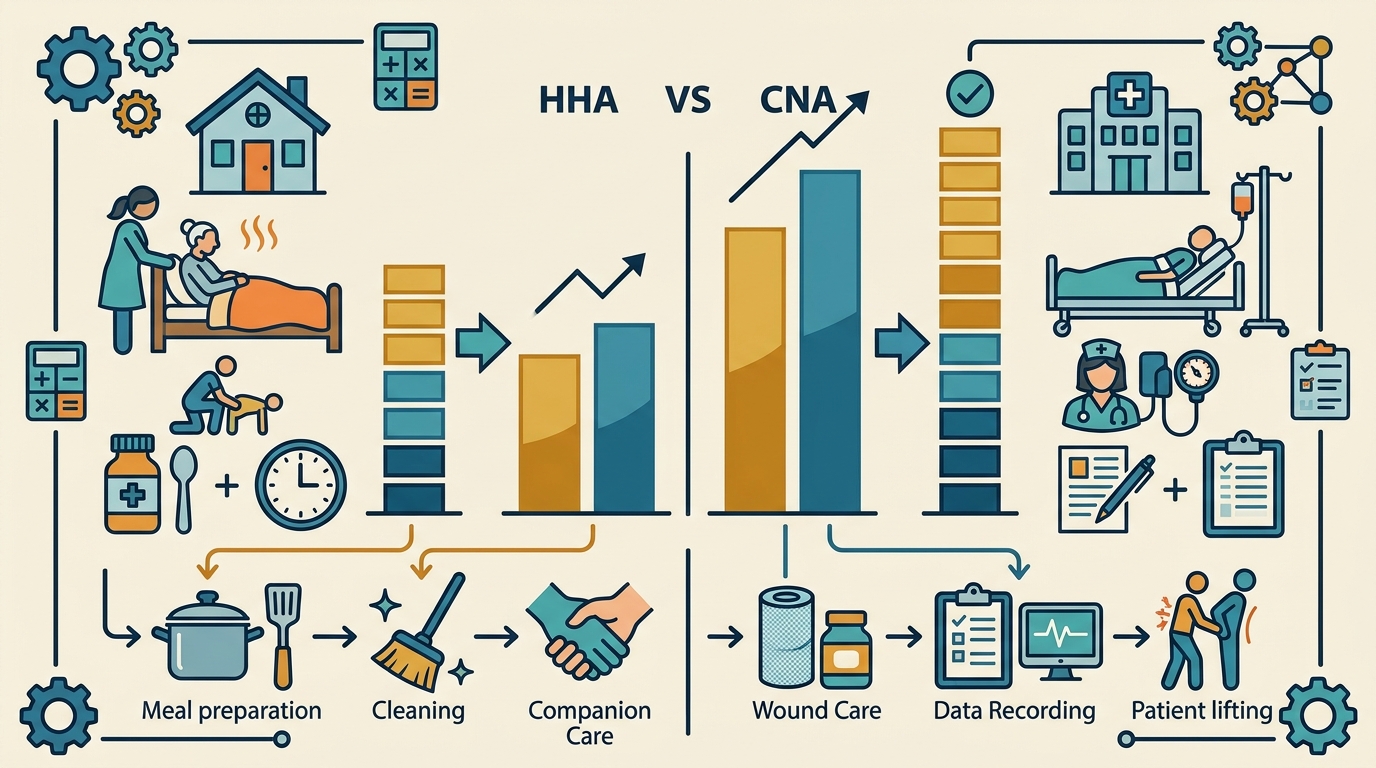
Home health aides and certified nursing assistants (CNAs) do overlapping hands-on care work, and in most national wage series their medians sit close together — usually with the CNA title slightly ahead, because more CNAs work in hospitals and nursing homes where shift differentials, overtime and union scales are built into the pay. The gap is narrow enough that your employer, setting, shift pattern and region matter more than the job title.
This guide shows you where to pull current, comparable figures for both roles in your own country, and what to check beyond the headline median.
Pay Side by Side
Put both jobs in the same units first. Most official wage data for these roles is published hourly, and annual equivalents assume full-time, year-round hours — which many home health aides do not get. Converting an hourly rate to a year without checking typical weekly hours is the most common way people overestimate home care earnings.
Use the table as a worksheet: look up each cell in the named source for your country, write in the figure and the year, and keep every number on the same basis (median, hourly, base pay before premiums).
| Pay point | Home Health Aide — source to use | CNA / Nursing Assistant — source to use |
|---|---|---|
| Entry-level (10th percentile, hourly, base) | US: BLS OEWS entry wage, home health and personal care aides. Canada: Job Bank low wage, home support workers. UK: ONS ASHE lower decile, care workers, plus NHS band 2 entry point. Australia: Fair Work modern award minimum, home care employee level 1 | US: BLS OEWS entry wage, nursing assistants. Canada: Job Bank low wage, nurse aides and orderlies. UK: ONS ASHE lower decile, nursing auxiliaries, plus NHS band 2–3 entry points. Australia: award classification for assistant in nursing, grade 1 |
| Median (50th percentile, hourly, base) | Same sources, median row — check whether the series merges home health aides with personal care aides, which can pull the median down | Same sources, median row — check whether hospital and nursing-home employers are reported separately |
| Experienced (90th percentile, hourly, base) | Same sources, top decile — driven by specialist clients, live-in work or supervisory visit roles | Same sources, top decile — usually hospital employment, long tenure on a published scale, senior aide grades |
| Annual equivalent | Convert only if you know contracted weekly hours; many posts are part-time or per-visit | Convert using rostered contracted hours, then add premiums separately |
Two cautions. Label every figure as median, mean or percentile — mean pay sits above median in both occupations because high-hour workers pull the average up. And read the by-industry tables: the same release usually splits nursing assistants across hospitals, skilled nursing facilities and home health, and that spread is often wider than the gap between the two job titles.
For location, it varies by a short list you can check: your state or regional figure (US OEWS publishes state and metro wages, Job Bank publishes provincial ranges, ASHE publishes regional figures), the local minimum wage or award floor, whether public home care funding sets a provider wage floor, and whether nearby facility employers bargain collectively.
Why the Pay Differs
Where a gap exists, it comes from four structural things rather than one job being harder than the other.
1. Certification and the registry. CNA is a protected title where it is used: an approved training course, a competency exam, and a listing on a state or provincial nurse aide registry that employers must check. Home health aide training is often shorter, and in some places the role can be filled with employer orientation only. Facility employers can only staff certain tasks with a registered aide, which narrows the hiring pool and lifts the rate. Check your own registry for the exact training hours and exam required — a national minimum is sometimes raised by individual states or provinces.
2. Who the employer is. CNAs cluster in hospitals, skilled nursing facilities and large long-term care groups: employers with HR-set wage scales and often union contracts with published step increases. Home health aides are more often employed by small agencies or directly by a household, where rates track public home care reimbursement. If your region publishes that reimbursement rate or a wage pass-through rule, it effectively caps much of the local market.
3. Shift premiums and overtime. A nursing home runs 24 hours, so CNA rosters generate night, weekend and public holiday differentials plus overtime past the weekly threshold in your jurisdiction's labour law. An aide taking two night shifts a week on a differential earns measurably more than the base rate in the table; double shifts during staffing shortages compound it. Visit schedules rarely produce the same premiums, and a 40-hour week built from short visits may include travel time paid at a different rate, or not paid at all. Check your national labour authority for the overtime threshold and your employer's written travel-time policy.
4. Hours actually offered. Two identical hourly rates give very different annual pay if one role offers 38 rostered hours and the other 24 visit hours with cancellations. Ask each employer for guaranteed minimum weekly hours in writing.
Against that, home health aide work offers one client at a time, more schedule control, and in some markets a premium for live-in, overnight or complex-needs clients. Those premiums are employer-set, so ask for the rate rather than assuming one exists.
Earnings Over a Career
In year one the two jobs sit close. Look at the entry-level row of your filled-in table: in most countries the floor for both is the same minimum wage or care award, so a new home health aide and a new CNA often start within cents of each other.
The paths diverge at the first formal milestone. For a CNA that is passing the competency exam and being listed on the nurse aide registry; many facility employers pay uncertified aides a trainee rate and move them onto the full scale once the certificate issues. Ask to see the step on the employer's wage scale where that lands, and whether back pay runs from the exam date. The next milestone is usually a specialist grade — medication aide or restorative aide where permitted, or a senior/charge aide classification — normally a named increment on a published scale, so you can price it before you train. Public-sector and unionised employers publish these openly: in the UK, the Agenda for Change bands and pay points are national, so you can see what moving from band 2 to band 3 adds.
For a home health aide, progression is about specialisation and responsibility. Hospice, dementia, paediatric or ventilator-dependent clients often carry an employer-set premium per hour or per visit. After a few years the common step is off the road entirely — scheduler, field supervisor, care coordinator or trainer — which usually converts hourly pay to a salaried rate. Ask agencies how many such posts exist and who filled the last one.
By the top-decile row, the gap generally widens in the CNA's favour, because that tail is dominated by long-tenure facility and hospital work with step increases, differentials and overtime stacked on a higher base. The home health aide top decile more often reflects long hours or live-in arrangements than a higher underlying rate.
The largest money move for either role is leaving it. Both are standard entry routes into licensed practical or vocational nursing and then registered nursing, and many facility employers run study support for staff who stay. Check the published pay scale for that licensed grade in your country before choosing which stepping stone to take.
Frequently asked questions
Which title should I search for in official wage data?
Search both, and note how your country groups them. The median row may combine home health aides with personal care or home support workers in one occupational code, while nursing assistants, nurse aides and orderlies sit in another. If the codes are merged, use the by-industry breakdown — home health services versus nursing care facilities versus hospitals — to see the real difference.
Is the pay gap big enough to justify certifying as a CNA?
Compare the entry-level row for both jobs in your region first. If they start at nearly the same hourly rate, the certificate's value shows up in the median and top-decile rows, where facility employment, differentials and step increases pull CNA pay ahead. Weigh course cost and unpaid training hours against that difference over two or three years, and ask whether local employers reimburse training.
Why does my offer look lower than the national median?
The median row is a national midpoint across all employers and experience levels, so a first job in a lower-wage region usually sits between the entry-level and median rows. Look up your own state, province or region in the same release and use its entry-level percentile as the realistic benchmark.
Does overtime change which job pays more?
Often, yes. The table rows are base hourly pay, excluding premiums. A CNA working rostered nights and weekends can finish the year above the annual equivalent of the median row, while a home health aide paid per visit may finish below it if weekly hours fall short. Ask for guaranteed minimum hours and the written overtime, travel and differential policy before comparing offers.

Written by
Desmond writes about the mechanics of job searching: resumes, interviews, the long silence after applying. He's fascinated by how much of getting hired depends on luck dressed up as skill.