How to Become a Veterinary Assistant
What restraint, kennel work and exam-room prep actually involve, and the training routes that help first-time applicants get taken seriously.
Quick answer
- Fastest path: apply directly to a clinic with a high school diploma or equivalent and learn on the job, which ranges from a few days to one year (O*NET OnLine, U.S. Dept. of Labor).
- Typical timeline: a few weeks if hired straight into a clinic; roughly 6 to 12 months if you complete a NAVTA-approved online program with a clinic externship first (Animal Behavior College).
- Minimum credential in the US: a high school diploma or GED is the usual entry point, and certification is not mandatory, though graduates of a NAVTA-approved program may sit the Approved Veterinary Assistant (AVA) exam (U.S. Bureau of Labor Statistics, 2025; NAVTA).
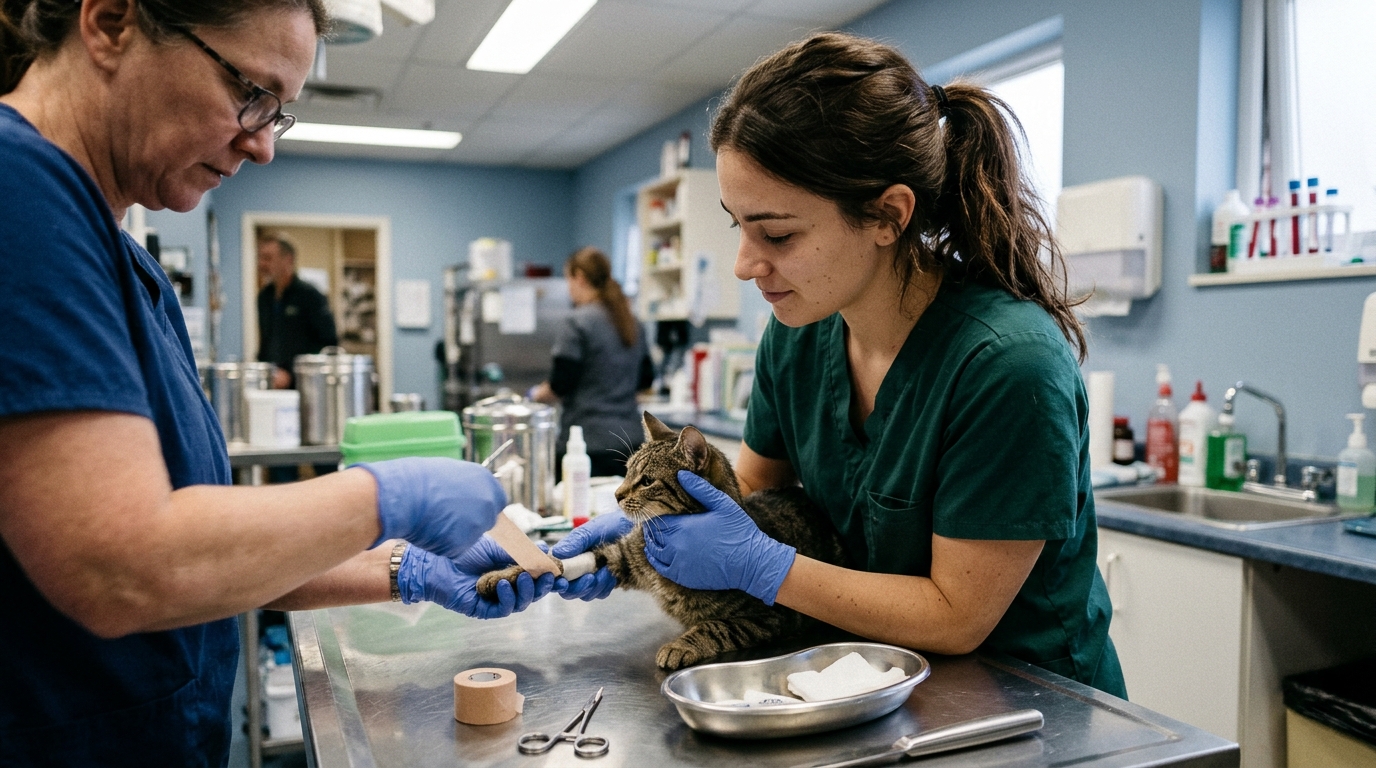
A veterinary assistant supports veterinarians and veterinary technicians with the hands-on work of a clinic: restraining animals for exams, cleaning kennels and surgical areas, feeding and monitoring patients, and preparing instruments and samples. In the United States, the typical entry-level education is a high school diploma or equivalent, no prior work experience in a related occupation is required, and on-the-job training is short-term (U.S. Bureau of Labor Statistics, 2025).
That makes it one of the faster animal-care jobs to enter, but the work is physically and emotionally demanding, and the occupation has one of the highest rates of injuries and illnesses of all occupations (U.S. Bureau of Labor Statistics, 2025). Requirements, titles and any licensing sit with the country, state or province you work in, so check your local veterinary regulator before you commit to a course.
Is This Career Right for You?
This job suits people who are steady around blood, vomit, urine and distressed animals, who can lift and restrain a struggling dog without losing their temper, and who would rather be on their feet all shift than at a desk. It does not suit someone who needs predictable weekday hours, a clean uniform at the end of the day, or distance from death — assistants may handle sick or abused animals and assist in euthanizing animals (U.S. Bureau of Labor Statistics, 2025).
The physical risk is real. Veterinary assistants and laboratory animal caretakers have one of the highest rates of injuries and illnesses of all occupations, from bites, scratches and kicks to back strain from lifting (U.S. Bureau of Labor Statistics, 2025). Expect scrubs, gloves, disinfectant, and hours spent on hard flooring.
Hours vary by employer. Some assistants work part time, and nights, weekends and holidays are common, particularly in emergency and 24-hour hospitals (U.S. Bureau of Labor Statistics, 2025).
Settings differ too. Most work sits in veterinary services — clinics and animal hospitals — but assistants and caretakers also work in colleges and universities and in research laboratories (U.S. Bureau of Labor Statistics, 2025). A research or university animal facility runs to stricter protocols and quieter routines than a busy general practice with walk-in emergencies and anxious owners at reception.
Steps to Becoming a Veterinary Assistant
- Finish a high school diploma or GED. This is the typical entry-level education for the occupation (U.S. Bureau of Labor Statistics, 2025), and ONET places the work in Job Zone 1-2, meaning very little to some preparation is needed (ONET OnLine, U.S. Dept. of Labor). Budget whatever time your remaining schooling takes; an adult GED route is usually a matter of months.
- Get unpaid animal-handling exposure. No prior work experience in a related occupation is required for entry (U.S. Bureau of Labor Statistics, 2025), but a few months of weekend shifts at a shelter, boarding kennel or rescue teaches you leash handling, cleaning protocols and whether you cope with the smell and the noise. Cost: usually nothing but travel.
- Decide between learning on the job and taking a program first. On-the-job training for this occupation ranges from a few days to one year (O*NET OnLine, U.S. Dept. of Labor). Applying straight to clinics is the cheapest and quickest route; a program is slower but gives first-time applicants something to show.
- If you choose formal study, pick a NAVTA-approved veterinary assistant program. NAVTA lists approved online programs including Animal Behavior College, Blackstone Career Institute, Career Step Online, Ignite Veterinary Assistant Program, Penn Foster, VetBloom and VetMedTeam (NAVTA). One of these, the Animal Behavior College Veterinary Assistant Program, is described as completable in 6 to 12 months, combining online coursework with a clinic externship (Animal Behavior College). Tuition varies by provider — ask for current fees and payment plans before enrolling.
- Sit the Approved Veterinary Assistant (AVA) examination. On graduating from a NAVTA-approved program you are eligible to take the AVA exam and, on passing, may use the AVA designation (NAVTA). Certification is not mandatory for veterinary assistants, but it lets you demonstrate competency in animal husbandry, health and welfare, and facility administration (U.S. Bureau of Labor Statistics, 2025); one approved provider notes it is not a requirement to work but can be a resume advantage for first-time applicants (Penn Foster).
- Apply into veterinary services. This is the largest employing industry for the occupation (U.S. Bureau of Labor Statistics, 2025). Expect a working interview or trial shift where you will be watched restraining a cat and cleaning a kennel run.
- Complete clinic induction and short-term on-the-job training. Typical on-the-job training needed to attain competency is short-term (U.S. Bureau of Labor Statistics, 2025). In the first weeks you will mostly clean, feed, restock and hold patients; experienced assistants take on more, such as prepping surgical packs for autoclaving, running pre-anaesthetic set-ups, collecting and labelling samples for the in-house analyser, and talking owners through discharge instructions.
- Keep the credential current if you hold one. The AVA designation must be renewed every two years, and renewal requires at least ten hours of veterinary continuing education (NAVTA). Factor course or conference costs into each renewal cycle.
- Plan your next step. Advancement usually means lead assistant, inventory or practice-administration duties, a move into laboratory animal care at a university or research facility, or training to become a credentialed veterinary technician — a separate qualification with its own accredited education and licensing exam, the rules for which are set by your state, province or national regulator. Check the regulator directly, as these requirements differ sharply between jurisdictions.
Education and Certification Options
| Path | Time | Approximate cost | Required or preferred |
|---|---|---|---|
| High school diploma or GED | Standard schooling, or months for an adult GED route | Free in public schooling; GED testing fees vary by state | Required in practice — it is the typical entry-level education (U.S. Bureau of Labor Statistics, 2025) |
| On-the-job training in a clinic | A few days to one year, depending on the role (O*NET OnLine, U.S. Dept. of Labor) | Paid from day one; no tuition | The standard route — typical training to competency is short-term (U.S. Bureau of Labor Statistics, 2025) |
| NAVTA-approved online veterinary assistant program with externship | Around 6 to 12 months for one approved provider (Animal Behavior College) | Tuition set by each provider — request current fees | Preferred, not required; useful for applicants with no clinic experience (Penn Foster) |
| Approved Veterinary Assistant (AVA) examination | Taken after program graduation; renewed every two years with ten hours of continuing education (NAVTA) | Exam and renewal fees set by NAVTA | Not mandatory, but demonstrates competency in husbandry, welfare and facility administration (U.S. Bureau of Labor Statistics, 2025) |
| Local college veterinary assistant certificate | Commonly one to two semesters; confirm with the college | Published per-credit tuition; confirm with the institution | Preferred by some employers — check whether the program is NAVTA-approved if you want AVA eligibility |
Where to Find Veterinary Assistant Jobs
- The NAVTA Career Center. NAVTA lists a Career Center among its resources for members and job seekers (NAVTA), which also puts you in front of clinics that value the AVA designation.
- CareerOneStop. The U.S. Bureau of Labor Statistics points to CareerOneStop for certification information (U.S. Bureau of Labor Statistics, 2025); it also carries local training and vacancy listings by state.
- Clinics and animal hospitals directly. Veterinary services is the largest employing industry for the occupation (U.S. Bureau of Labor Statistics, 2025). Walking a printed resume into independent practices still works, especially for weekend and overnight cover.
- Emergency and 24-hour animal hospitals. These carry the heaviest night, weekend and holiday rosters (U.S. Bureau of Labor Statistics, 2025), so they recruit more often and are frequently open to candidates without clinic experience.
- Colleges and universities. Animal facilities at teaching institutions employ assistants and laboratory animal caretakers (U.S. Bureau of Labor Statistics, 2025); their vacancies are usually posted on the institution's own human resources portal rather than commercial boards.
- Research laboratories. Another primary setting for this occupation (U.S. Bureau of Labor Statistics, 2025), covering husbandry, enclosure cleaning and daily health checks under documented protocols.
- Your externship placement. Programs such as the Animal Behavior College Veterinary Assistant Program combine online coursework with a clinic externship (Animal Behavior College), and host clinics routinely hire the students they have already trained.
- State, provincial or national veterinary association job boards. Most veterinary medical associations run a classifieds page for member practices; find the association for your jurisdiction and check it weekly.
Frequently asked questions
How much does it cost to become a veterinary assistant?
It can cost nothing. No prior work experience in a related occupation is required for entry and typical on-the-job training is short-term (U.S. Bureau of Labor Statistics, 2025), so a clinic can hire and train you without tuition. If you choose a NAVTA-approved program instead, tuition is set by each provider — NAVTA's approved list includes Animal Behavior College, Blackstone Career Institute, Career Step Online, Ignite Veterinary Assistant Program, Penn Foster, VetBloom and VetMedTeam (NAVTA) — so ask each one for current fees and whether exam costs are included.
How long does it take?
If you are hired directly, competency training is short-term and ranges from a few days to one year depending on the role (U.S. Bureau of Labor Statistics, 2025; O*NET OnLine, U.S. Dept. of Labor). A formal route takes longer: one NAVTA-approved program is described as completable in 6 to 12 months, including a clinic externship (Animal Behavior College). The AVA designation then needs renewing every two years with at least ten hours of continuing education (NAVTA).
Do I need certification or a licence?
Certification is not mandatory for veterinary assistants, though it allows you to demonstrate competency in animal husbandry, health and welfare, and facility administration (U.S. Bureau of Labor Statistics, 2025). One NAVTA-approved provider states plainly that the credential is not a requirement to work as a vet assistant but can be a resume advantage for first-time applicants (Penn Foster). Rules for credentialed veterinary technicians are different and are set by your state, province or national regulator, so check with that body rather than with a school.
Will a background check or age limit stop me?
Employers set their own screening, and clinics handling controlled drugs often run background checks and set minimum ages for working unsupervised or around radiography. Research facilities and universities typically add their own health screening, vaccination and biosafety induction requirements. Age rules for handling hazardous substances or night work are set by local labour regulations, so ask the employer and check your jurisdiction's rules before applying.
What is the pay and the job outlook?
Pay is usually hourly rather than salaried, with shift differentials for nights, weekends and holidays, since some assistants work part time and out-of-hours cover is common (U.S. Bureau of Labor Statistics, 2025). For current rates, check your national statistics agency — in the United States that is the Bureau of Labor Statistics Occupational Employment and Wage Statistics for this occupation; elsewhere, use your country's equivalent official wage data. On outlook, employment of veterinary assistants and laboratory animal caretakers is projected to grow much faster than average from 2025 to 2035 (U.S. Bureau of Labor Statistics, 2025).
Sources
- U.S. Bureau of Labor Statistics — Veterinary Assistants and Laboratory Animal Caretakers : Occupational Outlook Handbook (2025)
- O*NET OnLine (U.S. Dept. of Labor) — 31-9096.00 - Veterinary Assistants and Laboratory Animal Caretakers

Written by
Marisol steers Jobladderhq's coverage of hiring trends and the strange rituals of modern recruiting. She's drawn to the gap between what job ads promise and what the work actually feels like. Her editing hand favors clarity over jargon, always.