Is Becoming a Cybersecurity Analyst a Good Career Change?
A clear look at the alert queues, certification routes and pay-cut arithmetic behind a mid-career move into security work — plus the signs it is not for you.
Quick answer
- Budget 12-24 months to cross over from an IT-adjacent job and 2-3 years from a non-technical one; most people take a help desk, support or junior SOC role first, since work experience in a related occupation is typically needed (U.S. Bureau of Labor Statistics, 2025).
- Many employers prefer candidates who hold an information security certification, with some certifications aimed at entry-level workers and others at experienced professionals (U.S. Bureau of Labor Statistics, 2025) — start with an entry-level one such as ISC2 Certified in Cybersecurity or CompTIA Security+.
- Plan for a defined income gap of roughly 3-9 months at a lower title, and check current pay for your own country first (Occupational Outlook Handbook from the U.S. Bureau of Labor Statistics, or ONS, Statistics Canada or the ABS where you live).
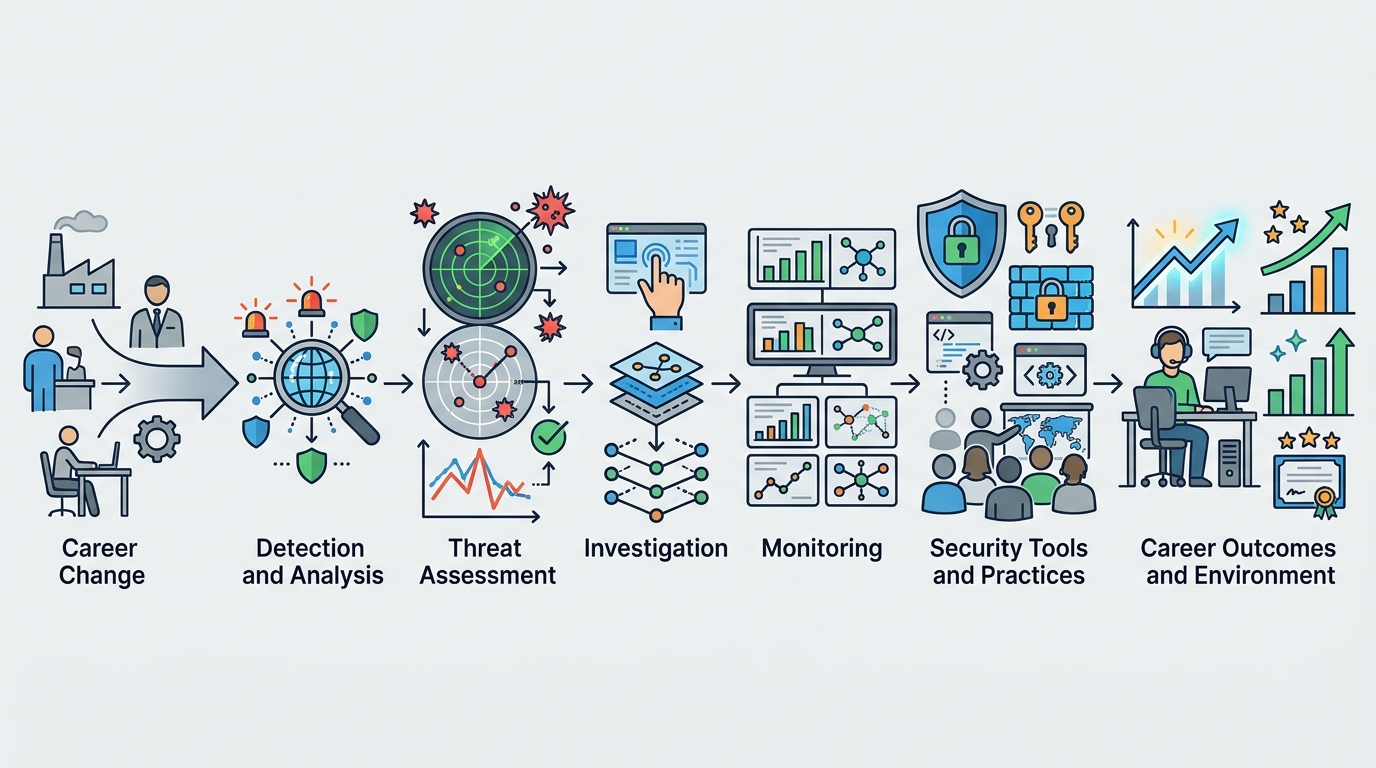
For many people already working, cybersecurity analysis is a realistic second career rather than a reinvention: the job rewards pattern-spotting, documentation and calm escalation. The U.S. Bureau of Labor Statistics (2025) lists a bachelor's degree as the typical entry-level education for information security analysts and notes that work experience in a related occupation is usually needed — but also records that some workers enter the occupation without a bachelor's degree.
Plan on roughly 12 to 24 months from your first course to your first paid security role if you already work in IT, and nearer two to three years coming from outside technology. The trade-off is usually a temporary step down in title and pay while you cross over.
What the Work Actually Involves
A day in a security operations or internal security team starts with the queue. Expect 1-2 hours triaging alerts that fired overnight: phishing reports forwarded by staff, impossible-travel logins, endpoint detections. Most are noise. Your job is to decide quickly which three or four are not, and to write down why you closed the rest.
Another 2-3 hours usually goes to deeper work on one or two items — pulling logs, checking whether a flagged file actually executed, confirming whether an account needs resetting, drafting the escalation note a manager will act on. O*NET OnLine (U.S. Department of Labor) lists monitoring current reports of computer viruses to determine when to update virus protection systems among the occupation's tasks; in practice that is 30-60 minutes a day reading vendor advisories and deciding what, if anything, must change today.
The rest of the week is less dramatic and often more valuable. O*NET also lists developing plans to safeguard computer files, and encrypting data transmissions and erecting firewalls to conceal confidential information. In calendar terms: a 45-minute change-advisory meeting, a half-day writing an access-control or backup procedure, an hour chasing a system owner about an unpatched server, and a recurring block for vulnerability scan review. Add an on-call rotation at many employers, commonly one week in four or one in six, varying by employer, sector and country.
If you imagine constant live intrusions, recalibrate. It is closer to clinical triage plus technical writing, punctuated by occasional genuinely bad days.
Who This Career Change Suits
- Help desk and desktop support technicians — you already read logs, reset credentials and talk frightened users down. The analyst queue is the same reflex aimed at threats rather than printers.
- Network or systems administrators — you know what normal traffic and normal account behaviour look like, the hardest thing to teach a new analyst.
- Financial auditors and compliance officers — evidence, control testing and sampling map straight onto security audit and governance work; ISACA's CISA sits in that lane.
- Police officers, military signals staff and investigators — chain of custody and the discipline of recording what you observed rather than what you assume.
- Nurses and paramedics — triage under time pressure, protocol adherence, and handover notes another person must act on at 3am.
- Insurance claims handlers and fraud investigators — pattern recognition across many small cases, plus the nerve to reject the ones that do not hold up.
- Secondary school teachers and corporate trainers — awareness programmes, phishing simulations and policy rollouts are mostly persuasion, and are a common first foothold.
- Anyone whose current job is mostly meetings and who misses producing something concrete — be honest, because the job swaps meetings for an alert queue, not for solitude.
Transferable Skills That Carry Over
| Prior Career | Skill | How It Applies Here |
|---|---|---|
| Help desk technician | Ticket triage and user questioning | Phishing and malware reports arrive as tickets; the first questions you ask are nearly identical |
| Financial auditor | Control testing and evidence documentation | Access reviews and audit readiness; the direct route toward ISACA's CISA, which requires five or more years of information systems auditing, control or security experience (ISACA) |
| Registered nurse | Clinical triage and structured handover | Ranking alert severity and writing escalation notes the next shift can act on without redoing your work |
| Police officer or investigator | Evidence handling and incident reporting | Preserving logs and artefacts during an incident, and producing a timeline that survives scrutiny |
| Network administrator | Traffic, DNS and firewall knowledge | Spotting anomalous connections and implementing the firewall and encryption controls O*NET OnLine (U.S. Department of Labor) lists among the occupation's tasks |
| Project coordinator | Stakeholder chasing and dependency tracking | Vulnerability remediation is largely persuading system owners to patch to a deadline |
| Teacher or trainer | Explaining risk to non-experts | Awareness programmes, policy briefings and the summary your manager has to take upstairs |
How to Get Started
- Read the official occupational profile for your country before you spend money. In the US, the Occupational Outlook Handbook entry for information security analysts (U.S. Bureau of Labor Statistics, 2025) gives median pay, typical entry-level education, projected employment growth to 2035 and projected annual openings. Elsewhere use the national statistics body — ONS in the UK, Statistics Canada, the ABS in Australia.
- Take one entry-level certification with no experience gate. ISC2's Certified in Cybersecurity (CC) has no work experience requirement; candidates must be at least 16 and agree to the ISC2 Code of Ethics (ISC2). ISC2 publishes the exam's item count, duration and passing score, the fee for standard ISC2 regions, and an annual maintenance fee once certified.
- Follow it with CompTIA Security+, the credential most often named in entry-level adverts. The exam uses multiple-choice and performance-based questions with a published time limit, length and passing score (IT Career Finder); check the current price for your own region rather than assuming the US figure (Coursera, 2025).
- Build a home lab and keep a written log. Stand up a virtual machine, a free log collector or SIEM, and generate your own alerts. Three to six months of weekly entries, with screenshots and conclusions, is the evidence that answers the hands-on question at interview.
- Move internally before you move externally. Volunteer for access reviews, phishing simulations or business continuity testing in your current employer's IT, risk or audit function — this builds exactly the related-occupation experience the U.S. Bureau of Labor Statistics (2025) says is typically needed.
- Target the realistic first title — SOC analyst tier 1, IT support with security duties, GRC analyst, security awareness coordinator — and build each application around one incident you handled in your current job.
- Plan the clock for later credentials. ISACA allows candidates who pass the CISA exam a window to apply for certification before meeting the five-year experience requirement, so passing early while you accumulate years is a legitimate strategy.
Costs and Time Commitment
Figures below are planning ranges, not quotes. Exam fees change and differ by country and region — check ISC2, CompTIA and ISACA's own current pricing before budgeting.
| Item | Typical Cost | Typical Time |
|---|---|---|
| ISC2 Certified in Cybersecurity (CC) | Exam fee as published by ISC2 for standard regions, plus an annual maintenance fee once certified (ISC2) | 4-8 weeks of part-time study |
| CompTIA Security+ | Exam voucher at CompTIA's published price for your region, plus study materials (Coursera, 2025) | 8-14 weeks of part-time study |
| Home lab | Low — a reused laptop and free tooling cover most of it | 3-6 hours a week for 3-6 months |
| Optional bootcamp or part-time degree | Far more than self-study; weigh it against the note that some workers enter without a bachelor's degree (U.S. Bureau of Labor Statistics, 2025) | 3-12 months part-time |
| Income gap after a sideways move to a junior role | Reduced earnings rather than none | 3-9 months before pay returns to your previous level; longer from a senior non-technical role |
| Total transition, IT-adjacent start | Certification fees plus study time | 12-24 months to first paid security role |
| Total transition, non-technical start | Certification fees plus a likely intermediate IT role | 2-3 years |
| CISA, later stage | ISACA exam and certification fees | Exam first, then five or more years of qualifying experience (ISACA) |
Frequently asked questions
Am I too old to start at 50?
Age bias in technology hiring is real and lands hardest on candidates aged 45-60, who are often read as expensive or technically stale. The structural counterweight is that ISC2 sets no work experience requirement for Certified in Cybersecurity and only a minimum age of 16 (ISC2), so the entry credential is open at any career stage, while the related-occupation experience the U.S. Bureau of Labor Statistics (2025) says is typically needed favours someone with two decades of audit, operations or support behind them. Lead with a six-month lab log and recent certification dates so technical currency is not the open question.
Do I need a degree to become a cybersecurity analyst?
The U.S. Bureau of Labor Statistics (2025) lists a bachelor's degree as the typical entry-level education for information security analysts, but also states that some workers enter the occupation without one. O*NET OnLine (U.S. Department of Labor) places the role in Job Zone 4, considerable preparation needed, where most occupations require a four-year degree and some do not. If you already hold a degree in any subject, two certifications plus a lab portfolio usually close the gap faster than a second degree.
How much will I earn, and how much pay will I lose first?
Look up the current median for information security analysts in the Occupational Outlook Handbook (U.S. Bureau of Labor Statistics, 2025), or the ONS, Statistics Canada or ABS equivalent where you live, rather than relying on recruiter claims. Pay is usually a base salary plus an on-call allowance where a rotation exists, commonly one week in four or one in six. The realistic cost of entry is 3-9 months at a junior title earning less than you do now.
Is the job market actually growing?
The U.S. Bureau of Labor Statistics (2025) publishes the number of information security analyst jobs, a projected growth rate for 2025-35 and a projected number of annual openings — check all three, because openings matter more than percentage growth when you are applying. Growth is uneven: regulated sectors such as finance and healthcare hire more analysts. The same source notes analysts may advance to chief security officer or computer and information systems manager, so the ceiling sits well above the first role.
Which certification should I pay for first if I can only afford one?
Choose by what you already do. With five or more years in audit, risk or controls, ISACA's CISA is the closest match, and ISACA gives candidates a window to apply for certification after passing the exam while completing the experience requirement. Starting cold, take ISC2's Certified in Cybersecurity first because it has no experience prerequisite, then add CompTIA Security+ within about six months.
Sources
- U.S. Bureau of Labor Statistics — Information Security Analysts : Occupational Outlook Handbook (2025)
- O*NET OnLine (U.S. Department of Labor) — 15-1212.00 - Information Security Analysts

Written by
Marisol steers Jobladderhq's coverage of hiring trends and the strange rituals of modern recruiting. She's drawn to the gap between what job ads promise and what the work actually feels like. Her editing hand favors clarity over jargon, always.