Physical Therapist vs. Physical Therapist Assistant: Which Career Path Is Right for You?
One route takes a doctoral degree and writes the plan of care; the other takes an associate degree and carries that plan out with patients.
Quick answer
- Education gap: physical therapists enter with a Doctor of Physical Therapy degree (U.S. Bureau of Labor Statistics), while physical therapist assistants enter with an associate's degree from an accredited PTA program.
- Authority gap: the therapist performs the initial evaluation and writes the plan of care; the assistant delivers treatment within that plan and documents the patient's response.
- Pay gap: O*NET OnLine publishes a median wage for physical therapists (2025) that sits above the median annual wage the Bureau of Labor Statistics publishes for physical therapist assistants (May 2025) — check both pages for current figures.
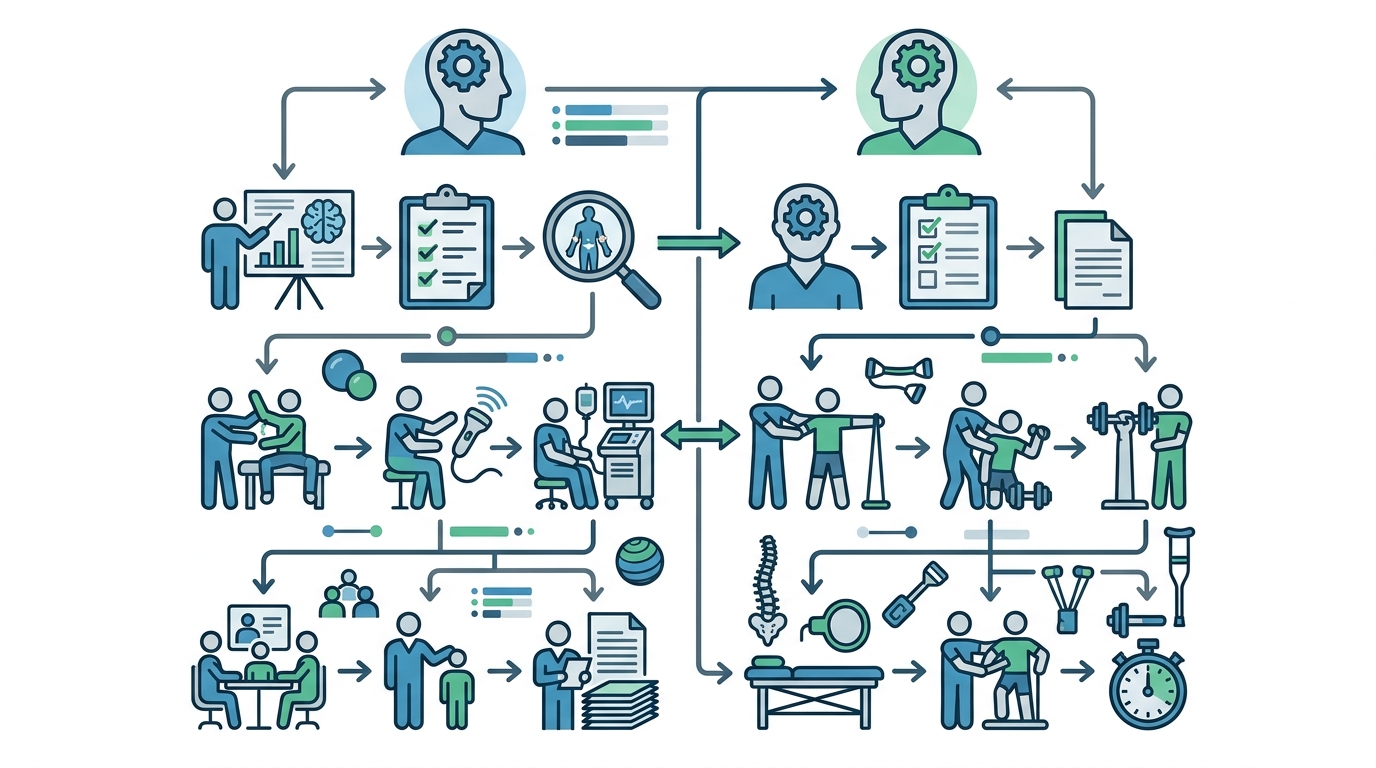
A physical therapist evaluates patients, diagnoses movement problems and writes the plan of care. A physical therapist assistant works under a therapist's direction to deliver that plan — the exercises, the gait training, the hands-on treatment — and reports back on progress.
The gap between them is mostly education and authority: the U.S. Bureau of Labor Statistics lists a doctoral or professional degree as the entry-level education for physical therapists, and an associate's degree for physical therapist assistants. Both must be licensed, and both sit on their feet all day.
Side-by-Side Comparison
The titles and data below are the U.S. ones — the Bureau of Labor Statistics Occupational Outlook Handbook and O*NET OnLine. If you are outside the United States, equivalent roles exist under different titles, different regulators and different pay data, so use your own national statistics agency instead.
| Category | Physical Therapist (PT) | Physical Therapist Assistant (PTA) |
|---|---|---|
| Median pay | ONET OnLine publishes a median wage for physical therapists (ONET OnLine, 2025). Pay is normally an annual salary in hospitals and outpatient clinics, and sometimes per-visit in home health. | The Bureau of Labor Statistics publishes a median annual wage specifically for physical therapist assistants (U.S. Bureau of Labor Statistics, May 2025), plus a combined median for the assistants-and-aides group (2025). Pay is usually hourly, or per-visit in home health. |
| Typical entry-level education | Doctoral or professional degree — a Doctor of Physical Therapy — as listed in the Bureau of Labor Statistics Similar Occupations table (2025); O*NET classifies the job as Job Zone 5, the band needing extensive preparation. | Associate's degree from an accredited physical therapist assistant program (U.S. Bureau of Labor Statistics). |
| Licence and exam | A state licence is required to practise; licensure includes passing the National Physical Therapy Examination (American Physical Therapy Association), administered by the Federation of State Boards of Physical Therapy. | Licensed or certified in all states (U.S. Bureau of Labor Statistics); licensure includes the PTA version of the National Physical Therapy Examination, also administered by the Federation of State Boards of Physical Therapy. |
| Physical demands | Hands-on and mostly standing: O*NET's task list includes treating patients directly and guiding them through exercise, so the work involves kneeling, crouching and supporting people as they move. | The Bureau of Labor Statistics describes the work as physically demanding — on your feet much of the day, stooping, kneeling and lifting or moving patients. |
| Schedule type | Varies by setting: outpatient clinics commonly offer early and evening appointment slots, and inpatient rehabilitation units cover weekends, so full-time hours are not always nine-to-five. | The Bureau of Labor Statistics notes that assistants and aides often work evenings and weekends to fit patients' schedules. |
| Growth outlook | The Bureau of Labor Statistics publishes a separate employment projection for physical therapists in the Occupational Outlook Handbook — read the figure there rather than borrowing the assistants' number. | The Bureau of Labor Statistics publishes a projected employment growth figure for physical therapist assistants and aides for 2025–2035, alongside the number of jobs held in that group (2025). |
Figures are revised each year. Look up the current numbers on the Occupational Outlook Handbook page for each occupation and the matching O*NET OnLine profile, and check your state licensing board for its own requirements, which differ from state to state.
Day-to-Day Differences
Picture the first hour of a shift in an outpatient clinic.
The physical therapist opens the schedule and takes the new referral first. That means an initial evaluation: reviewing the referral and medical history, testing range of motion, strength, balance and gait, identifying the movement problem behind the pain, then setting measurable goals and writing the plan of care in the clinic's electronic record. O*NET lists this evaluation-and-planning work among the core tasks of the role. The therapist also decides what gets delegated and to whom.
The physical therapist assistant starts somewhere else entirely: reading the plan of care the therapist already wrote, setting up the treatment area and taking the first patient through it. The Bureau of Labor Statistics describes assistants as working under the direction of a physical therapist to deliver treatment — supervising exercise sets, guiding gait training with a gait belt or parallel bars, applying hands-on techniques, and recording how the patient responded so the therapist can adjust the plan.
The entry-level and experienced versions differ too. A newly licensed therapist usually treats a lighter caseload with mentoring before taking on complex or post-surgical cases and supervising assistants. A new assistant follows the written plan closely; an experienced one handles harder patients, adapts the session within the parameters the therapist set, and shows aides how to prepare equipment and move patients safely.
Which Career Is Right for You
- Choose physical therapist assistant if you want the shortest accredited route into licensed clinical work — the Bureau of Labor Statistics lists an associate's degree as the typical entry-level education, against a doctoral or professional degree for therapists.
- Choose physical therapist if you want to be the one performing the initial evaluation and writing the plan of care, rather than delivering a plan someone else wrote.
- Choose physical therapist assistant if tuition cost and time out of the workforce are your binding constraints, and you would rather be earning while deciding whether to pursue a Doctor of Physical Therapy later.
- Choose physical therapist if you want to supervise assistants and aides, carry clinical responsibility for complex or post-surgical cases, or move into clinic management.
- Choose physical therapist assistant if you prefer treatment minutes over documentation and evaluation time, and you can handle the physical load the Bureau of Labor Statistics describes — standing most of the day, stooping, kneeling and lifting patients.
- Choose physical therapist assistant if evening and weekend availability suits you; the Bureau of Labor Statistics notes assistants and aides often work those hours to fit patients' schedules.
Frequently asked questions
Which pays more starting out?
Physical therapists. O*NET OnLine publishes a median wage for physical therapists (2025) that sits above the median annual wage the Bureau of Labor Statistics publishes for physical therapist assistants (May 2025). The trade-off is the entry requirement: a doctoral or professional degree for therapists versus an associate's degree for assistants, so assistants typically start earning several years earlier and with less tuition. Check both current figures on the Occupational Outlook Handbook and O*NET pages before you commit.
Can I work as a PTA first and convert to PT later?
There is no automatic upgrade. The Bureau of Labor Statistics states that physical therapists must earn a Doctor of Physical Therapy degree and be licensed, which means completing a full doctoral program and passing the physical therapist version of the National Physical Therapy Examination. Some PTA coursework may count toward prerequisites, but that is decided by the individual program, so ask admissions offices directly.
Do both jobs need a licence, and is it the same exam?
Both need one. The Bureau of Labor Statistics says physical therapists must be licensed and that physical therapist assistants are licensed or certified in all states. The American Physical Therapy Association identifies the National Physical Therapy Examination as the licensure exam, and the Federation of State Boards of Physical Therapy administers separate PT and PTA versions of it. State boards add their own requirements on top, so check the board where you intend to practise.
How does a physical therapist aide fit into this?
It is a third, distinct role. The Bureau of Labor Statistics lists a high school diploma or equivalent as the typical entry-level education for physical therapist aides, with no licensure requirement, and publishes a separate median annual wage for aides (May 2025) below the assistants' median. Aides prepare treatment areas, move equipment and handle clerical tasks rather than delivering treatment; the Bureau's page also names the single largest employer setting for aides if you want to know where most of those jobs sit.
Sources
- U.S. Bureau of Labor Statistics — Physical Therapist Assistants and Aides : Occupational Outlook Handbook (2025)
- O*NET OnLine — 29-1123.00 - Physical Therapists (2025)

Written by
Wyatt covers work outside the office: construction, logistics, repair, and the people who keep things running. He's skeptical of career advice that assumes everyone sits at a desk.