Receptionist Interview Questions: What to Expect and How to Prepare
From switchboard scenarios to typing-speed questions, here is what front desk hiring panels actually ask, and how to shape answers that hold up.
Quick answer
- Rehearse an upset-visitor story out loud: Indeed's employer guidance lists 'tell me about a situation where you needed to manage an upset individual at the reception desk' as a standard receptionist question (Indeed Employer Resources, 2026).
- Measure your typing speed and accuracy on a free online typing test in the week before the interview, because employers ask for the number directly (Indeed Employer Resources, 2026).
- Prepare a downtime answer naming filing documents, preparing memos and sorting mail, which is what employer guidance expects to hear (Indeed Employer Resources, 2026).
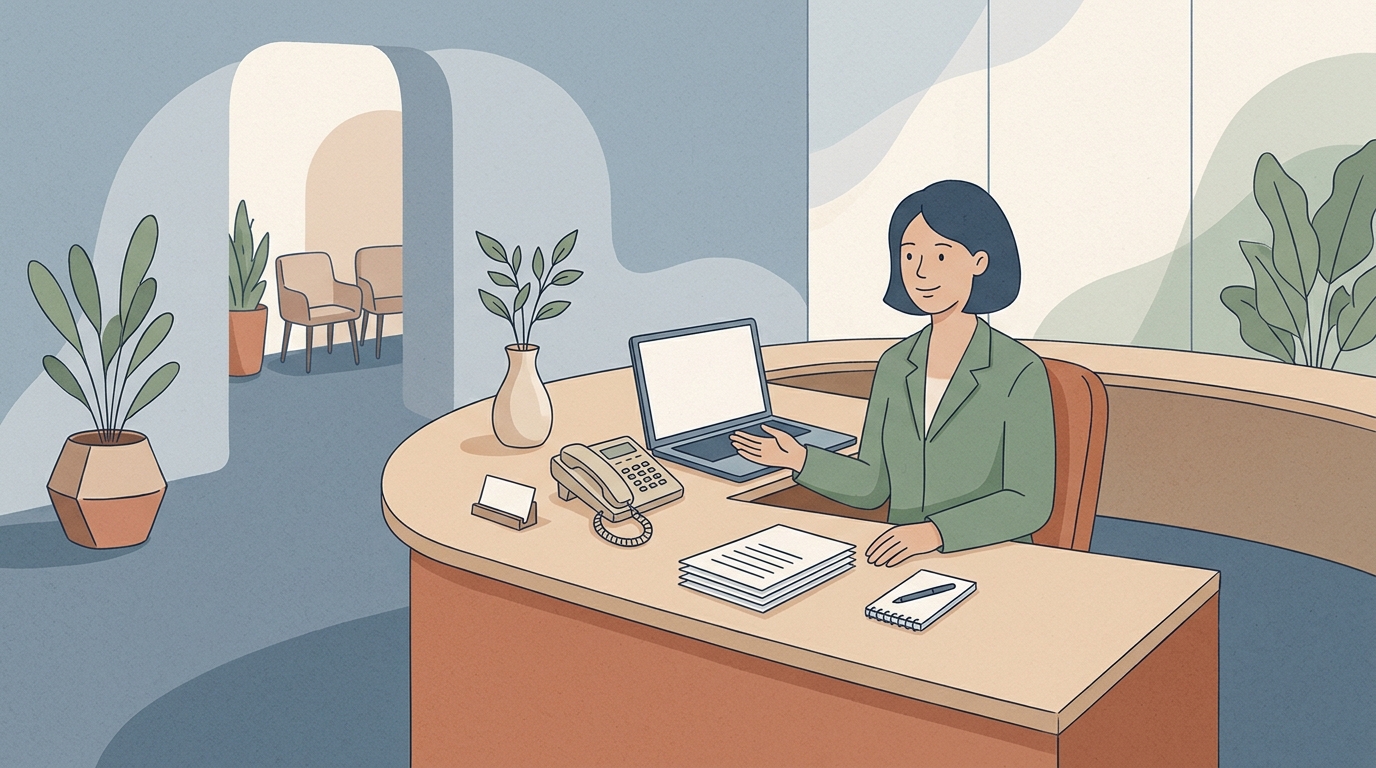
A receptionist interview tests three things: how you sound to a stranger, how you handle two demands at once, and whether you turn up on time. Expect scenario questions about upset visitors and ringing phones, direct questions about software and typing, and sometimes a short practical test at the desk itself.
This guide covers the usual format, eight questions with worked sample answers, and the answer patterns that get candidates ruled out.
What This Interview Usually Covers
Receptionist hiring usually starts with a short phone screen, which doubles as a test of your telephone manner, and moves to an interview with the office manager, practice manager or HR coordinator, often with someone from the team you would support sitting in.
Practical testing is common. You may be asked to type a short passage, enter a booking into the scheduling system, or role-play a call transfer. Expect a direct question about your years of typing experience and your typing speed (Indeed Employer Resources, 2026).
Questions map closely to the published tasks for the occupation. ONET lists operating a telephone switchboard to answer, screen or forward calls, provide information, take messages or schedule appointments, and greeting people entering the establishment, determining the nature of their visit and directing or escorting them (ONET OnLine, U.S. Department of Labor, 2026-10-06). Prepare an example for each.
Content is tailored to the setting. Workable notes that a receptionist for a hotel has different responsibilities from one at a doctor's office, so questions should match the exact work environment (Workable, 2024-10-03). A medical front desk will probe confidentiality; a corporate lobby will probe visitor screening and sign-in.
Panel make-up varies by employer, sector and country. A sample guide for Aboriginal Community Controlled Health Services instructs panels to ensure at least one Aboriginal panel member is present and to use yarning-style, conversational questioning where appropriate (AH&MRC of NSW, undated).
Common Questions and Sample Answers
Tell me about a situation where you needed to manage an upset individual at the reception desk
This is a standard employer question for the role (Indeed Employer Resources, 2026).
Sample answer
A client arrived for an appointment that had been cancelled by an email he never received, and he raised his voice in a full waiting area. My job was to settle the room and still get him seen. I moved him to a quieter seat, apologised for the email failure without blaming a colleague, pulled his record up in the practice booking system, and offered a slot that had just opened that morning. He took it and stayed. Afterwards I flagged the bounced email to the practice manager, and we added a confirmation phone call to every cancellation.
How would you handle a phone ringing while you are helping someone at the desk?
Sample answer
Our desk took a steady run of calls through the lunch rush, often while a courier stood waiting for a signature. I needed the visitor and the caller both to feel attended to. I would say to the visitor, "May I take this? It will be very quick," answer, then either take a message on the pad or offer to let the caller hold while I finished the sign-in. Every caller got a name and a callback time. At my review, my manager noted that no visitor had complained about being interrupted at the desk.
How do you prioritise tasks when everything seems urgent?
Sample answer
Our front desk dropped to a single person while my colleague was on leave. I had to keep reception running alone. I worked to a fixed order, the same one a Teal sample answer sets out: the person standing in front of me first, then ringing phones, then everything else by deadline (Teal, undated). Email and filing moved into set blocks mid-morning and mid-afternoon, tracked on a Monday.com board. Nothing was missed across the cover period and the courier log stayed current, so my manager reused the system the next time someone was away.
How many years have you spent typing, and what is your typing speed?
Sample answer
I have typed for work since my first admin role, most recently taking phone messages straight into the booking system while the caller was still speaking. Accuracy mattered more than raw speed, because a mistyped mobile number means a missed appointment. I retested myself on a free online typing test this week, so I can give you my words per minute and my accuracy rate today. I also read every phone number back to the caller before ending the call, and the practice manager logged no wrong-number callbacks from my messages last year.
What do you do during slow periods?
Sample answer
January afternoons at our office were quiet. I was asked to keep the desk covered but not idle. I used those hours for filing documents, preparing memos and sorting mail, which are the examples Indeed's employer guidance gives for productive downtime (Indeed Employer Resources, 2026), and I rebuilt the visitor badge log into a single Excel sheet. Finding a past visitor's details went from hunting through folders to one search, and the office manager asked me to do the same for the meeting room log.
What safety and security measures did you follow at your previous company?
Workable lists this as a core receptionist question (Workable, 2024-10-03).
Sample answer
Our building shared a lobby with several other tenants, so tailgating was a real risk. I was responsible for sign-in and badge control. Every visitor signed the log, showed photo ID, received a dated badge and was escorted or announced to their host, never sent upstairs alone. I also ran the fire roll-call from the sign-in sheet. At the annual drill we accounted for everyone on site before the warden called it, and he kept my sign-in format for the following year.
How do you handle a busy front desk with multiple phone calls and visitors?
Sample answer
Mondays brought deliveries, walk-ins and the weekend voicemail backlog at once. I had to keep the queue moving without losing bookings. I kept Microsoft Outlook and the scheduling app open side by side so I could see room availability in real time, used a message pad for anything that needed a colleague, and cleared voicemail before the doors opened. Waiting time at the desk stayed short even on the busiest Monday that quarter, and no appointment was double-booked.
What hours can you work, and can you be here on time to open?
Sample answer
My previous role opened the office ahead of the staff start time, and I was the keyholder, so running late meant locked-out colleagues. I built a buffer into my commute and saved a backup bus route on my phone. Across that whole period I opened late only on the morning of a rail line closure, and I phoned the duty manager early so she could unlock. I can cover the opening shift in your advert, and I am available for late cover with a week's notice.
Mistakes That Cost Candidates the Job
- Describing an upset visitor as "difficult" or "rude" and ending the story there, with no de-escalation step and no outcome. Workable warns interviewers to beware of candidates who lack patience, because the receptionist sets the first impression of a company (Workable, 2024-10-03).
- Answering "I'd ask my manager" to every scenario question, which reads as an inability to make a quick judgement call at the desk.
- Saying you do not know your typing speed when asked, instead of giving a recently tested figure and your accuracy rate.
- Answering the downtime question with "I'd find something to do" rather than naming filing, memos, mail sorting or a log you would rebuild.
- Giving a generic answer about "people skills" when the employer works in a specific setting: a hotel desk and a doctor's desk need different answers (Workable, 2024-10-03).
- Talking over the interviewer or trailing off mid-sentence. Poor communication and weak multitasking are the traits employers are explicitly told to screen out (Workable, 2024-10-03).
- Being vague about your availability, or discovering in the room that you cannot make the opening time the advert states.
- Naming confidential details about a former employer's clients, which tells a medical or legal reception panel exactly what you would do with theirs.
Frequently asked questions
What should I wear to a receptionist interview?
Match the front desk you would be sitting at, one notch smarter: collared shirt or blouse, plain trousers or skirt, closed shoes. If the advert mentions a uniform, ask when you confirm the appointment what the current uniform is and dress to that standard.
Do I need qualifications or a certificate?
Usually not a degree. In the O*NET education survey for U.S. receptionists and information clerks, 49% of respondents said a high school diploma or equivalent is required, 26% some college with no degree and 21% a post-secondary certificate (O*NET OnLine, U.S. Department of Labor, 2026-10-06). UK guidance says most employers prefer GCSE English and maths plus good IT skills (Online Learning College, citing the National Careers Service).
Will a Certified Professional Receptionist qualification help?
Treat it as a bonus, not an entry ticket. One job description template lists Certified Professional Receptionist or Certified Administrative Professional as preferred rather than required (x0pa, undated), and a skills guide states the role needs no specific education or training, though requirements vary per company (Vizito, undated).
How do I answer the salary question?
Ask for their budgeted range first, then give yours. Reception pay is usually hourly, sometimes salaried, with shift or weekend loading in hotels and healthcare. Check current rates for your own country before the interview using the national statistics body, such as O*NET or BLS in the US, ONS in the UK, ABS in Australia or Statistics Canada, alongside live adverts for your city and sector.
How soon should I follow up?
Email the same day or the next morning: thank the interviewer, name one thing from the conversation, and restate your availability for the opening shift. If you have heard nothing by the date they gave you, phone reception the next working day and ask for an update. Handled well, that call is a live demo of your phone manner.
Sources
- O*NET OnLine (U.S. Department of Labor) — 43-4171.00 - Receptionists and Information Clerks (2026-10-06)
- Indeed (Employer Resources) — 8 Receptionist Interview Questions [Updated 2026] (2026)

Written by
Marisol steers Jobladderhq's coverage of hiring trends and the strange rituals of modern recruiting. She's drawn to the gap between what job ads promise and what the work actually feels like. Her editing hand favors clarity over jargon, always.