Respiratory Therapist vs. Registered Nurse: Which Career Change Is Right for You
Two hospital careers with different credential ladders, exam loads and physical demands — here is how they line up for a mid-career switch.
Quick answer
- Physical demand: registered nursing is the role the U.S. Bureau of Labor Statistics (2025) explicitly flags for back injuries from lifting and moving patients, on top of constant walking, bending and standing.
- Exam load: respiratory therapy asks for more sittings — the CRT exam first, then an additional exam for RRT (BLS, 2025) — against one qualifying licensure exam for nursing.
- Breadth vs. focus: nursing wins on range of settings and specialties; respiratory therapy wins if you would rather go deep on one body system and own the ventilators.
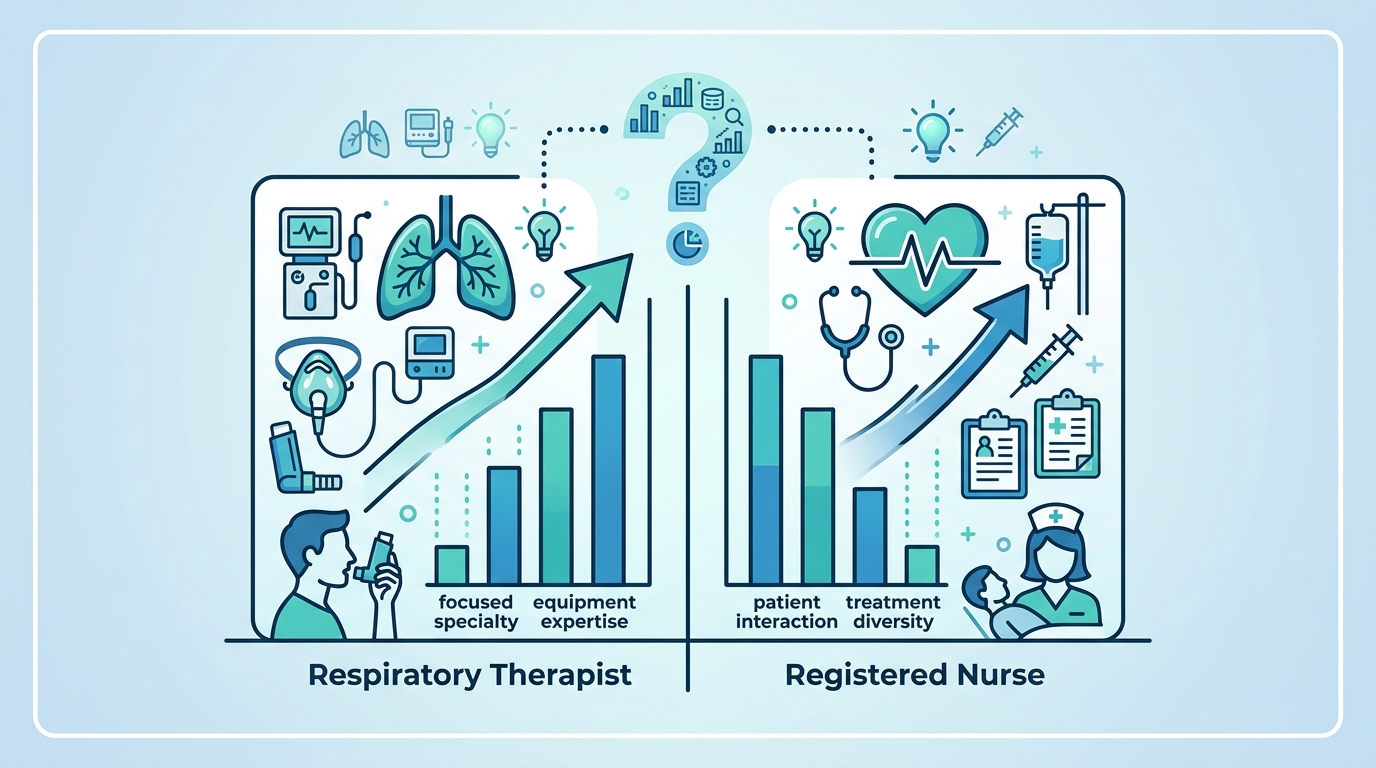
Respiratory therapy and registered nursing both put you in direct patient care, usually in a hospital, usually on shifts. Respiratory therapy is the narrower cardiopulmonary role with a two-step credential — Certified Respiratory Therapist (CRT), then Registered Respiratory Therapist (RRT); registered nursing is the broader role with three education routes and far more settings to move into later (U.S. Bureau of Labor Statistics, 2025).
For most career changers, either switch is a two-to-four-year project from first prerequisite course to first licensed shift, and it costs tuition before it pays anything.
Side-by-Side Comparison
Pay and employment figures below come from the U.S. Bureau of Labor Statistics (2025), which publishes a median annual wage, employment level, projected growth and projected annual openings for each occupation. Look both up in the Occupational Outlook Handbook before you commit. Outside the United States, check your own national statistics agency and health regulator — respiratory care is not a separately licensed profession everywhere.
| Dimension | Respiratory Therapist | Registered Nurse |
|---|---|---|
| Entry education and time | A college respiratory care program; see the entry-level education listed by BLS (2025) | Three routes (BLS, 2025): a BSN, typically 4 years; an ADN/ASN; or a hospital-based diploma, typically 2 to 3 years |
| Licence and exams | Licensure required in most states (BLS, 2025); CRT exam first, then an additional exam for RRT | State-issued licence requiring graduation from an approved nursing program and a passing score on a qualifying exam (BLS, 2025) |
| Median pay | Median annual wage published by BLS (2025) — check the Handbook entry | Median annual wage published by BLS (2025) — check the Handbook entry and compare the two |
| Outlook | Projected 2025–35 growth and annual openings published by BLS (2025) | Same measures published by BLS (2025); nursing is by far the larger occupation by job count |
| Schedule | Shifts including nights, weekends and holidays (BLS, 2025) | Round-the-clock shifts, nights, weekends, holidays and on-call (BLS, 2025) |
| Physical demands | Long periods on your feet, moving between units with equipment (BLS, 2025) | Walking, bending, stretching, standing; vulnerable to back injuries from lifting patients (BLS, 2025) |
| Typical career-changer starting age | Late 20s to late 40s, with students admitted in their 50s | Late 20s to late 40s, plus a visible 50-plus cohort from aide and allied-health roles |
| Realistic total transition | About 2 to 3 years including prerequisites and credential exams | About 2 to 4 years, depending on the route |
What Each Job Looks Like Day to Day
A respiratory therapist works a caseload defined by one system: breathing and the heart–lung relationship. You interview and examine patients with breathing or cardiopulmonary disorders, consult with physicians on treatment plans, and perform diagnostic tests such as measuring lung capacity (U.S. Bureau of Labor Statistics, 2025). Across a shift you might set up and adjust a ventilator in intensive care, give a nebulised treatment in the emergency department, record how a patient is progressing, and teach someone being discharged to use their equipment at home. Hospitals employ the largest share of respiratory therapists (BLS, 2025), and you move between units rather than staying with one group of patients.
A registered nurse carries a group of patients and coordinates everything that happens to them. You assess conditions, record medical histories and symptoms, administer medicines and treatments, contribute to care plans, operate and monitor medical equipment, and consult with doctors and other healthcare professionals (U.S. Bureau of Labor Statistics, 2025). A shift might mean a full medication round, admitting a new patient, escalating a deteriorating one, and teaching a family to manage an illness after discharge. Hospitals employ the largest share of registered nurses too (BLS, 2025), but the licence also opens clinics, home health, schools and public health if shift work stops working for you.
Which Fits Your Background
- Paramedic or EMT: you already manage airways under time pressure. Respiratory therapy turns that into a licensed specialty, and the CRT-then-RRT ladder (BLS, 2025) is a familiar exam-based progression.
- Certified nursing assistant or home health aide: hands-on care, mobility work and documentation map directly onto registered nursing, and bedside hours often satisfy program entry expectations.
- Elementary or secondary teacher: explaining one thing five ways to anxious people is the core of the registered nurse's duty to teach patients and families how to manage an illness or injury (BLS, 2025).
- Biomedical equipment technician or HVAC tradesperson: if gas flow, pressure and calibration are familiar, respiratory therapy's equipment-heavy work sits closer to you than nursing's medication-centred day.
- Retail or restaurant manager: triaging competing demands and handing over cleanly is charge-nurse work; registered nursing gives that experience somewhere to go.
- Returning after a caregiving gap: if you need a defined finish line, the hospital-based nursing diploma route takes typically 2 to 3 years against 4 for a BSN (BLS, 2025), and respiratory therapy's single program plus exams is comparably compact.
How to Decide and Test the Waters
- Shadow both on the same unit. Ask a hospital's volunteer services or education department about observation shifts. A day with a respiratory therapist and a day with a registered nurse on a medical-surgical floor shows you who is lifting patients, who is running between floors, and whose job you envy.
- Trial the schedule before you enrol. Both roles run round-the-clock shift coverage, and hospital nursing adds on-call (BLS, 2025). Work a few overnight or weekend shifts and watch what it does to your sleep and household.
- Take one prerequisite part-time. Anatomy and physiology gatekeeps both paths. One evening or online course tests your study stamina for a fraction of full tuition, and the credit usually counts toward either program.
- Get a cheap entry credential and work in a hospital now. Basic Life Support (CPR) certification plus a nursing assistant credential puts you on a unit within months, paid, alongside both professions.
- Call the program and the state board in the same week. Ask what old college credits transfer, and ask the board exactly what it requires — licensure is state-issued for registered nurses and required in most states for respiratory therapists (BLS, 2025), and rules differ across state lines.
- Price the gap before you resign. Budget for 18 to 24 months of reduced income if you drop to part-time hours, plus tuition, uniforms, background checks and exam fees — two sittings if you pursue CRT then RRT (BLS, 2025). Confirm current amounts with the school and the credentialing body.
Frequently asked questions
Which one gets me working sooner?
Usually respiratory therapy: one college program plus credential exams, with most career changers landing near the 2-to-3-year mark including prerequisites. Registered nursing runs about 2 to 4 years depending on route — a hospital-based diploma typically 2 to 3 years, a BSN typically 4 (U.S. Bureau of Labor Statistics, 2025). The tradeoff is exams: respiratory therapy typically means two sittings, CRT then RRT, against one qualifying licensure exam for nursing.
I'm 52. Is it too late to start either one?
The 45-to-60 group hits two real obstacles: clinical placements that assume daytime availability, and paying tuition close to retirement. Both are survivable — a 2-to-4-year transition still leaves 10 or more working years, and both occupations have projected annual openings through 2035 (BLS, 2025), largely replacement need. After 50, respiratory therapy is often the kinder bet physically: nursing is the role the BLS (2025) flags for back injuries from lifting and moving patients.
Can I switch from one to the other later?
Not without redoing the academic side. Neither the CRT/RRT credentials nor a registered nurse licence substitutes for the other's approved program, so expect to repeat 2 to 4 years of schooling and sit a different exam (BLS, 2025). Some general-education and science prerequisites carry across, which can shave a term. Decide properly now rather than treating one as a stepping stone.
Sources
- U.S. Bureau of Labor Statistics — Respiratory Therapists : Occupational Outlook Handbook (2025)
- U.S. Bureau of Labor Statistics — Registered Nurses : Occupational Outlook Handbook (2025)

Written by
Priya tracks wages, layoffs, and the slow shifts in what counts as a stable job. She writes for readers trying to make sense of numbers that rarely match their own experience.