Server Pay: Average Salary, Range, and What Affects It
How restaurant service pay is built from a direct wage plus tips, which official figures to look up, and the shifts and venues that change your total.
Quick answer
- The U.S. Bureau of Labor Statistics published a median hourly wage for waiters and waitresses for May 2025, plus an annual quick-facts equivalent (U.S. Bureau of Labor Statistics, 2025) — look up both before you judge an offer.
- BLS also publishes the 10th and 90th percentile hourly figures for May 2025; the gap between them is the realistic entry-level-to-experienced spread, driven mainly by venue type, check average and hours rather than years alone (U.S. Bureau of Labor Statistics, 2025).
- BLS states that its wage data for this occupation include tips, and that tipped employees receive at least the federal minimum wage as a combination of direct wages and tips depending on the state (U.S. Bureau of Labor Statistics, 2025).
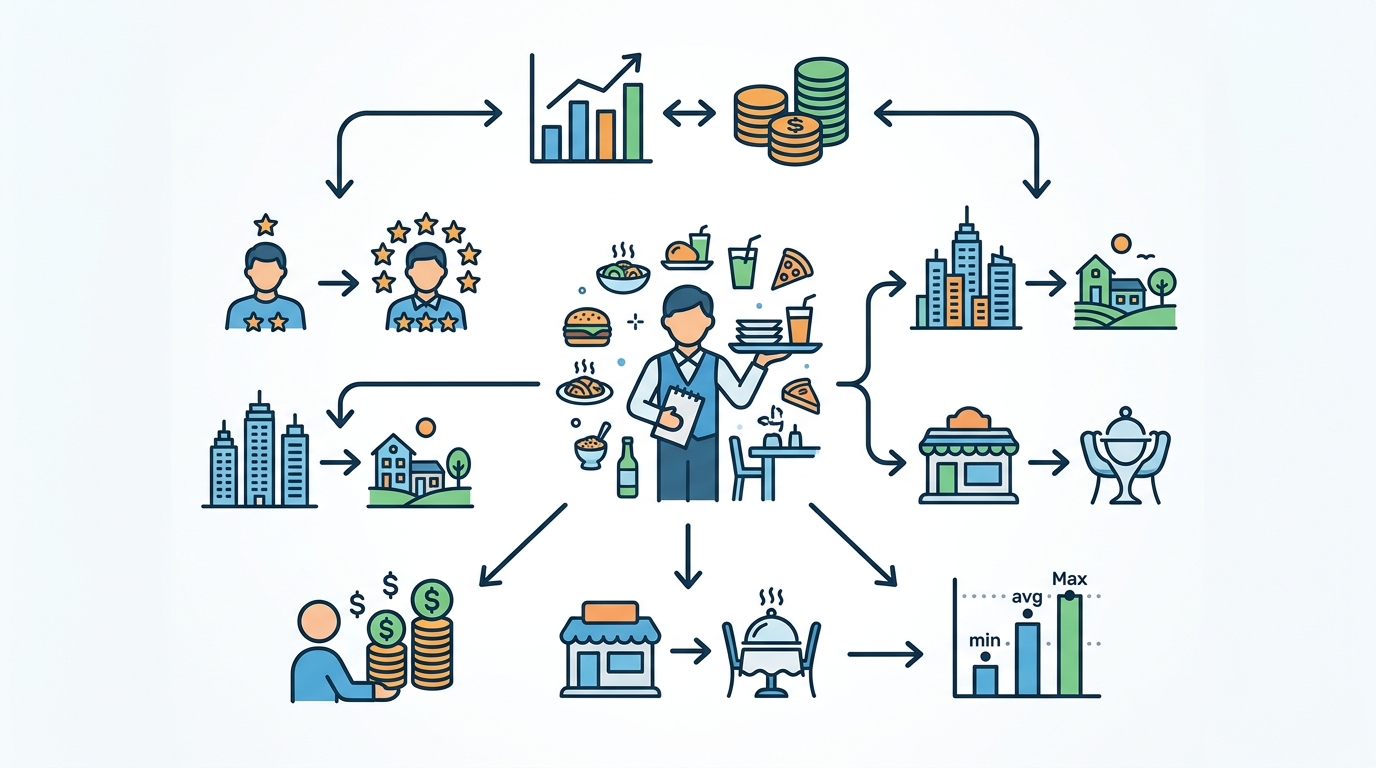
Server pay has two parts: a direct hourly wage from the employer and tips from guests. In the United States, the headline benchmark is the median hourly wage for waiters and waitresses published by the U.S. Bureau of Labor Statistics for May 2025, which the agency says already includes tips (U.S. Bureau of Labor Statistics, 2025) — so it sits closer to total earnings than to base pay.
This guide tells you which published tables to open, what each one measures, and which factors move your own number. Outside the United States, do the same with your national statistics office, since tipping law differs by country and by state.
What This Job Pays
The reference figure for servers in the United States is the median hourly wage for waiters and waitresses, published for May 2025 by the U.S. Bureau of Labor Statistics (U.S. Bureau of Labor Statistics, 2025). The same Occupational Outlook Handbook page shows an annual quick-facts pay figure beside the hourly median (U.S. Bureau of Labor Statistics, 2025), so you can read the hourly and annualised versions of the same data together. Open that page yourself rather than trusting a figure quoted second-hand — it is updated on a yearly cycle.
Median means the midpoint: half of waiters and waitresses earned more, half less. It is not an average, and it is not what a new hire should expect on a first shift. For the spread, BLS publishes the hourly amount the lowest-earning 10 percent earned less than, and the amount the highest-earning 10 percent earned more than, both for May 2025 (U.S. Bureau of Labor Statistics, 2025). Those two numbers bracket almost the whole occupation.
The caveat is what sits inside the number. BLS states that its wage data for this occupation include tips, and that tipped employees earn at least the federal minimum wage as a combination of direct wages and tips, depending on the state (U.S. Bureau of Labor Statistics, 2025). The direct hourly wage on your offer letter can be a fraction of the published median in states that allow a tip credit, and equal to the full state minimum in states that do not. Ask any employer for both halves: the direct wage per hour, and a realistic tip range for the shifts you would actually work.
Two other sources are worth cross-checking. ONET OnLine, sponsored by the U.S. Department of Labor, publishes a median wage for the Waiters and Waitresses occupation under SOC code 35-3031.00 with national employment totals (ONET OnLine, 2025). Data USA, drawing on U.S. Census Bureau American Community Survey responses, publishes an average salary for the "waiters & waitresses" occupation and the size of that workforce (Data USA, 2024). Expect these to differ from the BLS median: one is a median and one an average, reference years differ, and survey-based annual earnings depend on how many weeks and hours people actually worked. Much serving is part-time or seasonal, which pulls annual figures below what a full-time schedule would produce at the same hourly rate.
Salary by Experience and Location
No published table splits server pay by years of experience, so use the percentile and industry breakdowns as proxies: new servers in casual venues cluster near the bottom decile, long-tenured servers in high-check venues near the top. The table shows which figure to pull for each stage and setting.
| What you want to know | Figure to look up | Source and year |
|---|---|---|
| Entry-level / first server job | 10th percentile hourly wage | U.S. Bureau of Labor Statistics, May 2025 |
| Mid-career / typical full-time server | Median hourly wage, plus the annual quick-facts equivalent | U.S. Bureau of Labor Statistics, May 2025 |
| Experienced / fine dining, high-volume sections | 90th percentile hourly wage | U.S. Bureau of Labor Statistics, May 2025 |
| Cross-check on the midpoint | Median wage for SOC 35-3031.00 | O*NET OnLine, 2025 |
| Annual earnings including part-time and seasonal work | Average salary for waiters & waitresses | Data USA, 2024 |
| Hotel and resort dining rooms | Median hourly wage in traveler accommodation | U.S. Bureau of Labor Statistics, 2025 |
| Restaurants, cafes and bars | Median hourly wage in food services and drinking places | U.S. Bureau of Labor Statistics, 2025 |
| Stadiums, casinos, theatres, attractions | Median hourly wage in arts, entertainment, and recreation | U.S. Bureau of Labor Statistics, 2025 |
For geography, use the state and metropolitan-area tables in the BLS Occupational Employment and Wage Statistics (OEWS) release for SOC 35-3031. Pull the row for your own state — New York, Texas and California each have their own published median and percentile figures, and state differences are large because tipped-wage law is set at state level, not federally. Some states require the full state minimum wage before tips; others permit a tip credit, so the direct wage is lower and more of your earnings come from guests. Read your state labour department's current tipped minimum wage page alongside the OEWS figure. Outside the United States, repeat the exercise with your national statistics office, since in several countries a service charge is built into the bill and tipping is marginal.
What Affects Pay in This Field
- Industry and venue type. BLS publishes separate medians for waiters and waitresses in traveler accommodation, in food services and drinking places, and in arts, entertainment, and recreation (U.S. Bureau of Labor Statistics, 2025). Compare the three and you will see the setting moves the midpoint before any question of skill arises.
- Check average. Tips are usually a percentage of the bill, so if your tip percentage holds steady, a venue with twice the check average produces roughly twice the tip income from the same number of covers. It is the biggest lever most servers can pull.
- State tipped-wage rules. BLS notes that tipped employees earn at least the federal minimum wage as a combination of direct wages and tips, depending on the state (U.S. Bureau of Labor Statistics, 2025). In tip-credit states your direct wage is lower and slow shifts hurt more; where the full minimum is required before tips, your floor is higher.
- Shift and section. Dinner, weekend and holiday shifts carry higher check averages and more turns than weekday lunch, and section assignment changes covers per shift.
- Hours and schedule stability. The hourly median annualises to the BLS quick-facts annual figure only at full-time hours (U.S. Bureau of Labor Statistics, 2025); part-time and seasonal work is part of why the survey-based average salary reported by Data USA shows a different picture (Data USA, 2024).
- Tip pooling and tip-outs. Many venues share tips with bussers, runners, bartenders and hosts as a set percentage of your sales or tips. Get the exact percentages in writing — they come straight off your take-home.
- Alcohol service and upselling. Beverage knowledge raises the check average on the same table count, and where state law requires responsible-service certification, holding it widens the venues that can roster you.
- Unionisation and benefits. Hotel and large-venue food service is more often covered by collective agreements than independent restaurants, which can set direct wage rates, overtime, scheduling protections and health coverage by contract. Ask whether the role is covered and request the wage schedule.
How This Job's Pay Compares
The cleanest comparison is within the occupation, because BLS publishes the median hourly wage for waiters and waitresses separately for traveler accommodation, for food services and drinking places, and for arts, entertainment, and recreation (U.S. Bureau of Labor Statistics, 2025). Put those three beside the overall median and you can see how much of the gap between two server jobs is the setting rather than the person.
For titles people confuse with serving — bartender, host or hostess, food preparation and serving worker, food service manager — BLS keeps a separate Occupational Outlook Handbook profile for each with its own May 2025 median. Compare like with like, checking in each case whether the agency notes that tips are included, since that decides whether you are comparing total earnings or base pay.
On demand, BLS projects employment change for waiters and waitresses over 2025–35, for food and beverage serving workers overall, and for all occupations as a benchmark on the same page (U.S. Bureau of Labor Statistics, 2025). ONET describes projected 2025–2035 growth for the occupation as "slower than average" and publishes a projected number of openings for the decade (ONET OnLine, 2025). Slow growth with a large opening count is typical of a big, high-turnover occupation: ONET also reports the national employment total (ONET OnLine, 2025) and Data USA reports the workforce size from Census survey data (Data USA, 2024). Vacancies are common, but raising your pay comes from moving to a higher-check venue or into a lead, bartender or management role.
Frequently asked questions
Does the published median for servers include tips?
Yes, for the United States. BLS states that its wage data for waiters and waitresses include tips, and that tipped employees earn at least the federal minimum wage as a combination of direct wages and tips depending on the state (U.S. Bureau of Labor Statistics, 2025). The median is therefore closer to total earnings than to base pay, and the direct hourly wage on your offer may be much lower.
Why do different websites give different average pay for servers?
Because they measure different things. BLS publishes a median hourly wage and an annual equivalent for May 2025 (U.S. Bureau of Labor Statistics, 2025); O*NET publishes a median wage for SOC 35-3031.00 (O*NET OnLine, 2025); Data USA reports an average salary from Census survey responses (Data USA, 2024). Medians differ from averages, reference years differ, and survey-based annual earnings reflect part-time and seasonal schedules.
How much more can an experienced server earn than a beginner?
Use the published percentiles. BLS gives the hourly amount the lowest-earning 10 percent of waiters and waitresses earned less than and the amount the highest-earning 10 percent earned more than, both for May 2025 (U.S. Bureau of Labor Statistics, 2025). That span is driven by venue check average, shift allocation, hours worked and state tipped-wage rules.
Which kind of venue pays servers the most?
Compare the industry medians BLS publishes for waiters and waitresses in traveler accommodation, in food services and drinking places, and in arts, entertainment, and recreation (U.S. Bureau of Labor Statistics, 2025). That ranking reflects typical check averages and shift patterns, so it is a better guide than job-ad wording.
Is server work a growing field?
BLS publishes a projected employment change for waiters and waitresses for 2025–35 alongside figures for food and beverage serving workers overall and for all occupations (U.S. Bureau of Labor Statistics, 2025). O*NET calls the occupation's projected 2025–2035 growth "slower than average" while still projecting a substantial number of openings (O*NET OnLine, 2025), reflecting high turnover in a very large occupation.
What should I ask an employer about pay before accepting a server job?
Ask for the direct hourly wage, the tip-out or tip-pool percentages and who shares in them, average weekly hours, which shifts you would start on, and the venue's typical check average. Then check your state labour department's current tipped minimum wage, since BLS notes the direct wage and tip mix depends on the state (U.S. Bureau of Labor Statistics, 2025).
Sources
- U.S. Bureau of Labor Statistics — Waiters and Waitresses : Occupational Outlook Handbook (2025)
- O*NET OnLine (sponsored by U.S. Department of Labor/Employment and Training Administration) — 35-3031.00 - Waiters and Waitresses (2025)

Written by
Wyatt covers work outside the office: construction, logistics, repair, and the people who keep things running. He's skeptical of career advice that assumes everyone sits at a desk.