Top 20 Warehouse Interview Questions and How to Answer Them
From picking accuracy and forklift safety to shift flexibility, here is how hiring managers phrase warehouse questions and what a strong answer sounds like.
Quick answer
- Prepare one safety story and one accuracy story — a near-miss you reported and a count error you caught — because both come up in almost every warehouse interview.
- Know the equipment vocabulary before you walk in: pallet jack, reach truck, RF scanner, pick list, cycle count, dock door — and which of those you have actually used.
- Give exact shift availability, start times and overtime limits; vague answers about nights and weekends are a common reason candidates are passed over.
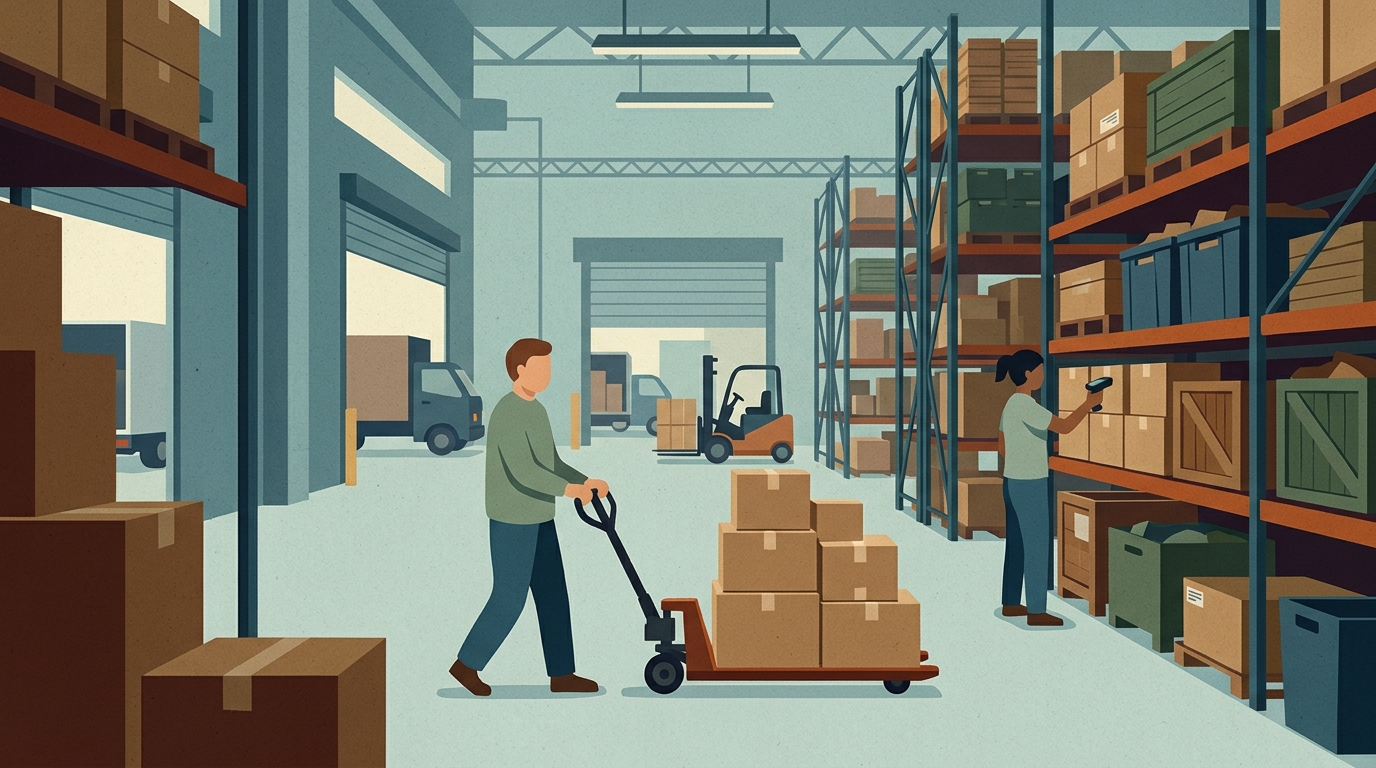
Warehouse interviews are short, practical and weighted toward safety, accuracy and attendance. Hiring managers want evidence that you can read a work order, move stock without damaging it or yourself, and cover the shift pattern they need filled.
This guide covers the format to expect, seven questions with full STAR answers, thirteen more to rehearse, and the answer patterns that quietly screen candidates out.
What This Interview Usually Covers
Most warehouse hiring runs in two or three short stages. A recruiter or agency coordinator screens you by phone for availability, paperwork, transport to site and any equipment tickets you hold. You are then invited on site, often alongside other candidates, for a 15-30 minute conversation with a shift supervisor or operations manager.
Expect part of it to happen on the floor. Supervisors walk you past the pick faces and dock doors and ask what you would do in a given situation. Many sites add a practical element: a safe-lifting demonstration, a short scanner or pick-list exercise, or a competency check on a counterbalance or reach truck.
The questions follow the daily work. Laborers and material movers read work orders or receive oral instructions to determine assignments and equipment needs (ONET OnLine, U.S. Department of Labor, 2025), so you will be asked how you follow instructions and what you do when they are unclear. Protective equipment such as safety shoes, glasses, gloves and hard hats is a documented part of the work context (ONET OnLine, 2025), so safety questions are near-certain.
How many rounds there are, whether fitness or substance screening is included, and when references are checked vary by employer, state and country.
Common Questions and Sample Answers
"Why do you want to work in a warehouse?"
Sample answer
Situation: I spent two years in a retail stockroom and preferred back-of-house to the shop floor. Task: I wanted work where output is measured rather than dictated by footfall. Action: I took a weekend manual handling course, then worked six months of night replenishment to test whether I could hold the pace. Result: I averaged 180 cases an hour on nights with no lost-time incidents, and I want to build on that rather than go back to tills.
"Walk me through how you work from a pick list or work order."
Sample answer
Situation: My last site picked from paper lists in the morning and RF scanners after a system upgrade. Task: I had to switch without losing accuracy. Action: I read the full order first, checked location codes against the aisle map, scanned every barcode instead of eyeballing boxes, and flagged short lines to the team leader before moving on. Result: My accuracy stayed above 99 percent through the four-week transition, and the supervisor used my method in the refresher briefing.
"Tell me about a time you spotted a safety hazard."
Sample answer
Situation: Mid-shift I found a pallet in aisle 12 with a cracked bearer, stacked three high above a walkway. Task: It had to be dealt with before the next forklift pass. Action: I coned off the aisle, radioed the shift supervisor, and we broke the load down and re-palletised it rather than moving it loaded. Result: It took 20 minutes, nothing fell, and the near-miss report added pallet checks to the goods-in routine.
"Describe a time you made a picking or counting error."
Sample answer
Situation: I mispicked a similar-looking SKU on a 40-line pharmacy order. Task: I caught the discrepancy at the end-of-shift check. Action: I stopped the pallet before dispatch, told the team leader immediately, re-picked the line and wrote up the cause — two near-identical packs in adjacent bins. Result: The order shipped on time and the bins were separated and relabelled, which ended a repeat error we had seen three times that quarter.
"Tell me about meeting a tight dispatch deadline."
Sample answer
Situation: Two loaders called in sick on a day with eleven outbound loads and a 4 p.m. trailer cut-off. Task: I covered a second dock alongside my own. Action: I asked the supervisor to re-sequence so the two fullest trailers went first, staged pallets by door an hour ahead, and kept a pallet jack permanently at each door. Result: All eleven loads left by 4:15 p.m. and every delivery window was met.
"What equipment have you operated?"
Sample answer
Situation: My last site ran counterbalance trucks in goods-in and pallet jacks on the pick face. Task: I was trained on counterbalance in my first month. Action: I passed the in-house assessment, ran daily pre-use checks on forks, mast, horn and tyres, and logged two defects that took trucks off the road. Result: Eighteen months of loading and stacking to three-pallet height with no racking strikes, and I am happy to be re-assessed to your standard.
"What shifts can you work?"
Sample answer
Situation: My previous role was a four-on, four-off pattern including nights. Task: I needed reliable transport for 6 a.m. starts. Action: I set up a lift share with two colleagues and kept a bus route as backup for when it fell through. Result: One absence in 14 months. I can work days, nights or weekends here, and I can start at 6 a.m. from week one.
Rehearse these thirteen in the same STAR shape:
- What does good housekeeping look like on a pick face?
- How do you check a load for damage at goods-in?
- What would you do if the scanner showed stock the bin did not have?
- How do you cope with chilled or outdoor temperatures?
- What PPE would you expect to wear here, and when?
- Tell me about a time you trained someone new.
- How do you handle being moved between departments mid-shift?
- What would you do if you saw a colleague lifting unsafely?
- Describe your attendance record over the last year.
- A supervisor pushes you to pick faster. What do you do?
- How do you settle a disagreement with someone on your shift?
- What do you know about what we store and ship here?
- Where do you want to be in two years?
Mistakes That Cost Candidates the Job
- Saying you would "keep an eye on it" when asked about a damaged pallet or a leaking drum, instead of naming the action: cone it off, stop work, report it. Exposure to contaminants is a documented part of this work context (O*NET OnLine, U.S. Department of Labor, 2025), so vague safety answers stand out.
- Claiming you can drive a forklift when you have only ridden on one. Equipment claims are usually checked by a practical assessment, and overstating ends the process on the spot.
- Hedging on availability with "I'm fairly flexible" when the vacancy is specifically nights or weekends. Give the exact hours and days you can commit to.
- Badmouthing a former supervisor or agency when asked why you left. Say what you did, say what you wanted next, stop there.
- Giving no figures. "I was a fast picker" tells a supervisor nothing; "I averaged 130 lines an hour at 99 percent accuracy" is checkable.
- Denying you have ever made an error. Describe the mispick, how you caught it and what changed afterwards.
- Arriving in open-toe shoes or without photo ID when the interview includes a floor walk. Sites with safety-footwear rules will not take you past the barrier.
- Asking only about pay and breaks. Ask about the shift pattern, the training period and how performance is measured first.
Frequently asked questions
What should I wear to a warehouse interview?
Clean trousers, a plain shirt or polo, and closed, flat, sturdy shoes. No suit needed. If the invitation mentions a site tour, call the recruiter and ask whether safety boots and a hi-vis vest are provided or whether you should bring your own.
Will there be a physical or practical test?
Often, yes — a safe-lifting demonstration, a short pick or scanner exercise, or an equipment competency check for machine roles. Ask the recruiter when you confirm the appointment so you arrive dressed for the floor and know whether a fitness screen is included.
How do I answer the salary question?
Give a range, not a single figure. Build it from current job ads for the same shift pattern within commuting distance, plus your national labour statistics agency's published figures for warehouse and material-moving occupations. Pay is usually hourly with shift premiums, so ask how overtime and nights are rated.
Do I need a qualification or licence to apply?
For general warehouse work, usually not. The occupation is classed as needing very little to some preparation, typically a high school diploma or equivalent with a few days to a year of on-the-job training (O*NET OnLine, U.S. Department of Labor, 2025). Machine operation normally needs certification — check with the employer and your local workplace safety regulator.
How should I follow up after the interview?
Email or text the recruiter within 24 hours confirming your availability and interest, then call once if you have heard nothing by the date they gave you. Warehouse hiring moves quickly, especially through agencies, so one prompt check-in is enough.
Sources
- O*NET OnLine (U.S. Department of Labor, Employment and Training Administration) — 53-7062.00 - Laborers and Freight, Stock, and Material Movers, Hand (2025)

Written by
Noor writes personal essays and interviews about career changes, burnout, and starting over. She's interested in the stories people tell themselves about what a job is supposed to mean.