What Does a Firefighter Do? Duties, Skills, and Salary Explained
From 24-hour shift rotations and breathing apparatus drills to medical calls that far outnumber fires, here is the work behind the uniform.
Quick answer
- Shifts are rostered around the clock — commonly 24 hours on with days off, or rotating day and night tours — not standard office hours.
- Most services require firefighter certification to a national standard (for example NFPA 1001 Firefighter I and II in the US and Canada), plus breathing apparatus and hazardous materials training.
- Pay follows a published public-sector scale or union agreement with step increases and shift loadings — check the hiring service's scale or your national statistics agency.
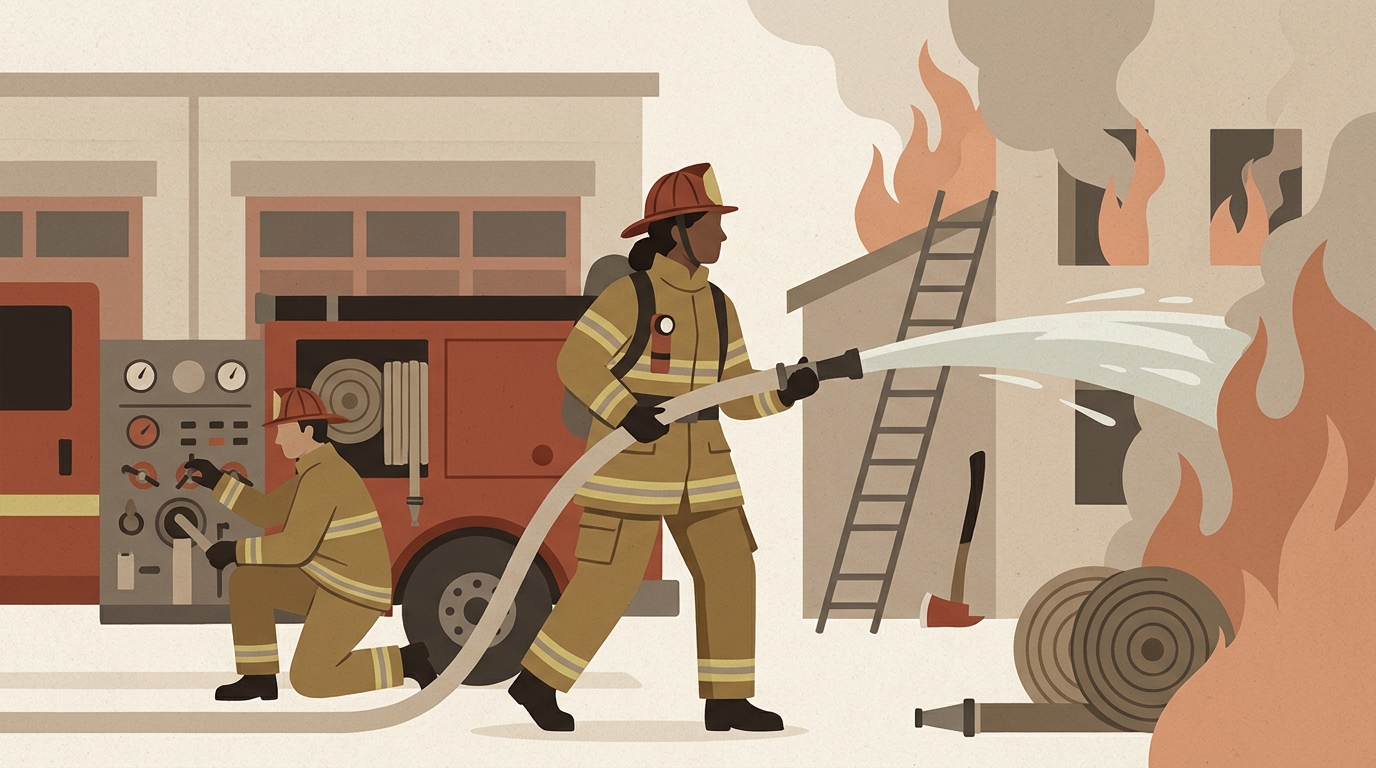
A firefighter responds to fires, road collisions, medical emergencies, hazardous material spills and rescues, and spends much of the rest of the shift training, checking equipment and inspecting buildings. In most countries, medical and rescue calls make up a larger share of the workload than structure fires.
Entry is competitive and physical: recruits usually pass written, physical and medical tests before a paid recruit academy, and many services expect an emergency medical qualification on top of firefighting certification.
What a Firefighter Does
A firefighter's core job is to respond to emergencies, make the scene safe and get people out of danger. That covers far more than fire: cardiac arrests and falls, road collisions needing extrication, flooding, gas leaks, chemical spills, lift rescues and automatic alarm activations.
Most firefighters work for municipal, county or district fire and rescue services. Others crew aircraft rescue and firefighting units at airports, industrial brigades at refineries, chemical plants and power stations, military base fire departments, or wildland agencies covering forests and national parks. Volunteer and on-call firefighters staff much of the rural coverage in many countries.
At an incident, crews work under an officer within an incident command system: laying and charging hose lines, forcing entry, searching smoke-filled rooms on self-contained breathing apparatus, ventilating roofs, operating the pump panel or aerial ladder, and treating patients.
Between calls the job is preparation — testing hose and ladders, servicing breathing apparatus sets, checking appliance inventory, drilling on standard operating procedures, and visiting buildings to update pre-incident plans.
New firefighters work under direct supervision on hose, tools and search tasks. Experienced firefighters drive the appliance, operate the pump or aerial, mentor probationers and act up as crew commander. Wildland firefighters do different work again: hand-line construction, chainsaw and pump work, and long deployments away from home.
A Typical Day
- Takes over from the outgoing shift at roll call, with handover notes on appliance status and any hydrants out of service.
- Checks the appliance: water and fuel levels, breathing apparatus cylinder pressures, defibrillator and oxygen, hydraulic rescue tools, thermal imaging camera and ladder security, logging faults in the station maintenance system.
- Responds to calls dispatched through the computer-aided dispatch system and mobile data terminal, donning turnout gear and riding the assigned seat position.
- At a medical call, assesses the patient, delivers oxygen, CPR or defibrillation as trained, and hands a patient care report to the ambulance crew.
- Runs a scheduled drill — search and rescue in the smoke house, ladder pitching, pump operation or extrication practice on a scrap vehicle.
- Carries out station duties: washing and re-bedding hose, decontaminating used turnout gear, refilling air cylinders and restocking the medical bag.
- Completes a pre-incident planning visit or community safety work, such as fitting smoke alarms or recording access points and risers in a commercial building.
- Finishes training records and a fitness session before handover to the next watch.
Salary and Job Outlook
Firefighter pay is almost always set by a published scale rather than negotiated individually, so you can find the exact figures before you apply. What varies is the service, the country, and whether the role is career, on-call or volunteer.
| Stage | How pay is usually structured | Where to check current figures |
|---|---|---|
| Entry (recruit / probationary) | Fixed recruit rate during academy training, often below the qualified rate, rising on passing probation | The hiring service's recruitment page, which normally publishes the full scale |
| Mid (qualified firefighter) | Step increases tied to years served and completed competency portfolios, plus shift allowances and overtime | National pay agreement or union collective agreement for that service |
| Experienced (senior firefighter, driver/operator, specialist) | Higher step plus payments for driving, breathing apparatus instruction, hazmat or urban search and rescue qualifications | Service pay scale, where specialist allowances are listed separately |
| National median earnings | Published as an occupational average across all employers and experience levels | US: Bureau of Labor Statistics Occupational Employment and Wage Statistics. UK: ONS Annual Survey of Hours and Earnings. Canada: Statistics Canada / Job Bank. Australia: ABS and the relevant state fire service award |
For outlook, use the official projection series for your country — BLS Employment Projections in the US, or national and state labour market outlook data elsewhere. Local hiring depends on budget cycles, retirements and whether the service is career-staffed or on-call.
Skills and Qualifications
Hard skills and credentials you can obtain and prove
- Firefighter certification to a recognised national standard — for example NFPA 1001 Firefighter I and II, certified through IFSAC or Pro Board in the US and Canada, or the trainee programme run by your national or state fire service elsewhere.
- Emergency medical certification: EMT or paramedic certification (NREMT in the US), or the service's own first responder and casualty care qualification.
- Self-contained breathing apparatus competence, including wearer checks and confined space procedures.
- Hazardous materials Awareness and Operations level training.
- A valid driver's licence; many services require or train you towards a heavy vehicle licence for appliance driving.
- A pass in the physical ability test used locally — the CPAT in much of North America, or the national firefighter selection tests in the UK — covering ladder lift, hose drag, equipment carry and casualty evacuation in full kit.
- A medical and eyesight standard, plus a fitness standard usually expressed as a VO2 max or bleep test result.
Soft skills that matter on a crew
- Taking direction instantly under noise, heat and time pressure, and giving clear radio messages.
- Living and working at close quarters with a small crew across long shifts, including sleeping at the station.
- Calm communication with people who are injured, frightened or hostile.
- Judgement about when to back out or call for more resources.
- Willingness to keep retraining: competency and medical recertification continue for your whole career.
How to Get Started
- Check the entry requirements of the specific services you would join. Minimum age (often 18, sometimes 21), education level (usually secondary school completion), driving licence, residency and medical standards vary by service, state and country, so read the current recruitment page.
- Build to the physical standard months before applying. Train specifically for the ladder climb, hose drag and equipment carry, and practise in a weighted vest if you can.
- Get an emergency medical qualification. In the US and Canada an EMT course typically runs a few months part-time; elsewhere, check whether the service trains you in-house or expects it up front.
- Consider volunteer, on-call or cadet service. It gives you real incident experience, certification and a reference from a serving officer.
- Apply in the formal recruitment window and prepare for each stage: written aptitude test, physical ability test, structured interview, medical and background check. Services often open applications only every one to three years, so register for alerts.
- Complete the recruit academy — commonly 12 to 24 weeks, paid — then serve your probationary period on station, finish the competency portfolio, and add qualifications such as driver/operator or rescue technician to open promotion routes.
Frequently asked questions
Do you need a degree to be a firefighter?
No. Most career fire services require secondary school completion or equivalent, not a degree. A degree in fire science, paramedicine or emergency management can help at selection and later for officer promotion, and some services award extra points for it. Entry still rests on the written test, physical ability test, interview and medical.
How many hours do firefighters work?
Rosters vary by service and country. Common patterns are 24 hours on followed by 48 or 72 off, or two day shifts then two night shifts and rest days. You sleep at the station on night tours and are woken by calls, and overtime to cover vacancies or major incidents is routine.
Is being a firefighter stressful?
The specific stressors are disrupted sleep on night shifts, heavy physical work in heat and full protective gear, and repeated exposure to serious injury and death on medical and collision calls. Most services run peer support and occupational health programmes for this reason. The trade-off many firefighters cite is long blocks of time off and a close working crew.
How long does it take to become a firefighter?
Allow roughly one to three years from deciding to becoming operational. Recruitment windows often open only every year or two, selection itself can run several months, and the recruit academy is commonly 12 to 24 weeks. A probationary period of around a year on station usually follows.
What is the difference between a career and a volunteer firefighter?
Career firefighters are employed full time on a published pay scale and roster. Volunteer or on-call firefighters respond from home or work and are typically paid per call, by retainer, or not at all. Operational training standards are often similar, and volunteer service is a common route into a career post.

Written by
Desmond writes about the mechanics of job searching: resumes, interviews, the long silence after applying. He's fascinated by how much of getting hired depends on luck dressed up as skill.