
Data Scientist vs. Data Engineer: Which Career Path Is Right for You?
One role builds models and briefs stakeholders; the other designs and guards the databases underneath — here is how to tell which side suits you.
Quick answer
- The biggest practical difference: data scientists build and test models and present recommendations to stakeholders, while database administrators and architects design, secure, back up and restore the systems that hold the data (U.S. Bureau of Labor Statistics, 2025).
- Both paths typically start with a bachelor's degree (about four years), but data science asks for more upfront schooling: some employers require or prefer a master's or doctoral degree, adding roughly one to six years (U.S. Bureau of Labor Statistics, 2025).
- US national medians run close — $120,230 for data scientists, $104,620 for database administrators and $139,500 for database architects — but openings are not comparable in volume: about 24,800 a year versus about 7,300 under the 2025-2035 projections (U.S. Bureau of Labor Statistics, 2025). State and metro pay varies around these figures.
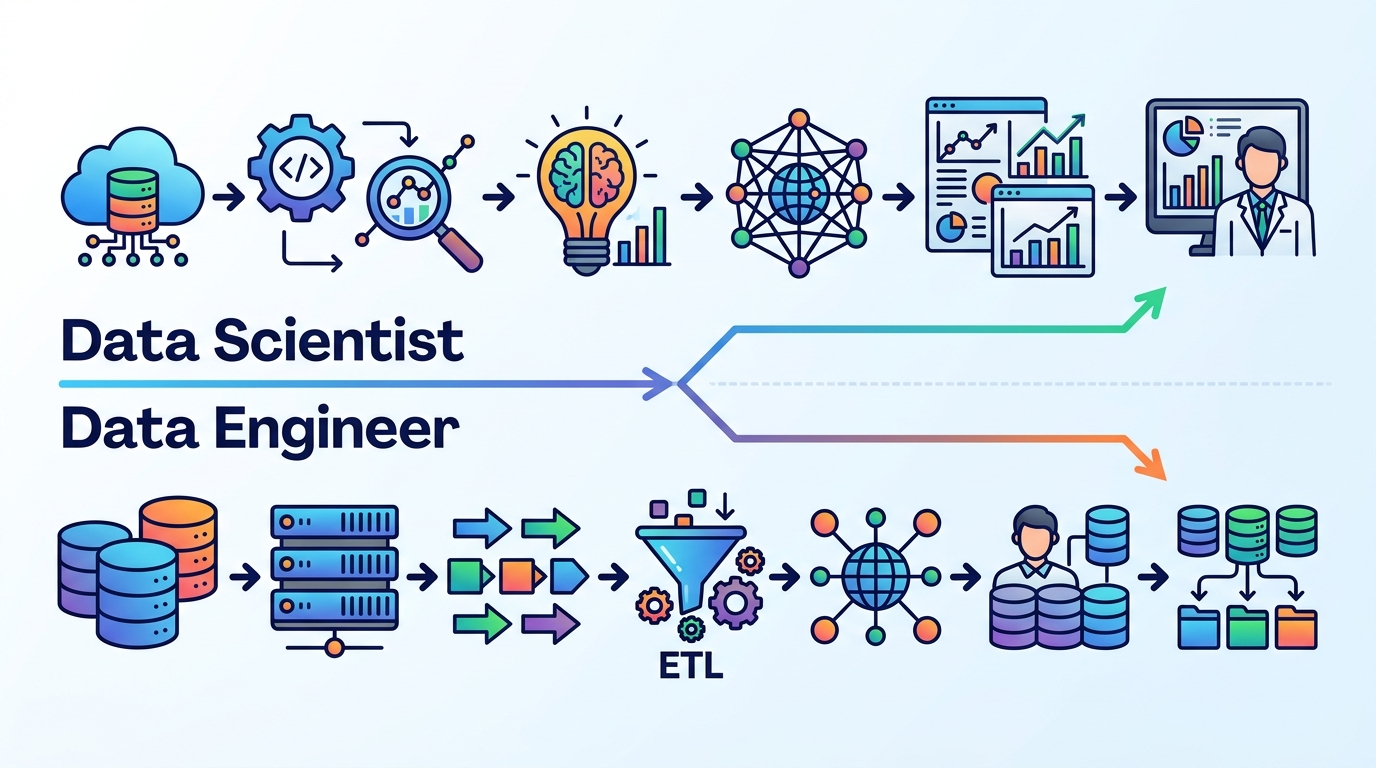
Data scientists find patterns in data and turn them into recommendations; data engineers build and maintain the databases and pipelines those recommendations depend on. In the United States, data science is the larger and faster-growing field — the U.S. Bureau of Labor Statistics (2025) reports a median wage of $120,230 a year for data scientists and projected growth of 35 percent from 2025 to 2035 — while the nearest published category for engineering-side work, database administrators and architects, shows a higher combined median of $126,760 but only 4 percent projected growth over the same period.
Both start from a bachelor's degree, both are mostly office-based, and both involve long stretches of unglamorous work. The question is whether you would rather answer a business question or build the system that makes answering it possible.
Head-to-Head Comparison
A note on job titles before the numbers. "Data engineer" is a common industry title but not a separate category in US federal statistics; the closest published occupation is database administrators and architects, whose listed duties — designing and building new databases, securing organizational data, backing up and restoring data, and maintaining databases and updating permissions (U.S. Bureau of Labor Statistics, 2025) — cover most of what engineering-side data roles do. Treat those figures as the best available proxy, not an exact match.
| Dimension | Data scientist | Data engineer (database administrators and architects) |
|---|---|---|
| Typical entry requirement | Bachelor's degree, about four years full time; some employers require or prefer a master's or doctoral degree, adding roughly one to six more years (U.S. Bureau of Labor Statistics, 2025) | Bachelor's degree in computer and information technology or a related field, about four years full time (U.S. Bureau of Labor Statistics, 2025) |
| Median pay (US national, 2025) | $120,230 per year, or $57.80 per hour (U.S. Bureau of Labor Statistics, 2025) | $126,760 per year combined, or $60.94 per hour; broken out, $104,620 for database administrators and $139,500 for database architects in May 2025 (U.S. Bureau of Labor Statistics, 2025) |
| Physical and schedule demands | Much of the time is spent in an office setting; most work full time (U.S. Bureau of Labor Statistics, 2025). Sedentary, screen-heavy work, with long stretches cleaning raw, unstructured data before any analysis begins | Most work full time (U.S. Bureau of Labor Statistics, 2025). Also sedentary and screen-heavy, with the added pressure that backups, restores and access problems have to be resolved when they happen, not when convenient |
| Five-year outlook | Employment projected to grow 35 percent from 2025 to 2035, much faster than the average for all occupations, with about 24,800 openings projected per year; about 275,600 jobs in 2025 (U.S. Bureau of Labor Statistics, 2025) | Employment projected to grow 4 percent from 2025 to 2035, about as fast as the average for all occupations, with about 7,300 openings projected per year; about 75,000 database administrator jobs and 69,500 database architect jobs in 2025 (U.S. Bureau of Labor Statistics, 2025) |
Two things stand out. First, the pay gap favours the engineering side only if you reach the architect end of it — the administrator median sits below the data scientist median (U.S. Bureau of Labor Statistics, 2025). Second, the growth difference is large and runs in one direction: 35 percent against 4 percent over 2025-2035, with roughly three times as many annual openings on the data science side.
Where you work matters too. The largest employing industries for data scientists include publishing, broadcasting and content providers at 12 percent, and insurance carriers, computer systems design, and management of companies at 10 percent each (U.S. Bureau of Labor Statistics, 2025). For both database administrators and architects, computer systems design and related services is the top employer, at 14 and 23 percent respectively. State and metro pay varies around these national medians; check your own area's current figures before you plan around any number here.
Day-to-Day Differences
Picture the same Tuesday at the same mid-sized company.
The data scientist starts with a question from a business team: which customers are most likely to cancel next quarter. The first job is working out which data are even available and useful (U.S. Bureau of Labor Statistics, 2025) — and then cleaning it. Raw records arrive unstructured, so a large chunk of the morning goes on structuring them into something software can actually read. That cleaning step is routine for this role and it is where a lot of the week disappears.
Afternoon: build a model, test it, re-test it when the first version flags half the customer base as a flight risk. Then open visualization software and turn the output into three charts a non-technical audience will understand. At four o'clock the data scientist sits in front of the marketing and finance leads and recommends a course of action — defending the assumptions, the sample, and what the model cannot tell them. Presenting business recommendations to stakeholders is part of the data scientist's listed duties and is not part of the database administrator or architect job description.
The data engineer's Tuesday starts with an alert instead of a question. Overnight loads failed on one table, so the first task is restoring data from backup and confirming nothing downstream is corrupted. Mid-morning is a permissions review: a new team needs read access, a departing contractor needs theirs removed, and both have to be done without opening a hole in organizational data security.
After lunch the work shifts from administration to design. A new product line needs somewhere to live, so the engineer gathers technical requirements from the application team and sketches the structure that will hold it — tables, keys, relationships, retention rules — then checks whether the existing architecture can absorb it or needs extending. Restoring from backup and administering user permissions are core to this role and are tasks a data scientist never owns. The day ends with monitoring: making sure analysts, including the data scientist upstairs, can reach the databases they need.
The contrast in a sentence: on Tuesday the data scientist had to convince people of something, and the data engineer had to keep something running. If being questioned in a meeting by a sceptical finance lead sounds worse than being paged about a failed restore, that tells you something. If it sounds better, that tells you the opposite.
Both jobs share the same downside, though: this is sedentary, screen-bound work in an office setting, mostly full time (U.S. Bureau of Labor Statistics, 2025), and neither role is mainly spent on the interesting part. Data scientists clean data; engineers patch, permission and monitor.
Who Thrives in Each Path
Data scientist
- You came from a research-heavy degree — economics, psychology, biology, statistics — where you already defended a methodology to people who wanted to poke holes in it. That is the same skill as explaining to a stakeholder why a model's recommendation holds.
- You tolerate ambiguity in the question itself. Determining which data are available and useful (U.S. Bureau of Labor Statistics, 2025) means starting before anyone has defined the problem properly, and some people find that intolerable.
- You are willing to spend more time on schooling. Some employers require or prefer a master's or doctoral degree (U.S. Bureau of Labor Statistics, 2025), so a bachelor's plus one to two more years is a realistic plan rather than an optional extra.
- You would rather your work be judged on whether a recommendation was right than on whether a system stayed up.
Data engineer / database administrator or architect
- You have worked in IT support, sysadmin or network roles and are comfortable being the person who gets called when something breaks. Backing up and restoring data is a listed duty here (U.S. Bureau of Labor Statistics, 2025), and it rarely breaks at a convenient hour.
- You think in structures rather than conclusions. Database architects research technical requirements and design and build new database structures and data architecture (U.S. Bureau of Labor Statistics, 2025) — satisfying if you enjoy getting a schema right, frustrating if you want to know what the data means.
- You are security-minded by temperament. Securing organizational data and managing permissions is ongoing, detailed, and unforgiving of carelessness.
- You can live with a tighter market. Four percent projected growth from 2025 to 2035 and about 7,300 openings a year (U.S. Bureau of Labor Statistics, 2025) means fewer entry points than the data science side, and you may need to be more flexible about location and industry — computer systems design and related services is the top employer for both roles.
Frequently asked questions
Which one pays more?
It depends which engineering-side role you reach. In the United States, data scientists had a 2025 median of $120,230 a year, database administrators $104,620 and database architects $139,500 in May 2025 (U.S. Bureau of Labor Statistics, 2025). Architects out-earn data scientists at the median; administrators do not. These are national figures, and state and metro pay varies around them.
Can I switch from data engineering to data science mid-career?
The common route is adding a master's degree in data science or statistics, typically one to two years full time, since some employers require or prefer a master's or doctoral qualification for data scientists (U.S. Bureau of Labor Statistics, 2025). Many engineers do it part time while staying employed, and volunteer first for modelling and visualization work internally to build a portfolio before applying out.
And going the other way, from data science to engineering?
This move usually needs less formal study, because both occupations list a bachelor's degree as typical entry-level education (U.S. Bureau of Labor Statistics, 2025). The gap is operational: backups and restores, permissions management, and database design. Target a hybrid analytics-engineering post first, take on schema and pipeline ownership there, then apply for architect roles once you have designed a production database end to end.
Do I actually need a master's degree for data science?
Not always. Typical entry-level education is a bachelor's degree, about four years, with some employers requiring or preferring a master's or doctoral degree (U.S. Bureau of Labor Statistics, 2025). Requirements vary by employer and industry, so read current job postings in your target sector before committing one to six more years of study. Research-heavy and regulated employers tend to ask for more.
Is a data engineer the same thing as a database architect?
Not identical, but they overlap heavily. US federal statistics do not publish a separate data engineer occupation, so database architects — who research technical requirements and design and build new database structures and data architecture — and database administrators, who keep users able to access databases and monitor operations (U.S. Bureau of Labor Statistics, 2025), are the closest published equivalents. Job titles vary by employer and country.
Sources
- U.S. Bureau of Labor Statistics — Data Scientists : Occupational Outlook Handbook (2025)
- U.S. Bureau of Labor Statistics — Database Administrators and Architects : Occupational Outlook Handbook (2025)

Written by
Desmond writes about the mechanics of job searching: resumes, interviews, the long silence after applying. He's fascinated by how much of getting hired depends on luck dressed up as skill.