How to Become a Chiropractor: Education, Licensing, and First-Job Steps
A plain walk-through of the undergraduate prerequisites, the four-year doctoral degree, the national board exam series, and the state paperwork that follows.
Quick answer
- Minimum credential: a Doctor of Chiropractic (D.C.) degree plus a state licence, with all four parts of the National Board of Chiropractic Examiners exam passed — all states and the District of Columbia require licensure (U.S. Bureau of Labor Statistics, undated).
- Realistic total: roughly 7 to 9 years (about 84–108 months) from starting undergraduate study to a first associate chiropractor post.
- Real tradeoff: four years of full-time doctoral study with little or no earnings, followed by manual, physically loaded clinical work on your hands, wrists and lower back.
Becoming a chiropractor means earning a Doctor of Chiropractic (D.C.) degree and holding a licence to practise. In the United States, D.C. programs typically take four years and require at least three years of undergraduate college education for admission, and all states plus the District of Columbia require a licence based on an accredited degree and the National Board of Chiropractic Examiners exams (U.S. Bureau of Labor Statistics, undated).
This guide follows the United States route in detail because that is where the requirements are most tightly specified. Licensure procedures are standardised within many countries, including the United States, Canada, England, Australia and New Zealand, though considerable variation remains among countries (National Board of Chiropractic Examiners, undated) — so if you plan to practise elsewhere, check your national regulator's rules before you enrol anywhere.
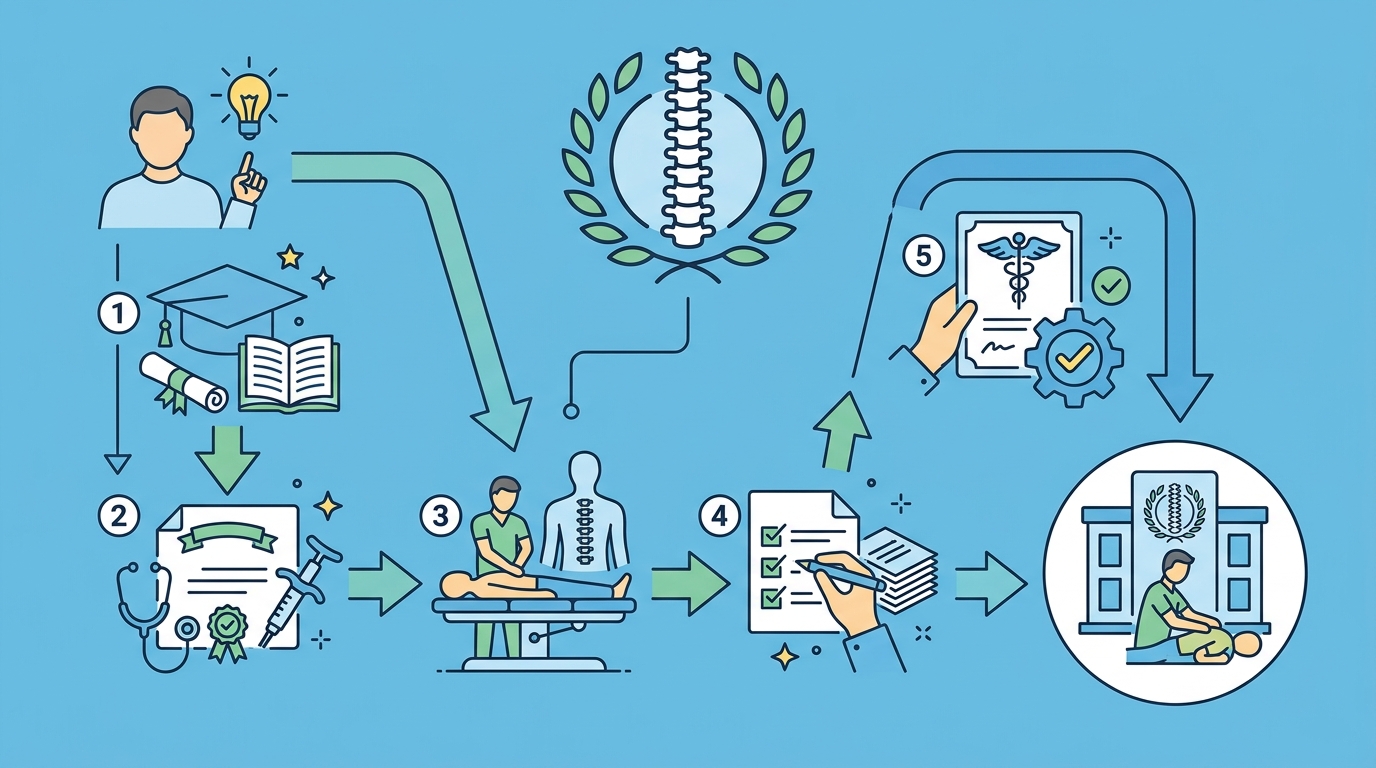
Step-by-Step Path to Entry
- Complete at least 90 semester hours of undergraduate study. Admission to a D.C. program requires at least 90 semester hours of undergraduate education, and some programs require a bachelor's degree for entry (U.S. Bureau of Labor Statistics, undated). That is generally at least three years of college (U.S. Bureau of Labor Statistics, undated). Load those credits with anatomy, biology, general and organic chemistry with labs, physics and psychology, and check the prerequisite list published by each program you are targeting — they differ.
- Check whether the state you want to practise in requires a bachelor's degree. Earning college credit in general studies is the first of four major steps, with a bachelor's degree required in some states (National Board of Chiropractic Examiners, undated). Confirm this with the state chiropractic board before you decide to stop at 90 hours.
- Graduate from a chiropractic college accredited by the Council on Chiropractic Education. The degree normally takes four years of full-time study (U.S. Bureau of Labor Statistics, undated). In 2017 there were 15 Doctor of Chiropractic programs on 18 campuses accredited by the Council on Chiropractic Education (U.S. Bureau of Labor Statistics, 2017), so expect to relocate. The later years include supervised clinical work as a student clinician in the college's teaching clinic.
- Sit the National Board of Chiropractic Examiners exam series. Part I evaluates basic science, Part II clinical sciences, Part III advanced clinical science, and PHT is a physiotherapy examination (National Board of Chiropractic Examiners, undated). The Part IV Practical Exam is developed from a Practice Analysis survey of current practice, covering conditions treated, case history, examination procedures, imaging and referrals (National Board of Chiropractic Examiners, undated). Computer-based exams run 22 weeks of the year at professional testing centres in the U.S. and internationally, plus 11 weekends each year on select chiropractic college campuses (National Board of Chiropractic Examiners, undated). Candidates typically take these before graduating (National Board of Chiropractic Examiners, undated).
- Apply for your state licence. All states and the District of Columbia require completion of an accredited D.C. program and passing all four parts of the NBCE exam (U.S. Bureau of Labor Statistics, undated). Many states also require a background check and a state-specific law exam, called a jurisprudence exam (U.S. Bureau of Labor Statistics, undated). Requirements are set state by state: the Georgia Board of Chiropractic Examiners, for example, requires Parts I, II, III and IV with a passing score of 375 (Georgia Secretary of State, undated).
- Take an associate chiropractor role, or an employed clinician post in a multidisciplinary or sports clinic. Once licensed you may use the titles "Doctor of Chiropractic," "D.C.," or "Chiropractic Physician" (National Board of Chiropractic Examiners, undated). Most new graduates start as an associate in someone else's practice rather than opening their own, because that avoids carrying premises, equipment and marketing costs in year one.
- Maintain and extend the licence. All states require a practising chiropractor to take continuing education classes to maintain a licence (U.S. Bureau of Labor Statistics, undated). Some chiropractors go on to postgraduate programs leading to diplomate credentials in specialty areas such as orthopedics and pediatrics (U.S. Bureau of Labor Statistics, undated).
Education and Certification Options
There is no shortcut around the doctoral degree. The real choices are how much undergraduate study you do first, and what you add after licensure.
| Route | Typical duration | Approximate cost | Required or preferred |
|---|---|---|---|
| Undergraduate study to 90 semester hours (with science prerequisites) | About 3 years full time | Published tuition per credit hour differs by institution and by public/private status — compare the fee schedules of the colleges you are considering | Required minimum for D.C. admission (U.S. Bureau of Labor Statistics, undated) |
| Full bachelor's degree | About 4 years full time | As above; one extra year of tuition and living costs | Required by some D.C. programs and some states (U.S. Bureau of Labor Statistics, undated; National Board of Chiropractic Examiners, undated) |
| Doctor of Chiropractic degree at a Council on Chiropractic Education–accredited college | 4 years full time (U.S. Bureau of Labor Statistics, undated) | Published annually by each college; there were 15 accredited programs on 18 campuses in 2017 (U.S. Bureau of Labor Statistics, 2017), so compare all of them plus relocation costs | Required everywhere in the U.S. |
| NBCE Parts I, II, III, PHT and Part IV | Taken across the D.C. program, usually before graduation (National Board of Chiropractic Examiners, undated) | Fees are set per part by the NBCE — check the current fee schedule before budgeting | Required: all 50 states accept or require NBCE scores (National Board of Chiropractic Examiners, undated) |
| State jurisprudence exam and background check | Weeks, after graduation | State board application and screening fees, published by each board | Required in many states (U.S. Bureau of Labor Statistics, undated) |
| Postgraduate diplomate program (e.g. orthopedics, pediatrics) | Part time over several years alongside practice | Set by the awarding program | Optional; adds specialty training (U.S. Bureau of Labor Statistics, undated) |
| Continuing education | Ongoing, every renewal cycle | Course-by-course | Required in all states to maintain a licence (U.S. Bureau of Labor Statistics, undated) |
On earnings: new graduates are usually paid either a salary, a base plus a percentage of collections, or purely on collections as an independent associate, while practice owners take what is left after rent, equipment, insurance and staff. For current figures, use official national data — the U.S. Bureau of Labor Statistics Occupational Employment and Wage Statistics series in the United States, the Office for National Statistics in the UK, Statistics Canada, or the Australian Bureau of Statistics — and note whether the number you are reading is national or state-level, because local rates differ.
Are You Ready? Readiness Checklist
Work through these before you commit tuition money. Each one is something you can verify this week.
- You have completed, or can realistically complete, at least 90 semester hours of undergraduate credit including the science prerequisites each target program lists (U.S. Bureau of Labor Statistics, undated).
- You have written to the chiropractic board of the state where you intend to practise and confirmed whether a bachelor's degree is required there (National Board of Chiropractic Examiners, undated).
- You have confirmed that every program on your shortlist is accredited by the Council on Chiropractic Education, and you are willing to relocate — there were 15 programs on 18 campuses in 2017 (U.S. Bureau of Labor Statistics, 2017).
- You have a written funding plan for four years of full-time doctoral study with limited earning capacity, based on each college's published tuition rather than an estimate.
- Nothing in your record would fail the background check that many states require (U.S. Bureau of Labor Statistics, undated).
- You can stand for most of a clinical day and apply repeated manual force through your hands, wrists, shoulders and lower back without aggravating an existing injury.
- You are prepared to pass a five-sitting exam series — Parts I, II, III, PHT and the Part IV practical — to a fixed cut score, such as the 375 required by the Georgia Board of Chiropractic Examiners (National Board of Chiropractic Examiners, undated; Georgia Secretary of State, undated).
- You accept that continuing education is mandatory for as long as you hold a licence, and that if you eventually own a practice you will also handle billing, insurance and patient acquisition (U.S. Bureau of Labor Statistics, undated).
Typical Timeline From Start to First Job
Approximate elapsed time from the first day of undergraduate study. Add a year if your target program or state requires a completed bachelor's degree.
- Year 0–3 (months 0–36): Complete at least 90 semester hours of undergraduate credit, including anatomy, biology, chemistry and physics labs, which is the admission minimum for a D.C. program (U.S. Bureau of Labor Statistics, undated).
- Year 3 (months 30–36): Apply to Council on Chiropractic Education–accredited chiropractic colleges; finish a bachelor's degree first if the program or state requires one (National Board of Chiropractic Examiners, undated).
- Year 3–5 (months 36–60): Begin the four-year D.C. program and work through basic and clinical sciences; sit NBCE Part I (basic science) and Part II (clinical sciences) at a testing centre or on a campus administration (National Board of Chiropractic Examiners, undated).
- Year 5–7 (months 60–84): Move into the teaching clinic as a student clinician; sit Part III (advanced clinical science), the PHT physiotherapy exam and the Part IV Practical Exam, which is built from the NBCE's Practice Analysis of current practice (National Board of Chiropractic Examiners, undated).
- Year 7, plus 1–4 months: Graduate, then file the state licence application, clear the background check and pass the state jurisprudence exam where required (U.S. Bureau of Labor Statistics, undated). Processing time depends on the board's schedule.
- Year 7–8 (months 84–96, allow up to 108): Start as an associate chiropractor in an established practice or as an employed clinician in a multidisciplinary clinic, using the title Doctor of Chiropractic (National Board of Chiropractic Examiners, undated).
Frequently asked questions
Can I become a chiropractor without a four-year degree?
In many cases yes. Admission to a Doctor of Chiropractic program requires at least 90 semester hours of undergraduate education — usually about three years — though some programs require a bachelor's degree for entry, and a bachelor's is required in some states (U.S. Bureau of Labor Statistics, undated; National Board of Chiropractic Examiners, undated). Confirm with both the college and the state board first.
What exams do I have to pass?
All states require passing all four parts of the National Board of Chiropractic Examiners exam (U.S. Bureau of Labor Statistics, undated). Part I covers basic science, Part II clinical sciences, Part III advanced clinical science, and PHT is a physiotherapy exam (National Board of Chiropractic Examiners, undated). Many states add a jurisprudence exam on state law and a background check.
When do students usually sit the national board exams?
Candidates typically take NBCE exams before graduating from chiropractic college, and all 50 states either accept or require those scores for licensure (National Board of Chiropractic Examiners, undated). Computer-based testing runs 22 weeks of the year at professional testing centres in the U.S. and internationally, plus 11 weekends each year on select chiropractic college campuses (National Board of Chiropractic Examiners, undated).
Why is there one national board instead of state exams?
The National Board of Chiropractic Examiners is a non-profit national and international testing organisation for the profession, established in 1963 to standardise chiropractic testing requirements rather than leaving each state with its own board (Wikipedia, undated). States still set their own additional requirements, such as jurisprudence exams and background checks (U.S. Bureau of Labor Statistics, undated).
Does the route work the same outside the United States?
Not identically. Licensure procedures are standardised within many countries, including the United States, Canada, England, Australia and New Zealand, but considerable variation remains among countries (National Board of Chiropractic Examiners, undated). Check the registering body in the country where you intend to practise before choosing a program, and ask specifically whether your intended degree is recognised there.
What are the main downsides of the work?
Four years of full-time doctoral study after undergraduate credits means a long stretch with limited income (U.S. Bureau of Labor Statistics, undated). The job itself is manual and repetitive, loading your hands, wrists and back across a full clinical day. Continuing education is mandatory in all states for as long as you practise (U.S. Bureau of Labor Statistics, undated).
Sources
- U.S. Bureau of Labor Statistics — Chiropractors : Occupational Outlook Handbook
- National Board of Chiropractic Examiners — Becoming a Chiropractor - National Board of Chiropractic Examiners

Written by
Priya tracks wages, layoffs, and the slow shifts in what counts as a stable job. She writes for readers trying to make sense of numbers that rarely match their own experience.