How to Become a Physical Therapist
A doctorate, a national exam and a state board file stand between you and your first caseload — here is the order to tackle them and what each stage takes.
Quick answer
- The fastest route in the United States is a bachelor's degree with anatomy, chemistry and physics prerequisites, followed by a three-year DPT program (U.S. Bureau of Labor Statistics, 2025) — about seven years of full-time study in total.
- Licensure is mandatory, not optional: all states require physical therapists to be licensed, including passing a qualifying exam, and some states also require a law exam and a criminal background check (U.S. Bureau of Labor Statistics, 2025).
- A clinical residency after graduation is optional, typically lasts about one year, and gives extra training in a specialty area; board-certified specialist status is a separate, later step requiring an exam and clinical work in that specialty (U.S. Bureau of Labor Statistics, 2025).
Becoming a physical therapist means earning a Doctor of Physical Therapy (DPT) degree and then getting licensed: in the United States, entry-level education is a doctoral or professional degree and every state requires a licence that includes passing a qualifying exam (U.S. Bureau of Labor Statistics, 2025). No prior work experience in a related occupation and no on-the-job training are required for entry, so the degree and the licence do the gatekeeping (U.S. Bureau of Labor Statistics, 2025).
From the first year of an undergraduate degree, expect roughly seven years before you treat patients independently: about four years of bachelor's study plus prerequisites, then a DPT that typically lasts three years (U.S. Bureau of Labor Statistics, 2025). Outside the United States the role is often called physiotherapist and the qualifying degree and regulator differ, so check your own country's health professions regulator before following the steps below.
What This Job Involves Day to Day
A physical therapist's day is built around a caseload of scheduled patients, most of them seen repeatedly over weeks of treatment.
- Reviewing and assessing. You read each patient's medical history and the referral or notes from doctors, surgeons or other healthcare workers, then diagnose functional and movement problems by watching the person stand, walk or move and listening to their concerns (U.S. Bureau of Labor Statistics, 2025).
- Building and running plans of care. You develop an individualised plan with specific outcomes, then deliver it using exercises, stretching, hands-on therapy and equipment to ease pain and improve mobility (U.S. Bureau of Labor Statistics, 2025).
- Recording progress and adjusting. You evaluate and document how each patient is progressing and modify the plan when it is not working (U.S. Bureau of Labor Statistics, 2025). Documentation is a real part of the day, not an afterthought.
- Teaching patients and families. You explain the recovery process and what the person needs to do between appointments (U.S. Bureau of Labor Statistics, 2025).
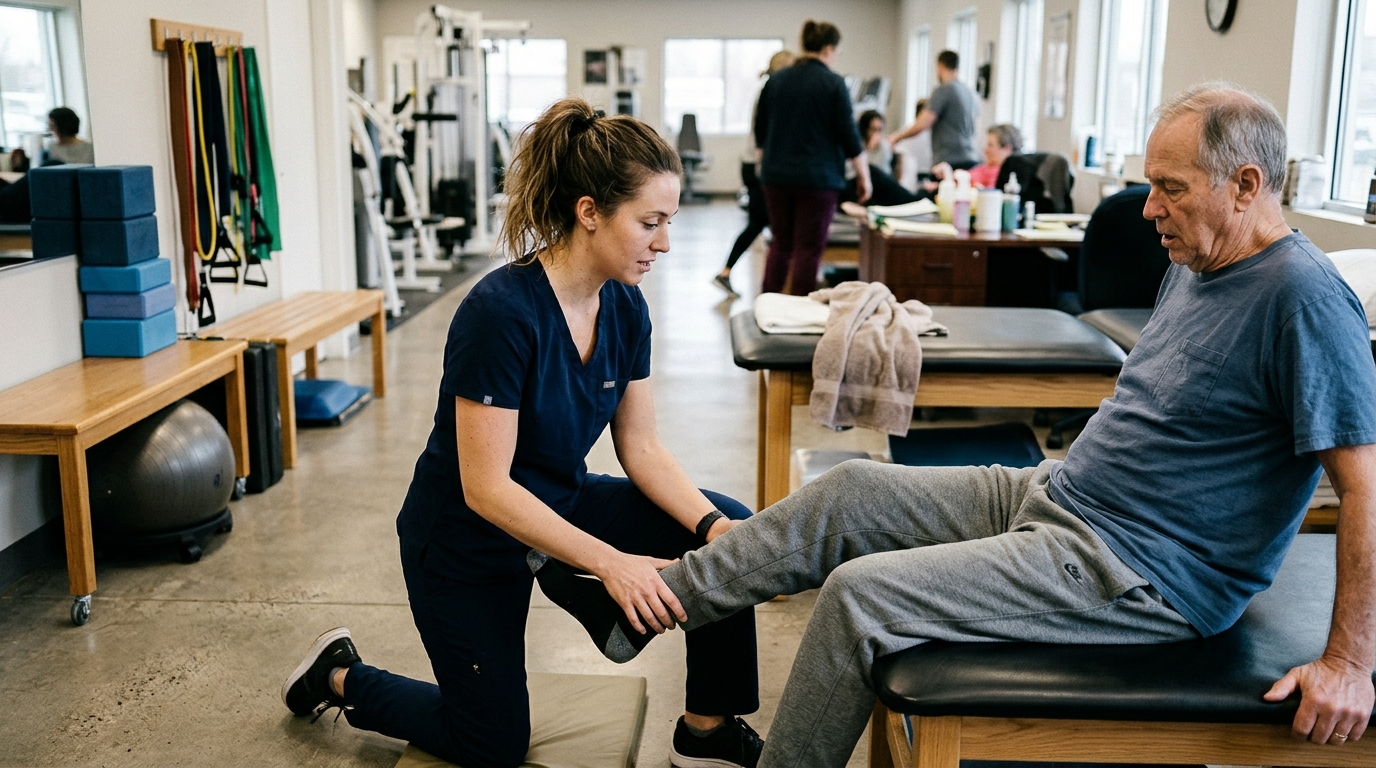
The settings are private offices and clinics, hospitals, nursing homes and patients' own homes, and you spend much of the day on your feet actively working with people (U.S. Bureau of Labor Statistics, 2025). You work as part of a healthcare team with patients of all ages, treating back and neck injuries, sprains, strains and fractures, arthritis, amputations, neurological conditions such as stroke or cerebral palsy, and work- or sports-related injuries (U.S. Bureau of Labor Statistics, 2025). Most physical therapists work full time during normal business hours, though part-time work is common and some posts include evenings or weekends (U.S. Bureau of Labor Statistics, 2025).
Step-by-Step Path to Get Started
- Finish a bachelor's degree and the prerequisite science courses (about 4 years). DPT programs typically require a bachelor's degree beforehand, often in recreation and fitness or a healthcare-related field, plus prerequisites such as anatomy, chemistry and physics (U.S. Bureau of Labor Statistics, 2025). Pull the prerequisite list from each program you want to apply to in your second undergraduate year so you can fit the courses in.
- Log observation or patient-contact hours (3–6 months, alongside study). Most DPT admissions committees set a minimum number of hours spent observing a licensed physical therapist, and the number is set by each program — check the admissions page of every school on your list. Outpatient orthopaedic clinics, hospital rehabilitation units and skilled nursing facilities are the usual places to arrange them.
- Apply to accredited DPT programs (application cycle runs roughly 6–12 months before you start). Apply only to programs accredited by the Commission on Accreditation in Physical Therapy Education (CAPTE); graduating from an accredited program is what makes you eligible to sit the licence exam in most jurisdictions. Allow 4–8 weeks to collect transcripts, references and a personal statement.
- Complete the DPT (typically 3 years). Programs typically last three years and often include biomechanics, neuroscience and pharmacology, with supervised clinical work in areas such as acute care and orthopedic care (U.S. Bureau of Labor Statistics, 2025).
- Prepare for and pass the National Physical Therapy Examination (8–12 weeks of study; exam offered on fixed dates each year). This is the qualifying exam behind every state licence (U.S. Bureau of Labor Statistics, 2025); it is administered by the Federation of State Boards of Physical Therapy. Register several months ahead, because seats at test centres fill by date.
- Clear the state-specific requirements (2–8 weeks). Other licence requirements vary by state, and some states also require a law exam and a criminal background check (U.S. Bureau of Labor Statistics, 2025). Look up your state's rules through CareerOneStop, which publishes state licensing board requirements for physical therapists (U.S. Bureau of Labor Statistics, 2025).
- File the licence application with your state board (4–12 weeks to process). Score transfer, fingerprinting and transcript verification each run on their own clock, so start the file before you sit the exam if your board allows it.
- Apply for your first post, or a clinical residency (job applications 1–3 months; residency about 1 year). New graduates may apply to a clinical residency program, which typically lasts about one year and provides additional training in a specialty area of care (U.S. Bureau of Labor Statistics, 2025). No prior work experience in a related occupation is required for entry to the occupation (U.S. Bureau of Labor Statistics, 2025).
Education, Certification, and Cost Requirements
| Requirement | Where to Get It | Typical Cost | Typical Time |
|---|---|---|---|
| Bachelor's degree plus anatomy, chemistry and physics prerequisites | Any accredited university; prerequisites can be taken at a community college | Set by the institution — public in-state tuition sits at the bottom of the range and private or out-of-state tuition at the top; check the published tuition and fees schedule for each school | About 4 years full time |
| Observation / patient-contact hours | Outpatient clinics, hospital rehab units, skilled nursing facilities | Unpaid in most cases; your costs are travel and any required immunisation or health screening | 3–6 months alongside study |
| Doctor of Physical Therapy (DPT) | A CAPTE-accredited DPT program | Set by the institution and by residency status; request the cost-of-attendance sheet, which separates tuition, clinical placement travel and equipment | Typically 3 years (U.S. Bureau of Labor Statistics, 2025) |
| National Physical Therapy Examination | Federation of State Boards of Physical Therapy | A fixed exam fee plus a separate score-transfer fee per state; both are published on the FSBPT fee schedule — confirm before you register | Exam day is one sitting; allow 8–12 weeks to prepare |
| State jurisprudence / law exam (where required) | Your state licensing board | A separate fee set by each board; some states bundle it into the licence application fee | 1–4 weeks |
| Criminal background check (where required) | State board's designated fingerprinting vendor | A fixed state fee plus a vendor fingerprinting fee, both published by the board | 2–6 weeks to clear |
| State licence | Your state physical therapy board; requirements listed on CareerOneStop | Application fee set by each board, plus renewal fees each cycle | 4–12 weeks to process |
| Clinical residency (optional) | Hospital, academic or clinic-based residency programs | Usually a salaried or stipended position rather than a tuition cost; confirm with the program | About 1 year (U.S. Bureau of Labor Statistics, 2025) |
| Board-certified specialist status (optional, later) | American Board of Physical Therapy Specialties | Application and exam fees set by the board, with a lower fee band for association members | Requires clinical work in the specialty plus an exam |
Before You Apply
Have these ready before you send a single application for a licensed post:
- Your licence number and the state that issued it, plus the expiry date — recruiters in hospitals and outpatient clinics screen for this in the first pass.
- Proof of graduation from a CAPTE-accredited DPT program, and official transcripts ordered and paid for in advance.
- Your NPTE result and any score transfers already requested for every state you intend to apply in.
- A cleared criminal background check where your state requires one, with the clearance letter saved as a PDF (U.S. Bureau of Labor Statistics, 2025).
- A one- to two-page clinical resume that lists each supervised clinical rotation by setting — acute care, inpatient rehab, outpatient orthopaedics, home health, skilled nursing — with the dates, caseload type and patient ages.
- A short list of clinical competencies: documentation systems you have used, modalities and manual techniques you are comfortable with, and any specialty populations such as neurological or paediatric patients.
- Current CPR or basic life support certification, plus immunisation records and a recent tuberculosis screening, which most hospital and nursing home employers check before a start date.
- Two or three clinical instructor references with current email addresses, asked in advance rather than listed cold.
- A plan for continuing education, which is typically required to keep your licence; your state board sets the hours and the cycle (U.S. Bureau of Labor Statistics, 2025).
Frequently asked questions
Can I get in without a healthcare-related bachelor's degree?
Yes, in most cases. Admissions committees care that the prerequisite science courses are complete and recent, not what the degree was called, although applicants commonly come from recreation and fitness or healthcare-related fields (U.S. Bureau of Labor Statistics, 2025). If you are changing careers, budget 12–24 months to pick up anatomy, chemistry and physics at a community college before you apply.
How long does the whole path take from a standing start?
Allow about seven years of full-time study if you begin with no college credit, then 2–5 months for the exam, background check and licence file to clear. People who already hold a bachelor's degree with the prerequisites done can be licensed roughly three and a half years after starting a DPT program.
Is a residency necessary to get hired?
No. No work experience in a related occupation and no on-the-job training are required for entry to the occupation, so a new licensee can go straight to a clinical post (U.S. Bureau of Labor Statistics, 2025). A residency is worth considering if you want concentrated training in one specialty area within a single year rather than picking it up piecemeal.
What are the ongoing costs after I'm licensed?
Licence renewal fees and continuing education are the two recurring items; continuing education is typically required to keep a licence and the hours are set by each state board (U.S. Bureau of Labor Statistics, 2025). Add professional liability insurance if your employer does not carry it for you, and the cost of maintaining basic life support certification.
Does my licence work if I move to another state?
Not automatically. Licence requirements beyond the qualifying exam vary by state, and some states add a law exam and a criminal background check (U.S. Bureau of Labor Statistics, 2025). Check the destination board's rules through CareerOneStop and request a score transfer early, since processing can add 4–12 weeks to a planned move.
Is demand for the role expected to hold up?
Demand is driven in part by a growing older adult population with more heart attacks, strokes and mobility-related disabilities, by rising chronic conditions such as diabetes, obesity and musculoskeletal disorders, and by greater emphasis on nonopioid approaches to pain management (U.S. Bureau of Labor Statistics, 2025). Those drivers favour settings such as nursing homes, home health and outpatient orthopaedic clinics.
Sources
- U.S. Bureau of Labor Statistics — Physical Therapists : Occupational Outlook Handbook (2025)
Written by
Noor writes personal essays and interviews about career changes, burnout, and starting over. She's interested in the stories people tell themselves about what a job is supposed to mean.