How to Become a Social Worker
A plain look at the degrees, supervised fieldwork and licence checks that stand between you and a first caseload, and how the rules shift country to country.
Quick answer
- The fastest entry route is a four-year bachelor's degree in social work, described by the U.S. Bureau of Labor Statistics (2026-08-27) as the most common requirement for entry-level nonclinical posts, with supervised fieldwork built into every BSW programme.
- Clinical practice needs a master's degree in social work, generally 2 years, plus post-graduate supervised experience and a clinical exam, because all US states licence clinical social workers (U.S. Bureau of Labor Statistics, 2026-08-27).
- Expect about 4 years from starting a bachelor's to a first nonclinical post, and several more years of supervised clinical training before a clinical licence; nonclinical licensing rules differ by state.
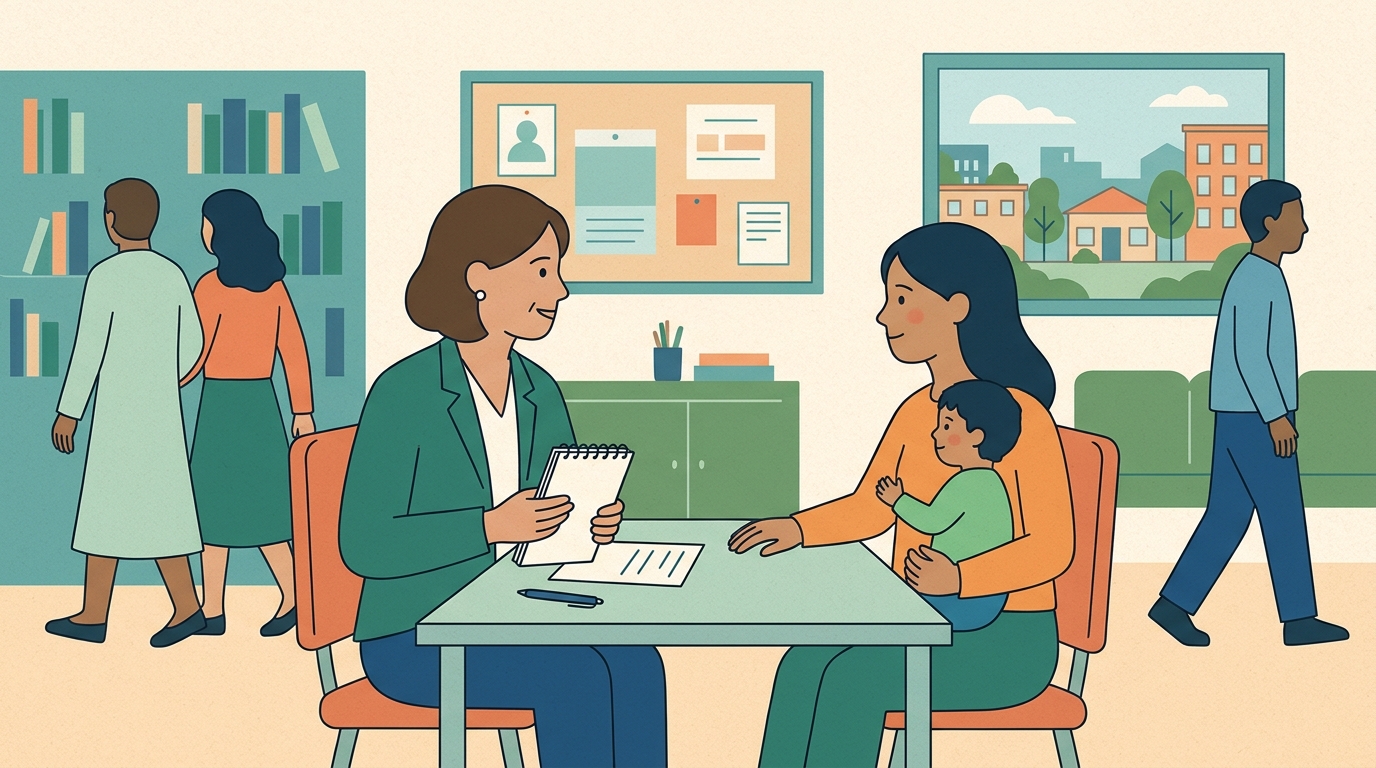
Social work is a practice-based profession and an academic discipline that promotes social change, development, cohesion and the empowerment of people, under the definition adopted internationally by the International Federation of Social Workers and the International Association of Schools of Social Work (IFSW/IASSW, 2014-07), which notes that national and regional bodies may amplify it. In practice that means a recognised degree, supervised fieldwork while you study, and in many places registration or a licence before you can practise.
In the US, social workers typically need a bachelor's or master's degree in social work and may also need a licence, with specific requirements set state by state (U.S. Bureau of Labor Statistics, 2026-08-27). Elsewhere the regulator and the accepted qualification differ, so the most useful early step is finding out who registers social workers where you intend to work.
What This Job Involves Day to Day
Most of your day is spent with people in difficulty and with the paperwork that difficulty generates. The U.S. Bureau of Labor Statistics (2026-08-27) lists typical duties as identifying people and communities in need of help; assessing clients' needs, situations and strengths; helping clients adjust to life changes such as illness or unemployment; researching and advocating for community resources; responding to crisis situations; monitoring clients' situations; and maintaining case files and records.
For child, family and school social workers, O*NET (2026-10-06) describes the work under occupation code 21-1021.00 as interviewing clients individually, in families or in groups to assess their situations, capabilities and problems; maintaining case history records and preparing reports; and serving as a liaison between students, homes, schools, family services, child guidance clinics, courts, protective services and doctors. A typical morning is two assessment interviews and a school meeting; the afternoon is writing them up and chasing a housing or clinic referral.
Settings vary more than the tasks: child welfare and human service agencies, healthcare providers and schools, with most social workers employed full time and some working evenings, weekends and holidays (U.S. Bureau of Labor Statistics, 2026-08-27). Not all of it is one-to-one — the same source distinguishes macro social work, which develops or improves social programmes, services and conditions alongside community organisations and policymakers. ONET rates child, family and school social work as Job Zone Four, "Considerable Preparation Needed", with an SVP range of 7.0 to less than 8.0, noting that most occupations in that zone require a four-year bachelor's degree (ONET, 2026-10-06).
Step-by-Step Path to Get Started
- Decide between direct practice and macro work (1-2 weeks). Direct practice means caseloads, assessments and crisis response; macro social work means programme and policy development with community organisations and policymakers (U.S. Bureau of Labor Statistics, 2026-08-27). Talk to practitioners through the national association in your country that belongs to the International Federation of Social Workers.
- Confirm who regulates the title where you will work (1-2 weeks). US licensing requirements vary by state, and the Bureau of Labor Statistics (2026-08-27) directs prospective social workers to contact their state licensure board, listing CareerOneStop as a resource for board requirements. Outside the US, read your national or provincial council's registration rules before choosing a course.
- Complete a bachelor's degree in social work (4 years full time). A BSW is the most common requirement for entry-level nonclinical positions in the US, and all BSW programmes require supervised fieldwork or an internship (U.S. Bureau of Labor Statistics, 2026-08-27).
- Treat the fieldwork placement as your first job (built into the degree). Ask for a mix of assessment interviews, record-keeping and multi-agency liaison, and keep a signed log of hours and competencies from your field instructor.
- For clinical practice, complete a master's degree in social work (generally 2 years). MSW programmes include a supervised practicum or internship. A BSW is not required to enter one — a bachelor's in almost any field is accepted, commonly public policy and social services, psychology or social science — and some programmes let BSW holders finish in under 2 years (U.S. Bureau of Labor Statistics, 2026-08-27).
- Apply for nonclinical roles while studying or straight after graduation (allow 2-3 months of applications). Target the employer types named by the Bureau of Labor Statistics (2026-08-27): child welfare and human service agencies, healthcare providers and school systems. Public agencies often recruit through a central government jobs portal with fixed closing dates.
- Accumulate post-graduate supervised clinical experience (several years, set by your state board). After the MSW, clinical social workers must complete supervised training and experience before licensure, and its length varies by state (U.S. Bureau of Labor Statistics, 2026-08-27). Agree the supervision arrangement in writing with a board-approved supervisor before counting hours.
- Pass the clinical licensing examination and apply for the licence (3-6 months including scheduling and processing). US clinical licensure requires a master's degree from an accredited programme, supervised post-graduate clinical experience and a passing clinical exam score (U.S. Bureau of Labor Statistics, 2026-08-27). Your state board names the exam and testing provider.
Education, Certification, and Cost Requirements
Costs are set by individual institutions and licensing boards rather than nationally, so the cost column names the factors that move the figure and where it is published.
| Requirement | Where to Get It | Typical Cost | Typical Time |
|---|---|---|---|
| Bachelor's degree in social work (BSW) | A university social work department recognised by your regulator or state licensure board | Tuition set per institution, driven by public versus private status, in-state or international fee status and full- or part-time study; published on each university's fee page | 4 years full time |
| Bachelor's degree in another field (route to an MSW) | Any university; common majors are public policy and social services, psychology or social science (U.S. Bureau of Labor Statistics, 2026-08-27) | Same tuition factors as above | 3-4 years full time |
| Supervised fieldwork or internship | Arranged by your BSW programme in child welfare and human service agencies, healthcare providers or schools | Included in tuition; out-of-pocket items are travel, a background check and required immunisations | Runs alongside the degree |
| Master's degree in social work (MSW) | An accredited MSW programme, required for US clinical licensure (U.S. Bureau of Labor Statistics, 2026-08-27) | Per-credit tuition set by the school; advanced standing for BSW holders cuts the credit count and the total | 2 years, or under 2 years for some BSW graduates |
| Post-graduate supervised clinical experience | A licensed employer or board-approved supervisor under your state board's rules | Free where your employer supervises in-house; charged per session for an external approved supervisor | Several years, set by the state |
| Clinical licensing examination | The exam named by your state licensure board; requirements listed via CareerOneStop | Exam fee plus a separate board application fee, both on the board's published fee schedule | 3-6 months to prepare, book and sit |
| Criminal record or child protection background check | The screening provider your employer or board specifies | A fixed per-check fee, sometimes with a fingerprinting charge; often reimbursed by public employers | 1-6 weeks to clear |
Before You Apply
Have these ready before you open an application form, not after a manager asks.
- A signed fieldwork or practicum record: hours, setting, populations served and your field instructor's name and credentials, since supervised fieldwork is required in every BSW programme (U.S. Bureau of Labor Statistics, 2026-08-27).
- A résumé that lists placements as positions — agency type, caseload size, age group or presenting issues, and the case record system you used, not a line reading "student placement".
- Your licence, registration or application reference number, or the date you filed it with your state licensure board or national regulator.
- Background check clearance in hand or in progress. Child welfare agencies and schools will not place you with children before it clears.
- Two references who have supervised your practice, briefed to speak to risk assessment and record-keeping.
- A de-identified writing sample — a mock assessment, case note or court-style report — because preparing reports is a listed daily task (O*NET, 2026-10-06).
- Worked interview examples: one crisis response, one multi-agency liaison involving a school, clinic, court or protective service, one case monitored over time.
- Setting-specific clearances: a driver's licence for home visits, immunisation records for healthcare employers, and confirmation you can work evenings, weekends or holidays where the rota requires it.
- For macro roles, a short portfolio: a needs analysis, a funding brief or a community resource mapping exercise.
Frequently asked questions
Can I become a social worker if my degree is in something else?
For the US master's route, yes: a bachelor's in almost any field is accepted for MSW entry (U.S. Bureau of Labor Statistics, 2026-08-27). You may be asked to clear prerequisite courses in human behaviour or statistics first, adding one or two semesters. Entry-level nonclinical posts are harder to win without a recognised social work qualification, so check your regulator's rules before assuming a related degree counts.
How long does it take from starting out to earning a clinical licence?
Plan on four years of undergraduate study, two years of master's study, then the post-graduate supervised period your board sets, which may run several years (U.S. Bureau of Labor Statistics, 2026-08-27). Holding a BSW can shorten the master's stage. Most people hold paid nonclinical jobs throughout the supervised period rather than studying full time.
Is a licence mandatory, or can I work without one?
For clinical practice in the US it is mandatory in every state (U.S. Bureau of Labor Statistics, 2026-08-27). For nonclinical roles the picture is mixed, because requirements are set state by state, and CareerOneStop is listed as the place to find your board's rules. In many other countries the title is protected by a national registration council, so confirm locally.
What should I budget for beyond tuition?
The recurring extras are the board application fee, the clinical exam fee, background checks and fingerprinting, travel to placements, and professional indemnity cover where your employer does not provide it. Board and exam fees sit on the licensing board's own fee schedule, which is the only figure worth quoting because it changes without notice. Paying an external approved supervisor for post-graduate hours is usually billed per session and is the largest cost after tuition.
Does an associate degree get me in the door?
Only in a minority of cases. In O*NET's survey of education needed for new hires in child, family and school social work, 6% of respondents said an associate's or other 2-year degree is required, against 69% for a bachelor's and 26% for a master's (O*NET, 2026-10-06). A two-year qualification is more realistic as a route into social work assistant or case aide posts, which can fund a part-time bachelor's completion.
Sources
- International Federation of Social Workers (IFSW) / International Association of Schools of Social Work (IASSW) — Global Definition of Social Work (2014-07)
- U.S. Bureau of Labor Statistics — Social Workers : Occupational Outlook Handbook (2026-08-27)
Written by
Wyatt covers work outside the office: construction, logistics, repair, and the people who keep things running. He's skeptical of career advice that assumes everyone sits at a desk.