How to Become a Veterinarian
Veterinary medicine is a licensed profession: this guide maps the accredited degree, the national exam and the registration paperwork, in order.
Quick answer
- The minimum education is a doctoral or professional degree: the U.S. Bureau of Labor Statistics lists that as the typical entry-level education for veterinarians, with no prior work experience in a related occupation and no on-the-job training required (U.S. Bureau of Labor Statistics, 2025).
- Licensing is mandatory, not optional. BLS states veterinarians must be licensed to practise in the United States and that most states also require a state licensing exam on top of the national exam (U.S. Bureau of Labor Statistics, 2025); in the UK, the RCVS Code of Professional Conduct states only those appropriately registered with the RCVS may practise veterinary surgery (Royal College of Veterinary Surgeons, undated).
- The fastest path is a direct-entry veterinary degree where that exists, or a four-year AVMA-accredited DVM/VMD programme after prerequisite undergraduate study; expect roughly five to eight years in total from first enrolment to your first licensed job.
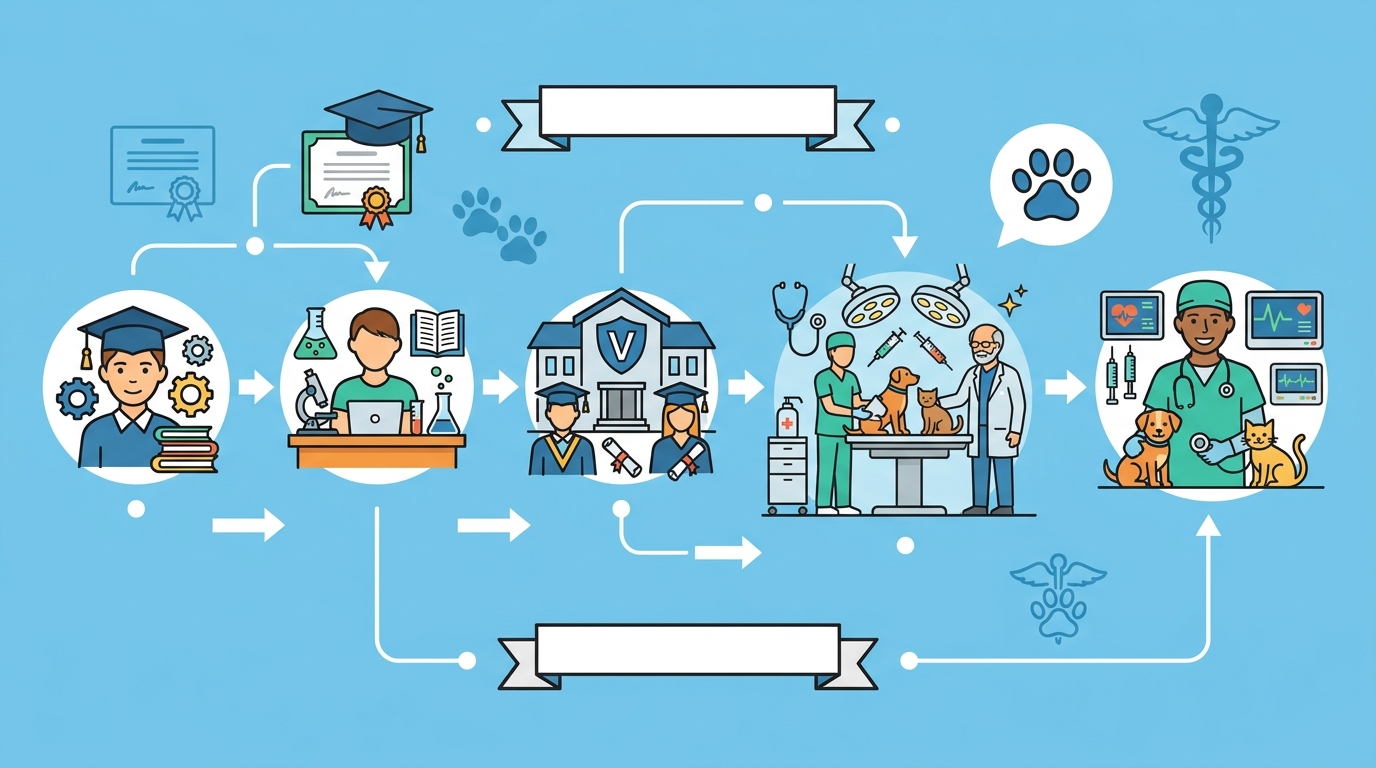
Becoming a veterinarian means earning a professional veterinary degree your future regulator accepts, then passing a licensing exam and registering before you can treat animals. In the United States and Canada that means a DVM or VMD from a college accredited by the AVMA Council on Education and a pass in the North American Veterinary Licensing Examination (NAVLE); in the UK it means a degree accredited by the Royal College of Veterinary Surgeons (RCVS) and entry onto its Register.
The route is long and front-loaded with study. Plan on roughly seven to eight years from starting university in the US or Canada, or five to six years of a direct-entry degree in the UK and much of Europe, before you are licensed to practise.
What This Job Involves Day to Day
Most of your day is clinical. ONET's task list for veterinarians includes examining animals to detect and determine the nature of diseases or injuries; treating sick or injured animals by prescribing medication, setting bones, dressing wounds, or performing surgery; and inoculating animals against diseases such as rabies or distemper (ONET OnLine, U.S. Department of Labor, undated). ONET summarises the occupation in two detailed work activities: 'Provide care for animals' and 'Treat animal injuries or illnesses' (ONET OnLine, U.S. Department of Labor, undated).
In practice that is a booked consulting list in the morning — vaccinations, lameness checks, skin and ear complaints, post-operative rechecks — a surgical block in the middle of the day, and paperwork at the end: clinical notes, prescriptions, lab result follow-ups and phone calls to owners about cost and prognosis.
The setting is usually a practice rather than a field. BLS states that most veterinarians work in private clinics and hospitals (U.S. Bureau of Labor Statistics, 2025); others work in farm and equine practice, laboratories, government animal health roles or research. You will work alongside veterinary technologists and technicians, who under ONET's task list administer anaesthesia under a veterinarian's direction, perform laboratory tests on blood, urine or faeces, and prepare animals for surgery (ONET OnLine, U.S. Department of Labor, undated) — so supervising and delegating start in your first week. BLS projects the job outlook for veterinarians at 9% for 2025–35, described as 'much faster than average' (U.S. Bureau of Labor Statistics, 2025).
Step-by-Step Path to Get Started
- Decide which regulator you will register with, before choosing a school (1–2 weeks of research). The AVMA Council on Education is recognised by the U.S. Department of Education for accrediting programmes leading to the DVM or VMD degree, and its realm of accreditation covers all veterinary colleges in the US and Canada (American Veterinary Medical Association, undated). In the UK, the RCVS publishes the list of accredited veterinary schools whose graduates can register once their degree has been awarded (Royal College of Veterinary Surgeons, undated).
- Complete the prerequisite study for entry (3–4 years in the US and Canada; none in direct-entry systems). North American veterinary colleges admit from undergraduate study and publish their own prerequisite science courses and animal-handling hours. In the UK and much of Europe the degree is normally entered straight from secondary school.
- Earn the veterinary degree (4 years for a DVM or VMD; typically 5–6 years for a direct-entry UK or European degree). RCVS states that to be added to the Register a veterinary surgeon must show the right educational qualifications — a veterinary degree — and continued ethical and professional good standing (Royal College of Veterinary Surgeons, undated).
- Apply for the NAVLE in your final year if you are heading for US or Canadian licensure (apply several months ahead of your chosen window). The NAVLE is the only national licensing examination used in North America, and all veterinarians graduating from AVMA-accredited schools must pass it before being licensed to practise in the United States or Canada (LSU School of Veterinary Medicine, undated). It runs in three testing windows each year: March, mid-July to early August, and mid-October to mid-November (Melbourne Veterinary School, University of Melbourne, undated).
- Submit both NAVLE applications for a US state or territorial board (allow 4–8 weeks for processing). Candidates applying to a US state or territorial veterinary licensing board must submit a national NBVME NAVLE application and a state/territorial NAVLE application (Melbourne Veterinary School, University of Melbourne, undated).
- Sit the state licensing exam where your board requires one (dates set by each state board). In addition to the national exam, most states also require veterinarians to pass a state licensing exam (U.S. Bureau of Labor Statistics, 2025) — usually a jurisprudence paper on that state's veterinary practice act.
- Apply to join the Register if you are qualifying in the UK (up to 6 months ahead; within 3 months of the award for the recent-graduate route). RCVS guidance states that graduates of accredited UK schools can register once their degree has been awarded and may apply up to six months before joining, and that those registering from the day of the award can only use that route up to three months afterwards (Royal College of Veterinary Surgeons, undated).
- Take your first post-registration job and enrol in the required early-career programme (first 12 months). The RCVS Code of Professional Conduct requires veterinary surgeons to maintain and develop knowledge and skills relevant to their practice and to comply with RCVS requirements on the Veterinary Graduate Development Programme (VetGDP) / Professional Development Phase (PDP) and continuing professional development (Royal College of Veterinary Surgeons, undated), so choose an employer with a named VetGDP adviser.
Education, Certification, and Cost Requirements
| Requirement | Where to Get It | Typical Cost | Typical Time |
|---|---|---|---|
| Prerequisite undergraduate coursework (US/Canada) | Any university offering the science courses listed by AVMA COE-accredited colleges | Tuition set by each institution and by resident or non-resident status, published on its tuition page | 3–4 years |
| DVM or VMD degree | A veterinary college accredited by the AVMA Council on Education | US$170,742 to US$289,597 for the full four years for US residents, depending on the school attended (AAVMC, reported) | 4 years |
| UK veterinary degree (direct entry) | An RCVS-accredited UK veterinary school | Tuition set by each university and by home or international fee status, published on the course page | Typically 5–6 years |
| NAVLE | National Board of Veterinary Medical Examiners (NBVME) | Examination fee set by the NBVME and published in its candidate bulletin | Apply months ahead; sit in one of three annual windows |
| State/territorial application and state licensing exam | The veterinary medical board of your state or territory | Application and exam fees set by each state board | Several weeks from application to licence issue |
| RCVS registration | Royal College of Veterinary Surgeons | Registration fee set annually by the RCVS | Apply up to 6 months ahead |
| RCVS statutory membership exam (non-accredited European qualifications) | Royal College of Veterinary Surgeons | Examination fee set by the RCVS | Sittings scheduled by the RCVS; allow several months to prepare |
| VetGDP / PDP and continuing professional development | Your employer plus RCVS-recognised CPD providers | Course prices set by each provider; many employers fund a CPD allowance | VetGDP in year one; CPD recorded annually |
The AAVMC figures cover US residents only — non-resident tuition is set separately by each college. Debt is the norm: the AVMA reported that the average vet school graduate had US$186,430 in student debt in 2021, up 17 per cent from a decade earlier (AVMA, reported).
Before You Apply
Have these ready before you send a registration application or a job application:
- Proof of identity in the form your regulator specifies — the RCVS lists it among the documents required to join the Register (Royal College of Veterinary Surgeons, undated).
- Proof of qualification: your degree certificate, or official confirmation of award if the ceremony has not happened yet.
- Proof of English language level, which the RCVS also lists as a required registration document (Royal College of Veterinary Surgeons, undated).
- A letter of good standing from the Dean, Principal or Rector of your veterinary school, required for RCVS registration (Royal College of Veterinary Surgeons, undated). Request it 4–6 weeks before you need it.
- Both NAVLE application records — national NBVME and state/territorial (Melbourne Veterinary School, University of Melbourne, undated) — plus your score report once issued.
- Your licence or registration number once granted; practices ask for it on the contract and for indemnity cover.
- A clinical CV, not a general one: two pages listing rotations, extramural or externship placements, species and caseload seen, and surgeries and anaesthesia cases performed or assisted.
- A case log of 5–10 anonymised cases showing diagnostic reasoning, treatment plan and outcome, plus two clinical referees warned in advance.
- Your good-standing declaration or background check as required by the state veterinary board, or by the RCVS, which requires continued ethical and professional good standing for entry to the Register (Royal College of Veterinary Surgeons, undated).
Frequently asked questions
Is there a route into veterinary work without a doctoral degree?
Not into the veterinarian role itself — BLS lists a doctoral or professional degree as the typical entry-level education (U.S. Bureau of Labor Statistics, 2025). The nearest lower-entry occupation is veterinary technologist and technician, whose O*NET tasks include administering anaesthesia under a veterinarian's direction and preparing animals for surgery (O*NET OnLine, U.S. Department of Labor, undated). Many people spend two to four years in that role while applying to veterinary school, and the clinical hours count towards admissions requirements.
When should I book the NAVLE, and what happens if I miss a window?
Work backwards from the sitting you want, as applications close well in advance. Missing a window means waiting roughly four months for the next one, which can push your licence date past an agreed job start date. Confirm the exact application deadlines with the NBVME before your final academic year begins.
How much should I budget beyond tuition?
Add the NBVME examination fee, the state or territorial board application fee, annual licence or registration renewal, professional indemnity cover and CPD courses — each set by the relevant board, regulator or provider rather than your school. Ask your school's student finance office for a full cost-of-attendance breakdown, which includes equipment, scrubs and placement travel across all years of the course.
Can I register in another country with the degree I already have?
Only if that regulator accepts your qualification. The RCVS states that graduates whose European qualification has not been directly accredited by the RCVS cannot register automatically and must take the RCVS statutory membership exam to practise in the UK, and that from January 2029 only qualifications from RCVS-accredited programmes will be accepted for registration (Royal College of Veterinary Surgeons, undated). Check the current rules with the regulator of the country you are moving to before you enrol anywhere, and check separately what permission to work is required.
Sources
- O*NET OnLine (U.S. Department of Labor) — How do they match: 29-1131.00 - Veterinarians
- American Veterinary Medical Association (AVMA) — AVMA Council on Education (AVMA COE)

Written by
Priya tracks wages, layoffs, and the slow shifts in what counts as a stable job. She writes for readers trying to make sense of numbers that rarely match their own experience.