How to Become a Veterinarian: Step-by-Step Guide
A science-heavy route into clinical practice, from prerequisite chemistry classes to licensing exams, on-call shifts and the reality of euthanasia.
Quick answer
- Minimum credential: a DVM or VMD from an accredited veterinary college plus a licence in the jurisdiction where you practise (U.S. Bureau of Labor Statistics, 2025).
- Realistic time from starting prerequisite coursework to a first associate role: roughly 6 to 9 years (about 72 to 108 months).
- In the United States and Canada, the North American Veterinary Licensing Examination (NAVLE) is required for licensure in all licensing jurisdictions (International Council for Veterinary Assessment).
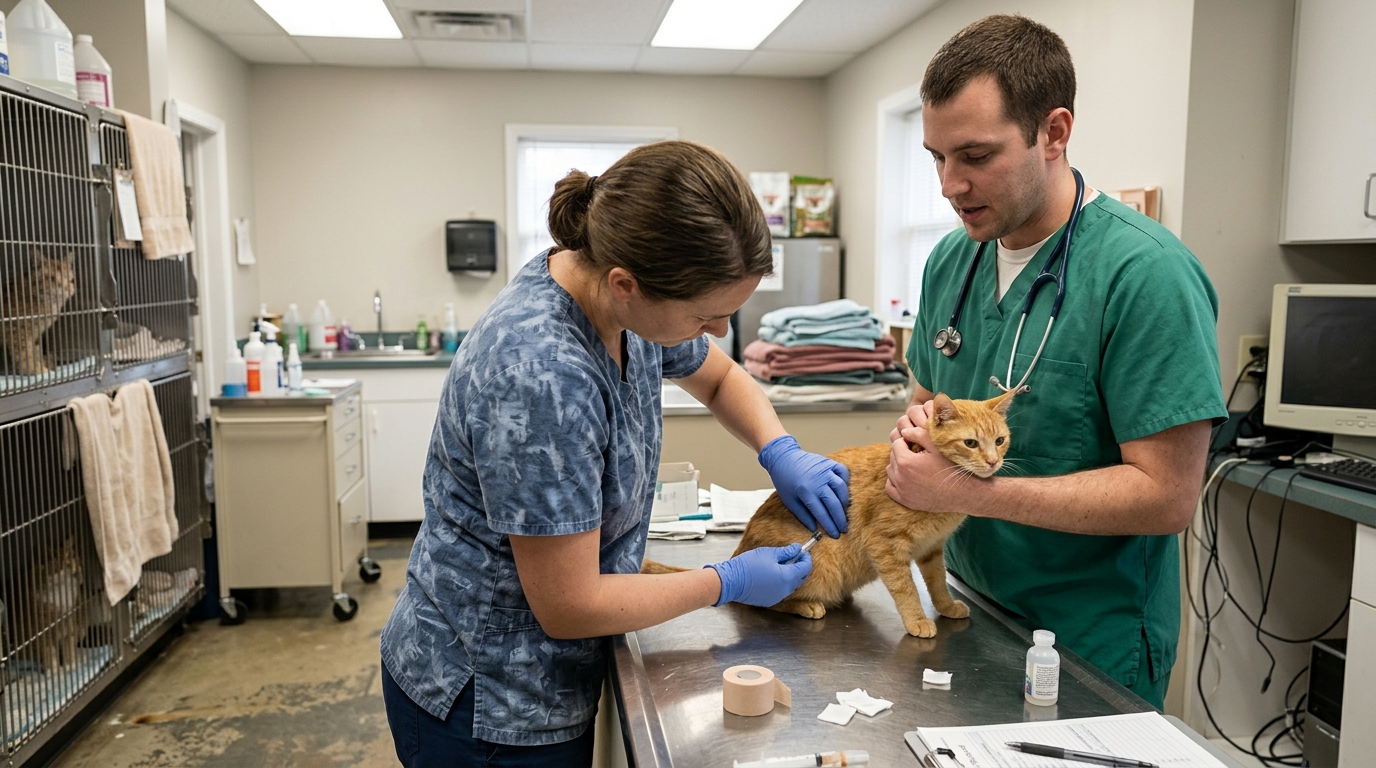
To work as a veterinarian you need a Doctor of Veterinary Medicine (DVM or VMD) degree from an accredited veterinary college plus a licence to practise, according to the U.S. Bureau of Labor Statistics (2025). The degree itself generally takes four years and combines classroom, laboratory and clinical work (U.S. Bureau of Labor Statistics, 2025), and it sits on top of prerequisite science coursework that most people complete over three or four years first.
Realistically, that means six to nine years of full-time study before your first clinical job, plus a national licensing exam. The route is well-defined, but it is long, academically demanding and emotionally heavy in ways that put some people off once they have spent time in a practice.
Step-by-Step Path to Entry
- Complete the prerequisite science coursework. Veterinary medical colleges typically require biology, chemistry and animal science, along with maths, humanities and social science courses (U.S. Bureau of Labor Statistics, 2025). Most applicants take these inside a three- or four-year bachelor's degree in a science subject, although a bachelor's degree is not required at most U.S. veterinary schools — the advice there is to keep grades strong while finishing the prerequisites (American Association of Veterinary Medical Colleges, 2026).
- Log paid or volunteer animal and clinical hours. Work as a veterinary assistant, kennel attendant, shelter technician, equine or dairy farm hand, or laboratory animal caretaker, and shadow licensed veterinarians across more than one species group. Admissions committees look at the depth and variety of these hours, and the work is also your chance to find out whether you can cope with restraint injuries, night calls and euthanasia before committing four years of tuition.
- Apply to an accredited college of veterinary medicine. In the United States, graduation from a college accredited by the American Veterinary Medical Association Council on Education (COE) is an important prerequisite for a licensure application (American Association of Veterinary Medical Colleges, 2025), and the COE exists to assure that minimum standards in veterinary medical education are met by accredited colleges (American Association of Veterinary Medical Colleges, 2022). COE accreditation also covers institutions outside the United States, such as the Massey University School of Veterinary Science and the Murdoch University School of Veterinary Medicine (American Veterinary Medical Association, October 2025). If you plan to practise elsewhere, check your national veterinary regulator's list of recognised degrees before you pay a deposit.
- Finish the DVM or VMD programme. The programme generally takes four years and includes classroom, laboratory and clinical components (U.S. Bureau of Labor Statistics, 2025). Most programmes run three years of classroom, laboratory and clinical work, with the final year spent on clinical rotations (U.S. Bureau of Labor Statistics, 2025).
- Pass the NAVLE. The North American Veterinary Licensing Examination is a requirement for licensure in all licensing jurisdictions in the United States and Canada (International Council for Veterinary Assessment). It takes around seven and a half hours and contains 360 clinically relevant multiple-choice questions, of which 300 are scored and 60 are unscored pretest items (International Council for Veterinary Assessment). Most students sit it during the final year of the degree.
- Apply for your licence. In all U.S. states, prospective veterinarians must complete an accredited veterinary programme and pass a qualifying national exam, and most states also require a state licensing exam covering local law and practice (U.S. Bureau of Labor Statistics, 2025). Requirements, fees and processing times are set state by state and country by country, so apply to the specific board that covers where you intend to work.
- Decide on an internship or board certification afterwards. Certification is not mandatory, but it allows veterinarians to demonstrate competency in areas including animal husbandry, health and welfare, and facility administration (U.S. Bureau of Labor Statistics, 2025). A one-year rotating internship followed by a residency is the usual path into specialist practice, and it adds three to five years on top of the degree.
Education and Certification Options
| Route | Typical duration | Approximate cost | Required or preferred |
|---|---|---|---|
| Pre-veterinary bachelor's degree (biology, animal science or similar) | 3-4 years full time | Published tuition differs by institution, residency status and country — check each university's current fee schedule | Preferred and held by most admitted applicants, but a bachelor's degree is not required at most U.S. veterinary schools (American Association of Veterinary Medical Colleges, 2026) |
| Prerequisite-only coursework without completing a degree | 2-3 years full time, longer part time | Charged per credit by the college you enrol with — compare current per-credit rates | An alternative at schools that accept it; you must still cover biology, chemistry, animal science, maths, humanities and social science (U.S. Bureau of Labor Statistics, 2025) |
| Veterinary assistant or veterinary technician role used as a stepping stone | Weeks to 2 years depending on the credential | Short courses and technician programmes publish their own fees | Not required for vet school, but a practical way to build the clinical hours admissions committees expect |
| DVM or VMD at an AVMA COE-accredited college | 4 years (3 years classroom, laboratory and clinical work, final year clinical rotations) (U.S. Bureau of Labor Statistics, 2025) | The single largest cost of the route; compare each college's published tuition, fees and living-cost estimates before applying | Required — you need the accredited degree plus a licence to practise (U.S. Bureau of Labor Statistics, 2025) |
| NAVLE (United States and Canada) | One exam day, around seven and a half hours, 360 multiple-choice questions (International Council for Veterinary Assessment) | Exam and application fees are published by the International Council for Veterinary Assessment and the state or provincial board | Required for licensure in all U.S. and Canadian licensing jurisdictions (International Council for Veterinary Assessment) |
| State or jurisdiction licensing exam | Typically one sitting, often on law and regulation | Set by the individual licensing board | Required in most states (U.S. Bureau of Labor Statistics, 2025); confirm with the board where you will practise |
| Rotating internship and specialist board certification | 1-year internship, then a 3-4 year residency | Internships are salaried positions; residency terms vary by host institution | Not mandatory, but certification demonstrates competency in areas such as animal husbandry, health and welfare, and facility administration (U.S. Bureau of Labor Statistics, 2025) |
Pay for veterinarians is usually structured as a base salary, sometimes with a production component tied to the fees you generate, and internships typically pay less than associate positions. For current figures, check the official statistics body for your country — the U.S. Bureau of Labor Statistics Occupational Employment and Wage Statistics in the United States, the Office for National Statistics in the United Kingdom, Statistics Canada, or the Australian Bureau of Statistics. National averages hide large differences between states, provinces and rural versus metropolitan practices.
Are You Ready? Readiness Checklist
- You have completed, or are enrolled in, biology, chemistry and animal science courses, plus the maths, humanities and social science requirements veterinary colleges typically ask for (U.S. Bureau of Labor Statistics, 2025).
- Your grades in those science prerequisites are competitive, since admissions advice is to maintain good grades while completing them (American Association of Veterinary Medical Colleges, 2026).
- You have recorded animal and clinical hours with dates, supervisors and species, from a veterinary assistant, shelter, farm or laboratory animal role.
- You have confirmed that every college on your shortlist appears on the AVMA Council on Education's accredited list, or on your own country's regulator's list of recognised degrees.
- You have read the licensing requirements of the specific state, province or country where you intend to practise, including whether a jurisdiction exam applies on top of the national exam (U.S. Bureau of Labor Statistics, 2025).
- You can commit to four years of full-time study after prerequisites, including a final year of clinical rotations on rotating schedules (U.S. Bureau of Labor Statistics, 2025).
- You can physically restrain and lift animals, stand for long shifts and work in noisy, unpredictable conditions; bites, scratches and kicks are an accepted hazard of the work.
- You have observed or discussed euthanasia with a practising veterinarian and are satisfied you can perform it and speak to owners afterwards.
- You have a written funding plan for tuition and living costs, and have checked the health and immunisation requirements (commonly including rabies vaccination) and any criminal background check that your chosen college or licensing board applies.
Typical Timeline From Start to First Job
- Month 0-36: Complete prerequisite science coursework — biology, chemistry, animal science, maths, humanities and social science (U.S. Bureau of Labor Statistics, 2025) — usually inside a bachelor's degree, while working weekends or summers as a veterinary assistant or kennel attendant.
- Month 30-48: Build and document clinical and animal-handling hours, secure references from licensed veterinarians, and submit applications to AVMA COE-accredited colleges. Many applicants apply more than once, so allow for a gap year.
- Month 48-84: Complete the first three years of the DVM or VMD, covering classroom, laboratory and clinical work (U.S. Bureau of Labor Statistics, 2025), and choose electives that point toward small animal, equine, food animal, shelter or public-health practice.
- Month 84-96: Spend the final year on clinical rotations (U.S. Bureau of Labor Statistics, 2025) and sit the NAVLE — 360 multiple-choice questions over roughly seven and a half hours (International Council for Veterinary Assessment). Start applying for jobs during this year.
- Month 94-100: Submit your licence application to the state, provincial or national board, including any jurisdiction exam required on top of the national exam (U.S. Bureau of Labor Statistics, 2025), and allow several weeks for processing.
- Month 96-108: Start as an associate veterinarian in a general practice, or as a rotating intern if you are aiming at a residency and board certification. Expect on-call or weekend emergency duty in the first year, and mentoring arrangements that differ sharply from one practice to another.
Frequently asked questions
Can I become a veterinarian without a four-year degree?
Possibly. A bachelor's degree is not required at most U.S. veterinary schools; what matters is completing the prerequisites with good grades (American Association of Veterinary Medical Colleges, 2026). In practice you still need biology, chemistry, animal science, maths, humanities and social science coursework (U.S. Bureau of Labor Statistics, 2025), and most admitted applicants hold a degree. Check each school's published entry rules.
How long does the veterinary degree itself take?
A veterinary medicine programme generally takes four years and includes classroom, laboratory and clinical components (U.S. Bureau of Labor Statistics, 2025). Most programmes run three years of classroom, laboratory and clinical work, with the final year spent on clinical rotations (U.S. Bureau of Labor Statistics, 2025). Add the prerequisite coursework beforehand and the full route usually runs six to nine years.
What is the NAVLE and when do I sit it?
The North American Veterinary Licensing Examination is required for licensure in all licensing jurisdictions in the United States and Canada (International Council for Veterinary Assessment). It runs around seven and a half hours and contains 360 clinically relevant multiple-choice questions, 300 scored and 60 unscored pretest items. Most candidates sit it in their final year, before applying to a licensing board.
Do I have to become board certified?
No. Certification is not mandatory, but it allows veterinarians to demonstrate competency in areas such as animal husbandry, health and welfare, and facility administration (U.S. Bureau of Labor Statistics, 2025). Specialist board certification usually follows a one-year rotating internship and a three- to four-year residency, so it is a deliberate extra commitment rather than a default next step.
Is there demand for veterinarians?
In the United States, employment of veterinarians is projected to grow 9 percent from 2025 to 2035, much faster than the average for all occupations, with about 3,100 openings projected each year on average over that decade (U.S. Bureau of Labor Statistics, 2025). Outlook elsewhere is published by national statistics agencies and differs between rural and metropolitan areas.
What are the hardest parts of the job?
Performing euthanasia and managing owners' grief, delivering cost estimates to people who cannot afford treatment, and on-call or emergency rotas that cut into evenings and weekends. The work is also physical: restraining frightened animals, lifting, and long periods standing. Spend time in a practice before applying so these are known quantities rather than surprises.
Sources
- U.S. Bureau of Labor Statistics — Veterinarians : Occupational Outlook Handbook (2025)
- International Council for Veterinary Assessment (ICVA) — ICVA - NAVLE

Written by
Marisol steers Jobladderhq's coverage of hiring trends and the strange rituals of modern recruiting. She's drawn to the gap between what job ads promise and what the work actually feels like. Her editing hand favors clarity over jargon, always.